Kent State shootings
The invasion of Cambodia and the end of draft deferments turned campus tension into an existential crisis for students.
The invasion of Cambodia and the end of draft deferments turned campus tension into an existential crisis for students.
In April 1970, the Vietnam War felt like it was winding down until President Richard Nixon announced the "Cambodian Incursion." This expansion of the conflict into a neutral nation outraged a public already weary of the war. Simultaneously, Nixon moved to end undergraduate student draft deferments. For male college students, the war was no longer a distant political issue; it was a looming personal reality.
Protest activity at Kent State had been simmering for years, led by groups like Students for a Democratic Society (SDS). By the time Nixon’s announcement hit the airwaves on April 30, the campus was a powderkeg. Students felt the government had not only lied about ending the war but was now actively seeking to pull them into it by force.
A weekend of arson and inflammatory rhetoric transformed a student protest into a perceived domestic insurgency.
A weekend of arson and inflammatory rhetoric transformed a student protest into a perceived domestic insurgency.
The days leading up to the massacre were marked by a rapid breakdown in order. On Friday, May 1, a demonstration in downtown Kent devolved into window-smashing and clashes with police. By Saturday, the campus ROTC building was burned to the ground by unidentified arsonists. Protesters even slashed fire hoses to prevent the blaze from being extinguished. This escalation prompted Kent’s mayor to declare a state of emergency and call in the Ohio National Guard.
Ohio Governor Jim Rhodes exacerbated the tension during a Sunday press conference, where he labeled the protesters "un-American" and compared them to "brown shirts" and "the communist element." By framing the students as a revolutionary threat to be "eradicated," Rhodes signaled to the National Guard that they were dealing with enemies of the state rather than citizens exercising their right to assembly.
In just thirteen seconds, the Ohio National Guard fired sixty-seven rounds into a crowd of unarmed students.
In just thirteen seconds, the Ohio National Guard fired sixty-seven rounds into a crowd of unarmed students.
On Monday, May 4, roughly 2,000 people gathered on the university Commons despite an official ban on the rally. After a failed attempt to disperse the crowd with tear gas and bullhorns, 28 guardsmen turned and opened fire. In a 13-second volley, they fired 67 rounds. The firing line was approximately 300 feet away from many of the students—the length of a football field.
The casualties revealed the indiscriminate nature of the shooting. Of the four students killed, two—Sandra Scheuer and William Schroeder—were simply walking between classes and were not participating in the protest. Nine others were wounded, including one student who was left permanently paralyzed. The "threat" the Guard claimed to face consisted largely of students shouting and, in a few instances, throwing rocks that caused no significant damage or injury to the armored troops.
The massacre triggered the largest student strike in U.S. history and a permanent shift in public opinion.
The massacre triggered the largest student strike in U.S. history and a permanent shift in public opinion.
The reaction to the shootings was immediate and massive. Over 4 million students participated in organized walk-outs, effectively shutting down hundreds of universities, colleges, and high schools across the United States. It was the only national student strike in the country's history, turning the Kent State campus into a symbol of the deep chasm between the American government and its youth.
Legal accountability for the event was nearly non-existent. While eight guardsmen were eventually charged with violating the students' civil rights, they were acquitted in a bench trial. The judge called the use of force "deplorable" but stopped short of criminal conviction. Despite the lack of legal consequences, the event became a permanent stain on the Nixon administration and accelerated the push to withdraw from Vietnam.
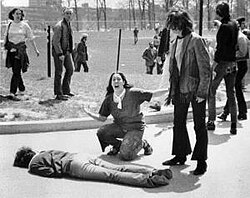
Image from Wikipedia

Poster calling for a nationwide student anti-war strike on May 4, 1970
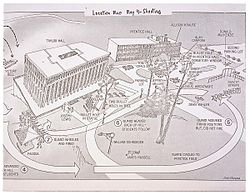
Map of the shootings

Photo taken from the perspective of where the Ohio National Guard soldiers stood when they opened fire on the students

Bullet hole in Solar Totem #1 sculpture by Don Drumm caused by a .30 caliber round fired by the Ohio National Guard at Kent State on May 4, 1970

Memorial at the site where student Jeffrey Miller fell, taken in 2007 from approximately the same perspective as John Filo's 1970 photograph

Image from Wikipedia