Jiddu Krishnamurti
Krishnamurti was engineered as a "World Teacher" through a colonial-era spiritual experiment.
Krishnamurti was engineered as a "World Teacher" through a colonial-era spiritual experiment.
In 1909, the Theosophical Society "discovered" Krishnamurti, then a "vague and dreamy" boy, on a beach in India. Society leader Charles Leadbeater claimed the boy possessed a "wonderful aura" and designated him the future "vehicle" for the Lord Maitreya—a prophesied World Teacher intended to guide humanity’s evolution. He was essentially a human vessel, raised in a state of extreme subservience and strict discipline to be filled by a higher spiritual entity.
This upbringing was an odd paradox of deprivation and opulence. While he was tutored by European high society and shielded from his own family, Krishnamurti initially struggled with formal schooling, having been considered "intellectually disabled" by early teachers. Despite this, he quickly mastered English and foreign languages, developing a "beatific detachment" and an austere personal magnetism that made him a global celebrity before he reached adulthood.
A series of agonizing "mystical episodes" in 1922 fundamentally rewired his perception of reality.
A series of agonizing "mystical episodes" in 1922 fundamentally rewired his perception of reality.
While living in Ojai, California, Krishnamurti underwent a grueling physical and mental transformation known as "the process." This involved acute, seizure-like pain in his neck and spine, delirious ramblings, and out-of-body experiences. He described these events as a meeting with "the vibrations of Lord Buddha" and a state of "profound calmness" that broke his previous sense of self.
These episodes recurred throughout his life and were accompanied by what he called "the Otherness"—a sense of sacred immensity that felt separate from his physical body. This period marked his transition from a passive student of Theosophy to an independent thinker. He later claimed that after his death, this specific consciousness would not return to a human body for "many hundred years."
He committed "institutional suicide" by dismantling the global organization built to worship him.
He committed "institutional suicide" by dismantling the global organization built to worship him.
In 1929, Krishnamurti shocked the spiritual world by disbanding the Order of the Star in the East, the massive organization formed specifically to support his mission. He famously declared that "Truth is a pathless land" and could not be approached through any religion, sect, or organized belief. He rejected the mantle of the World Teacher and the role of the guru, urging his followers to abandon all authority—including his own.
This act was a radical break from the "spiritual evolution" promised by Theosophy. He spent the remaining 57 years of his life as an independent speaker, refusing to start a new religion or sect. He lived as a "teetotaler, nonsmoker, and practitioner of yoga," maintaining that his only goal was to set man "absolutely, unconditionally free."
His philosophy demanded a "radical transformation" via passive, choiceless awareness.
His philosophy demanded a "radical transformation" via passive, choiceless awareness.
Krishnamurti’s "teachings" centered on the idea that human suffering stems from the mechanical nature of thought and the constant "image-making" of the mind. He argued that true meditation is not a contrived technique or a repetitive practice, but rather a state of "choiceless awareness"—a passive, alert observation of one's own thoughts and environment without judgment or interference.
He maintained that humanity could only be saved through an internal, psychological revolution, rather than through social or political systems. This message gained mainstream intellectual traction in the 1950s, particularly after being championed by Aldous Huxley. Today, his legacy persists through non-profit foundations and independent schools that focus on his educational philosophy: learning without the pressure of competition or authority.
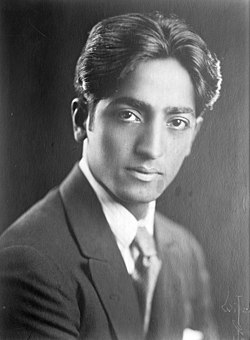
Image from Wikipedia

House in Madanapalle, in which Krishnamurti was born

Krishnamurti in 1910

Krishnamurti by Tomás Povedano
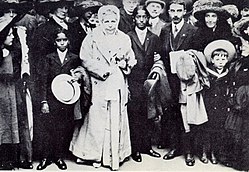
Krishnamurti in England in 1911 with his brother Nitya, Annie Besant, and George Arundale

Krishnamurti in the early 1920s

Krishnamurti on a 1987 Indian stamp

KFI retreat session at Rishi Valley on 17 November 2019, Padmanabhan Krishna addressing the gathering, with Radhika Herzberger presiding