Jesus
His name was a theological mission statement meaning "God saves"
His name was a theological mission statement meaning "God saves"
While known today as Jesus Christ, his contemporary name was likely Yeshua (the Aramaic/Hebrew version of Joshua). This name carries the literal meaning "Yahweh saves" or "salvation." The Gospel of Matthew explicitly links this etymology to his purpose: to save people from their sins. The title "Christ" is not a surname but a Greek translation of the Hebrew Mashiakh (Messiah), meaning "the anointed one"—a reference to the Jewish tradition of using sacred oil to mark individuals for holy office.
In his own time, he was identified by his hometown or family ties, called "Jesus of Nazareth" or "the carpenter’s son." It was only in the 1st century, as his followers consolidated their beliefs, that "Christ" transitioned from a functional title to a proper name. This naming convention reflects a parallel to the biblical Joshua who led the Jews into the Promised Land; in Christian theology, Jesus is the new Joshua leading humanity toward spiritual salvation.
The primary records of his life are ancient "persuasive biographies" rather than modern histories
The primary records of his life are ancient "persuasive biographies" rather than modern histories
Most of what is known about Jesus comes from the four canonical Gospels—Matthew, Mark, Luke, and John. Modern scholarship identifies these works as "ancient biographies," a genre that prioritizes the subject's character and theological significance over strict chronological accuracy or exhaustive detail. The Gospels of Matthew, Mark, and Luke are "Synoptic," meaning they share a similar narrative structure and likely drew from a common source (often referred to as the "Q source").
The Gospel of John stands apart, offering a more philosophical and cosmic perspective that identifies Jesus as the Logos (the divine Word). While virtually all modern scholars agree that Jesus was a historical person, the reliability of these texts varies among academics. Some view them as inerrant, while others see them as theological documents written decades after the events (roughly AD 60–100) to serve the needs of the burgeoning early Christian Church.
His ministry was an itinerant challenge to Jewish law that ended in Roman execution
His ministry was an itinerant challenge to Jewish law that ended in Roman execution
Jesus began his public life as a "rabbi" or teacher in the Roman province of Judaea, following a baptism by John the Baptist and a period of fasting in the wilderness. He moved through the region as an itinerant preacher, using parables—short, metaphorical stories—to interpret divine law. His ministry was defined by two distinct actions: healing the sick and debating religious authorities on the correct way to follow God. He gathered a core group of 12 apostles to help expand his movement.
His career was brief but disruptive. His claims of divine authority and his large following eventually drew the ire of Jewish authorities, who handed him over to the Roman government. He was tried and executed via crucifixion by Pontius Pilate, the Roman prefect. However, the movement did not end with his death; his followers became convinced he had risen from the dead, a belief that transformed a small Jewish sect into a worldwide religion.
Christian doctrine centers on the "Incarnation," the belief that Jesus was God in human form
Christian doctrine centers on the "Incarnation," the belief that Jesus was God in human form
Central to Christian theology is the Nicene Creed, which asserts that Jesus is the "Son of God" and the second person of the Trinity. Unlike other religious figures who are seen merely as messengers, Jesus is viewed by Christians as the "Incarnation"—God becoming flesh. This dual nature (fully divine and fully human) allows him to act as a bridge between humanity and the divine, enabling people to be reconciled to God through his sacrifice on the cross.
This theology posits that his death was a deliberate "atonement" for human sin and that his subsequent resurrection on the third day proved his victory over death. Christian eschatology further teaches that Jesus ascended into Heaven but will return for the "Second Coming" to judge the living and the dead. This cycle of birth, death, and rebirth is the foundation of the world's most widely used calendar (AD/CE) and its major holidays, Christmas and Easter.
Global religions are divided on his status as a divine being vs. a human prophet
Global religions are divided on his status as a divine being vs. a human prophet
While Christianity is built on the divinity of Jesus, other world religions offer starkly different interpretations. Judaism rejects the idea that Jesus was the Messiah, arguing that he did not fulfill the specific prophecies laid out in the Hebrew Bible and was neither divine nor resurrected. In this view, he was a teacher whose followers' claims exceeded the reality of his life.
In contrast, Islam holds Jesus (known as Isa) in high regard as one of God's most important prophets and the Messiah sent to the Israelites. Muslims believe in his virgin birth but strictly reject the idea that he was the "Son of God" or divine. Interestingly, most Islamic traditions hold that Jesus was not actually crucified but was instead raised alive into Heaven by God. Similarly, the Baháʼí and Druze faiths revere him as a significant manifestation of God’s word, though they do not share the orthodox Christian view of the Trinity.

A depiction of Jesus, titled Christ Pantocrator, 6th century AD, holding Bible in front of the sun. Christ's features on his right side (the viewer's left) are theorized to represent the qualities of his human nature, while his left side (the viewer's right) represents his divinity.

From top-left: Aramaic, Hebrew, Greek, Latin, and English transcriptions of the name Jesus

A 3rd-century Greek papyrus of the Gospel of Luke

Adoration of the Shepherds by Gerard van Honthorst, 1622

The Circumcision by Giovanni Bellini, c. 1500. The work depicts the circumcision of Jesus.

The Finding of the Saviour in the Temple by William Holman Hunt, 1860

The Baptism of Christ by John the Baptist, by Almeida Júnior, 1895

Jesus and the devil depicted in The Temptation of Christ, by Ary Scheffer, 1854

Sermon on the Mount, by Carl Bloch, 1877, depicts Jesus's important discourse.

The Exhortation to the Apostles, by James Tissot, portrays Jesus talking to his twelve disciples.

Jesus and the rich young man by Heinrich Hofmann, 1889
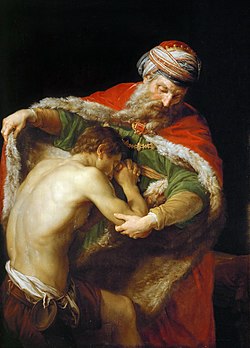
The Return of the Prodigal Son by Pompeo Batoni, 1773

Jesus cleansing a leper, medieval mosaic from the Monreale Cathedral, late 12th to mid-13th centuries

The Transfiguration of Jesus, depicted by Carl Bloch, 19th century

A painting of Jesus's final entry into Jerusalem, by Jean-Léon Gérôme, 1897