Japanese cuisine
A millennium of Buddhist decrees transformed Japan into a "seafood and soy" powerhouse
A millennium of Buddhist decrees transformed Japan into a "seafood and soy" powerhouse
For over 1,000 years, Japanese cuisine was defined by what was missing: meat. Following the introduction of Buddhism, Emperor Tenmu prohibited the consumption of most livestock in 675 AD. This taboo lasted until the late 19th century, forcing the culture to master the culinary potential of rice, soybeans, and the "bounty of the sea." Because red meat was "unclean," the Japanese perfected fermentation (miso, soy sauce) and relied on fish as the primary protein, even categorizing whales as "fish" to circumvent religious restrictions.
This long-term absence of animal fats led to a unique "minimalist" approach to seasoning. Rather than using heavy oils or spices like garlic and pepper to mask the flavor of meat, chefs focused on highlighting the natural profile of ingredients using sansho and ginger. Modern "staples" like sushi actually began as a functional preservation method, using the lactic acid fermentation of rice to keep salted fish from spoiling.
The "One Soup, Three Sides" formula dictates a rigid but harmonious table geometry
The "One Soup, Three Sides" formula dictates a rigid but harmonious table geometry
Traditional Japanese dining, or Washoku, is built on the structural philosophy of ichijū-sansai. This typically consists of a bowl of rice (the staple), a miso soup, and three side dishes (okazu). The arrangement is precise: rice always sits on the diner's left and soup on the right. This geometry isn't just aesthetic; it’s rooted in classic banquet dining and Zen temple traditions that emphasize frugality, balance, and the separation of flavors.
In Japanese etiquette, flavors are forbidden from "soiling" one another. Unlike Western dining where various components might share a large plate, Japanese meals use individual small bowls (sara or hachi) for every item. Even placing a main dish on top of rice is traditionally frowned upon (with the exception of donburi). This separation ensures that the delicate, seasonal profile of each ingredient remains untainted by its neighbor.
"Shun" elevates seasonality from a kitchen preference to a temporal art form
"Shun" elevates seasonality from a kitchen preference to a temporal art form
The Japanese concept of shun (seasonality) refers to the specific moment an ingredient is at its peak. This isn't just about freshness; it’s about heralding the arrival of the four seasons. Chefs prioritize "fruit of the mountains" (bamboo shoots in spring, chestnuts in autumn) and "fruit of the sea" (the first catch of skipjack tuna) to anchor the diner in the present moment. If an ingredient is available slightly before its peak, it is prized as hashiri—the "early run."
Visual presentation acts as a seasonal clock. Tree leaves, branches, and flowers are used as functional decor; for example, maple leaves might be floated in water to create a sense of ryō (coolness) during the humid summer months. This obsession with the "now" is a primary reason why Japanese cuisine was added to the UNESCO Intangible Heritage List in 2013.
The Meiji Restoration ended a 1,000-year meat fast to spark a global fusion movement
The Meiji Restoration ended a 1,000-year meat fast to spark a global fusion movement
The modern Japanese diet is a result of a massive cultural pivot in 1872. To modernize and align with Western powers, Emperor Meiji staged a New Year's feast featuring European-style meat dishes, effectively ending the national meat ban. This "Great Opening" led to the creation of yoshoku—Western-inspired dishes adapted to Japanese tastes. Iconic foods like tonkatsu (pork cutlet), curry rice, and ramen are actually relatively recent adaptations of Western and Chinese imports.
Today, this spirit of adaptation has come full circle. Japan has surpassed France in the number of 3-starred Michelin restaurants, with Tokyo holding the title of the world’s most decorated city for fine dining. While washoku remains the cultural heart, the global popularity of sushi and ramen represents a successful fusion of traditional Japanese precision with global culinary influences.
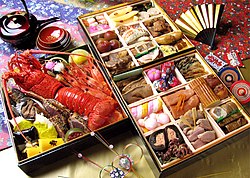
Osechi, new year special dishes

Sushi

A Japanese meal including tempura, sashimi, and miso soup

Breakfast at a ryokan (Japanese inn), featuring grilled mackerel, Kansai-style dashimaki egg, tofu in kaminabe (paper pot)

Kaiseki appetizers on a wooden plate

Yakiniku

Beef hot pot being made at a party in Japan

The use of soy sauce is prevalent in Japanese cuisine.

Japanese boiled spinach salad (ohitashi)

Gyūdon beef rice bowl (right) and niku shoyu ramen beef noodle (left)

Udon noodles

Soba noodles

Green wagashi

Lager

Sake