Great Famine (Ireland)
A single-crop dependency turned a botanical pathogen into a national catastrophe.
A single-crop dependency turned a botanical pathogen into a national catastrophe.
The Famine was triggered by Phytophthora infestans, an oomycete that causes potato blight. While the blight struck throughout Europe in the 1840s, it was uniquely devastating in Ireland because the rural poor were trapped in a monoculture. Over one-third of the population relied almost exclusively on the "Lumper" potato variety for survival; it was the only crop high enough in calories and easy enough to grow on the tiny, marginal plots of land allowed to Irish tenants by their landlords.
When the blight arrived in 1845, it didn't just cause a bad harvest; it obliterated the primary food source for over three million people. Because the Lumper was genetically uniform, there was no natural resistance. The resulting "Great Hunger" (An Gorta Mór) lasted for seven years, proving that the danger wasn't just the fungus itself, but a land-tenure system that left the peasantry with no alternative calories and no safety net.
British adherence to free-market ideology prioritized grain exports over human survival.
British adherence to free-market ideology prioritized grain exports over human survival.
The disaster was exacerbated by the British government’s commitment to laissez-faire economics. Under the leadership of Sir Charles Trevelyan, the Assistant Secretary to the Treasury, the government was reluctant to provide direct aid or close Irish ports to food exports. They feared that "interfering" with the market would stifle private enterprise or encourage a culture of dependency among the Irish poor.
As a result, a bitter paradox emerged: throughout the peak years of the famine, Ireland continued to export massive quantities of grain, livestock, and dairy products to England. While millions were starving, protected shipments of food left Irish docks under armed guard. Relief efforts, such as the repeal of the Corn Laws and the establishment of soup kitchens, were often too little, too late, or intentionally designed to be so "deterrent" (via harsh workhouses) that only the most desperate would seek help.
A decade of starvation permanently halved the population and birthed a global diaspora.
A decade of starvation permanently halved the population and birthed a global diaspora.
The demographic impact of the Famine is almost unparalleled in modern history. Between 1845 and 1852, Ireland’s population dropped by roughly 20% to 25%. Approximately one million people died from starvation or associated diseases like typhus and cholera, while another million fled the country. This triggered a trend of mass emigration that continued for a century; the population of the Republic of Ireland today is still significantly lower than it was in 1840.
Those who fled often traveled in "coffin ships"—overcrowded, disease-ridden vessels where mortality rates reached 30%. This mass exodus created the "Global Irish," a diaspora that profoundly shaped the history and politics of the United States, Canada, and Australia. The memory of the Famine became a foundational pillar of Irish-American identity, fueling a long-lasting and well-funded resentment toward British rule.
The Famine acted as a "cultural scythe," disproportionately destroying the Irish language.
The Famine acted as a "cultural scythe," disproportionately destroying the Irish language.
The Great Hunger did more than kill people; it nearly killed a language. The regions hit hardest by the blight—the rural west and south—were the heartlands of the Irish (Gaelic) language. Because the poorest Irish-speaking classes were the ones who died or emigrated in the greatest numbers, the social structure that supported the language collapsed.
In the wake of the Famine, English was viewed as the language of survival, commerce, and migration. Parents began to discourage their children from speaking Irish, seeing it as a "badge of poverty" that offered no future in a post-famine world. This shift represents one of the most rapid linguistic transitions in European history, turning Ireland from a predominantly bilingual or Irish-speaking nation into an English-speaking one within two generations.
The legacy of the Famine remains a flashpoint in the debate over colonial "genocide."
The legacy of the Famine remains a flashpoint in the debate over colonial "genocide."
Whether the Famine constitutes a "genocide" remains a subject of intense historical and political debate. While most historians agree that the British government did not create the blight, many argue that their policy of "calculated neglect"—driven by a mix of economic dogma and anti-Irish prejudice—was functionally equivalent to a man-made disaster. Some contemporary British officials even viewed the Famine as a "providential" solution to Irish overpopulation.
This trauma transformed Irish politics from a struggle for civil rights within the UK into a revolutionary movement for total independence. The perceived indifference of the British Parliament convinced a generation of Irish nationalists that Ireland could never be safely governed from London. The Famine provided the moral and political fuel for the 1916 Rising and the eventual formation of the Irish Free State.

Image from Wikipedia

A potato infected with late blight, showing typical rot symptoms

A starving Irish family from Carraroe, County Galway, during the Great Famine (National Library of Ireland)

An Irish Peasant Family Discovering the Blight of their Store by Cork artist Daniel MacDonald, c. 1847

Suggested paths of migration and diversification of P. infestans lineages HERB-1 and US-1

Potato production during the Great Famine. Note: years 1844, 1845, 1846, and 1848 are extrapolated.

Scene at the gate of the workhouse, c. 1846
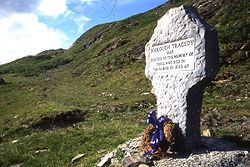
A memorial to the victims of the Doolough Tragedy (30 March 1849). To continue receiving relief, hundreds were instructed to travel many miles in bad weather. A large number died on the journey.

Rioters in Dungarvan attempt to break into a bakery; the poor could not afford to buy what food was available. (The Pictorial Times, 1846).

An 1849 depiction of Bridget O'Donnell and her two children during the famine

Lord Palmerston, then British Foreign Secretary, evicted some 2,000 of his tenants.

George Bingham, 3rd Earl of Lucan

The Emigrants' Farewell, engraving by Henry Doyle (1827–1893), from Mary Frances Cusack's Illustrated History of Ireland, 1868

Irish population in the United States, 1880

Irish population 1600–2010. Note the decrease beginning in 1845, which did not recover until the 21st century.