Iran–Contra affair
The Reagan administration bypassed Congress by turning a hostage crisis into a secret funding engine for proxy wars.
The Reagan administration bypassed Congress by turning a hostage crisis into a secret funding engine for proxy wars.
The scheme was a "two-birds-one-stone" gamble designed to solve two unrelated foreign policy headaches. The U.S. wanted to free seven American hostages held in Lebanon by Hezbollah, a group loyal to Iran. Simultaneously, the administration was desperate to support the Contras—right-wing rebels fighting the socialist Sandinista government in Nicaragua—but had been legally barred from doing so by Congress.
The solution was a secret, "triangular" arms deal. The U.S. sold thousands of anti-tank and anti-aircraft missiles to Iran (an official enemy) via Israel. The "surplus" profits from these inflated sales were then diverted to fund the Contras. This allowed the White House to pursue its anti-communist agenda in Central America without a single cent of taxpayer money being appropriated by a hostile Congress.
A rigid anti-communist obsession led officials to ignore a direct congressional ban on military aid.
A rigid anti-communist obsession led officials to ignore a direct congressional ban on military aid.
At the heart of the scandal was the Boland Amendment, a series of legislative acts specifically designed to stop the U.S. from funding the Contras' war. President Reagan, however, viewed the Contras as "the moral equivalent of our Founding Fathers" and a vital bulwark against Soviet influence in the Western Hemisphere.
This ideological drive created a culture of "ends justify the means." Staffers at the National Security Council (NSC) believed they were serving a higher purpose that trumped legislative "interference." They viewed Congress not as a co-equal branch of government to be consulted, but as a bureaucratic obstacle to be circumvented in the global struggle against communism.
The operation relied on a private "Enterprise" that functioned as a shadow government outside of constitutional oversight.
The operation relied on a private "Enterprise" that functioned as a shadow government outside of constitutional oversight.
To keep the operation off the books, NSC officials like Lt. Col. Oliver North used a network of shell companies and Swiss bank accounts known as "The Enterprise." This private entity managed planes, pilots, and arms shipments, effectively running a covert foreign policy that was invisible to the CIA, the State Department, and the Pentagon.
By outsourcing war to private contractors and foreign intermediaries, the administration sought "plausible deniability." If the operation were exposed, the President could claim he had no knowledge of the specific "diversion" of funds, even if he had authorized the broad policy of supporting the Contras. This created a dangerous precedent where the executive branch could conduct war without any public or legislative accountability.
The investigation revealed a systemic failure of accountability, ending in shredded evidence and high-level pardons.
The investigation revealed a systemic failure of accountability, ending in shredded evidence and high-level pardons.
When the story broke in 1986 via a Lebanese magazine, the administration went into damage-control mode. Oliver North and his secretary famously spent hours shredding documents before investigators could arrive. This mass destruction of evidence made it nearly impossible to prove the "smoking gun"—exactly how much Reagan knew about the illegal diversion of funds.
While 14 officials were charged and 11 convicted, the consequences were largely symbolic. Most convictions were vacated on technicalities related to immunized testimony. The final chapter was written by George H.W. Bush, who issued six pardons in the twilight of his presidency, including one for Defense Secretary Caspar Weinberger. This effectively killed the independent counsel’s investigation, leaving the full extent of the executive branch's involvement an eternal matter of historical debate.

Image from Wikipedia

A BGM-71 TOW antitank guided missile
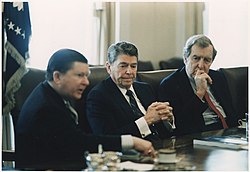
President Reagan (center) receives the Tower Commission Report in the White House Cabinet Room; John Tower is at left and Edmund Muskie is at right, 1987.

Reagan addresses the affair from the Oval Office; March 4, 1987.

Oliver North's mugshot, after his arrest