Impressionism
Impressionism shifted the focus from the object itself to the transient sensation of light hitting the eye.
Impressionism shifted the focus from the object itself to the transient sensation of light hitting the eye.
Before this movement, painting was a studio-bound pursuit focused on verisimilitude—creating a polished, realistic window into a scene. The Impressionists moved their easels outdoors (en plein air) to capture the "momentary." They realized that light changes by the second, meaning a cathedral or a haystack is never actually the same color twice.
By prioritizing "optical truth" over physical detail, they captured how humans actually perceive the world: as a harmony of reflected lights and movement rather than sharp, static lines. This "art of immediacy" used ordinary subject matter—picnics, street scenes, and landscapes—to argue that the present moment was as worthy of high art as any historical epic.
The movement was a radical rebellion against the rigid, "escapist" standards of the French Académie.
The movement was a radical rebellion against the rigid, "escapist" standards of the French Académie.
In the mid-19th century, the Académie des Beaux-Arts acted as a strict gatekeeper, favoring historical, religious, or mythological themes with invisible brushwork and "restrained" colors. Their annual juried show, the Salon de Paris, was the only path to commercial success. Impressionists like Monet and Renoir were routinely rejected for their "unfinished" look and contemporary subjects.
This institutional friction led to the landmark "Salon des Refusés" in 1863 and the subsequent formation of an independent society. By bypassing the Salon to host their own exhibitions, the Impressionists broke the state's monopoly on artistic taste, effectively inventing the modern concept of the "independent artist" and the "avant-garde."
One of history’s most famous artistic brands was born from a critic's satirical attempt to mock its "unfinished" look.
One of history’s most famous artistic brands was born from a critic's satirical attempt to mock its "unfinished" look.
The name "Impressionism" was originally an insult. In 1874, critic Louis Leroy wrote a scathing review of the group’s first independent exhibition. Mocking Claude Monet’s painting Impression, Sunrise, Leroy joked that "wallpaper in its embryonic state is more finished than that seascape." He used the word "impression" to imply the work lacked the skill and labor required for a "real" painting.
Surprisingly, the artists embraced the label. While the group was diverse—some focused on landscapes (Monet), others on the human form (Renoir), and others on urban life (Degas)—the term "Impressionism" gave them a unified identity. It signaled their shared rebellion against the "brown" art of the past in favor of a bright, spontaneous future.
A specific set of optical techniques, including the total rejection of black paint, created the "vibrating" quality of their work.
A specific set of optical techniques, including the total rejection of black paint, created the "vibrating" quality of their work.
Impressionists revolutionized the physics of the canvas. Instead of blending colors on a palette to create a smooth transition, they applied "broken" brushstrokes of pure, unmixed color side-by-side. This exploited the principle of simultaneous contrast, allowing the viewer's eye to "mix" the colors at a distance, which created a shimmering, vibrating effect that mimicked natural sunlight.
Critically, "pure" Impressionism avoided the use of black paint entirely. To create shadows or dark tones, they mixed complementary colors (like blue and orange). This ensured that even the darkest parts of a painting remained luminous and full of color, reflecting their belief that shadows in nature are not black, but simply light of a different temperature.

The 1872 painting "Impression, Sunrise" by Impressionist artist Claude Monet.
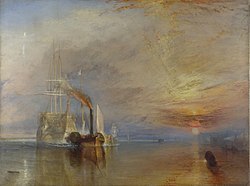
J. M. W. Turner's atmospheric work was influential on the birth of Impressionism, here The Fighting Temeraire, 1839

Pierre-Auguste Renoir, Dance at Le Moulin de la Galette ((Bal du moulin de la Galette), 1876, Musée d'Orsay, one of Impressionism's most celebrated masterpieces.

Édouard Manet, Le déjeuner sur l'herbe (The Luncheon on the Grass) 1863

Alfred Sisley, View of the Canal Saint-Martin 1870, Musée d'Orsay

Claude Monet, Haystacks, (sunset) 1890–1891, Museum of Fine Arts, Boston

Claude Monet, Woman with a Parasol – Madame Monet and Her Son 1875, National Gallery of Art, Washington, D.C.

Camille Pissarro, Boulevard Montmartre, 1897, the Hermitage, Saint Petersburg

Mary Cassatt, Lydia Leaning on Her Arms (in a theatre box), 1879

Camille Pissarro, Hay Harvest at Éragny, 1901, National Gallery of Canada, Ottawa, Ontario

Berthe Morisot, Reading, 1873, Cleveland Museum of Art

Claude Monet, Jardin à Sainte-Adresse, 1867, Metropolitan Museum of Art, New York., a work showing the influence of Japanese prints

Berthe Morisot, The Harbour at Lorient, 1869, National Gallery of Art, Washington, D.C.

Mary Cassatt, Young Girl at a Window, 1885, oil on canvas, National Gallery of Art, Washington, D.C.

Eva Gonzalès, Une Loge aux Italiens, or, Box at the Italian Opera, c. 1874, oil on canvas, Musée d'Orsay, Paris