Hubble's law
Distant galaxies retreat faster as the fabric of the universe stretches
Distant galaxies retreat faster as the fabric of the universe stretches
Hubble's law describes the fundamental observation that the velocity at which a galaxy moves away from Earth is proportional to its distance. In simple terms: the farther away a galaxy is, the faster it appears to be receding. This relationship is expressed by the formula $v = H_0D$, where $v$ is the velocity, $D$ is the distance, and $H_0$ is the "Hubble constant."
This isn't a local phenomenon or a random drift; it is a uniform property of the cosmos. If you see a galaxy at 10 million light-years moving at a certain speed, a galaxy 20 million light-years away will be moving twice as fast. This observation effectively turned the universe from a static, eternal backdrop into a dynamic, evolving system.
Expansion is a metric growth of the void, not a race through it
Expansion is a metric growth of the void, not a race through it
A common misconception is that galaxies are flying through space like shrapnel from an explosion. In reality, Hubble’s law describes the "metric expansion" of space itself. The galaxies are relatively stationary within their local coordinates; it is the space between them that is stretching.
Imagine dots on a balloon being inflated. The dots aren't "traveling" across the rubber; the rubber is simply expanding, increasing the distance between every dot simultaneously. Because this expansion happens everywhere at once, light traveling through this stretching space has its wavelength pulled and lengthened—a phenomenon known as cosmological redshift.
Discovery was a collaborative leap from mathematics to observation
Discovery was a collaborative leap from mathematics to observation
While named after Edwin Hubble, the law was a collective achievement. In the 1910s, Vesto Slipher discovered that most galaxies showed a "redshift," meaning they were moving away. In 1927, Georges Lemaître, a Belgian priest and physicist, used Einstein’s equations to theoretically propose that the universe was expanding and even estimated the expansion rate.
Two years later, Edwin Hubble provided the definitive observational proof by calculating the distances to these galaxies using Cepheid variable stars. Hubble’s data confirmed Lemaître’s theory, providing the first concrete evidence that the universe had a beginning. In 2018, the International Astronomical Union officially recommended renaming the law the "Hubble–Lemaître law" to honor this joint discovery.
The universe's expansion rate is currently the biggest crisis in cosmology
The universe's expansion rate is currently the biggest crisis in cosmology
The "Hubble Constant" ($H_0$) represents the speed of the universe's growth, but scientists cannot agree on what that number actually is. This is known as the "Hubble Tension." When astronomers measure the early universe (using the Cosmic Microwave Background), they get a value of roughly 67 km/s/Mpc. When they measure the modern universe (using Supernovae and stars), they get roughly 73 km/s/Mpc.
This 9% discrepancy might seem small, but in physics, it is a "five-sigma" crisis. It suggests that our fundamental model of the universe—the Lambda-CDM model—is missing something vital. Whether it’s an undiscovered particle, a misunderstanding of gravity, or "new physics," the Hubble Tension is currently the most significant crack in our understanding of the cosmos.
The law serves as the blueprint for the Big Bang and the age of time
The law serves as the blueprint for the Big Bang and the age of time
Hubble’s law is the "run-the-tape-backward" mechanism for all of modern cosmology. If the universe is expanding today, it must have been smaller yesterday. By calculating the rate of expansion, scientists can work backward to a point of "zero distance"—the Big Bang.
Based on current estimates of the Hubble constant, we can determine the age of the universe to be approximately 13.8 billion years. Without Hubble’s law, we would have no way to measure the lifespan of the cosmos or predict its ultimate fate—whether it will expand forever (the Big Freeze) or eventually succumb to the density of matter and collapse (the Big Crunch).

Three steps to the Hubble constant
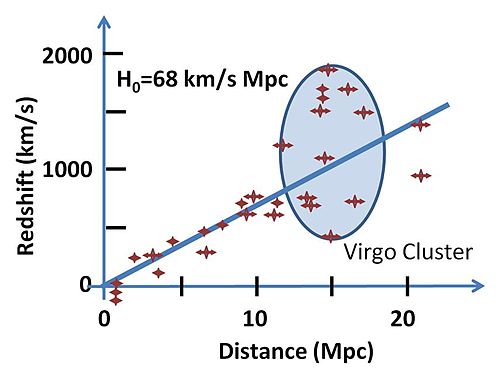
Fit of redshift velocities to Hubble's law. Various estimates for the Hubble constant exist.

A variety of possible recessional velocity vs. redshift functions including the simple linear relation v = cz; a variety of possible shapes from theories related to general relativity; and a curve that does not permit speeds faster than light in accordance with special relativity. All curves are linear at low redshifts.

The age and ultimate fate of the universe can be determined by measuring the Hubble constant today and extrapolating with the observed value of the deceleration parameter, uniquely characterized by values of density parameters (ΩM for matter and ΩΛ for dark energy).A closed universe with ΩM > 1 and ΩΛ = 0 comes to an end in a Big Crunch and is considerably younger than its Hubble age.An open universe with ΩM ≤ 1 and ΩΛ = 0 expands forever and has an age that is closer to its Hubble age. For the accelerating universe with nonzero ΩΛ that we inhabit, the age of the universe is coincidentally very close to the Hubble age.

The value of the Hubble constant in (km/s)/Mpc, including measurement uncertainty, for recent surveys

Summary of H0 estimates (circa 2025) from different cosmological probes with error bars smaller than 3.5 standard deviations. The top part shows estimates based on early-time measurements assuming a flat LCDM cosmology, the middle part contains cosmology-independent direct measurements of H0, while the bottom part shows estimates that contain some form of astrophysical modeling.

Estimated values of the Hubble constant, 2001–2020. Estimates in black represent calibrated distance ladder measurements which tend to cluster around 73 (km/s)/Mpc; red represents early universe CMB/BAO measurements with ΛCDM parameters which show good agreement on a figure near 67 (km/s)/Mpc, while blue are other techniques, whose uncertainties are not yet small enough to decide between the two.