Harlem Renaissance
The movement was a "creative crucible" fueled by the Great Migration and the economic vacuum of World War I.
The movement was a "creative crucible" fueled by the Great Migration and the economic vacuum of World War I.
The Harlem Renaissance wasn't just an artistic choice; it was an escape. Between 1890 and 1908, Southern states enacted Jim Crow laws that effectively disenfranchised Black Americans, trapping them in a system of sharecropping, lynchings, and "convict labor" that resembled slavery. When the boll weevil destroyed cotton crops and World War I halted European immigration, Northern factories suddenly needed labor. This "Great Migration" turned Harlem into the final destination for hundreds of thousands seeking both a paycheck and a life without state-sanctioned terror.
By the early 1900s, Harlem evolved from an exclusive white suburb into a middle-class Black neighborhood. This concentration of "ambitious people" in one place allowed for a unique cultural feedback loop. While the movement is geographically tied to Manhattan, its roots were Southern and its influence was global, drawing in Black intellectuals from the Caribbean and Francophone Africa who were living in Paris.
It replaced the demeaning caricatures of minstrelsy with the militant, self-assured "New Negro."
It replaced the demeaning caricatures of minstrelsy with the militant, self-assured "New Negro."
Before the 1920s, Black representation in American theater and literature was largely limited to the "minstrel show" tradition—white-authored stereotypes designed for ridicule. The Harlem Renaissance shattered this through "The New Negro Movement," named after Alain Locke’s 1925 anthology. This era introduced complex, human portrayals of Black life, such as Ridgely Torrence's plays which featured Black actors conveying deep emotional yearnings rather than slapstick comedy.
This shift was also deeply political. Poets like Claude McKay published militant sonnets like "If We Must Die," which signaled a "renewed militancy" in the struggle for civil rights. For writers like Langston Hughes, Harlem provided the "courage to express our individual dark-skinned selves without fear or shame," creating a foundation for Black art-making to be institutionalized within the broader American cultural landscape.
Harlem served as a spiritual laboratory where traditional Christianity was both reformed and challenged.
Harlem served as a spiritual laboratory where traditional Christianity was both reformed and challenged.
Religion was a central, yet contested, pillar of the Renaissance. While the Black church remained a social anchor, writers and critics used the era to interrogate the "irony of religion" as a force for both good and oppression. Figures like Aaron Douglas used biblical imagery in their art but added "rebellious" African influences, while poets like Countee Cullen explored the inner tension between inherited African heritage and the "new" Christian culture.
This intellectual reawakening also expanded the definition of Black spirituality. Harlem became a melting pot for diverse faiths, including Islam (via the Moorish Science Temple), Black Hebrew Israelites, and traditional African practices like Voodoo and Santeria. This pluralism reflected a broader desire to reclaim an identity that predated American enslavement.
The "Harlem Stride" piano style broke down class barriers through musical innovation.
The "Harlem Stride" piano style broke down class barriers through musical innovation.
Music during this era was a tool for social mobility and class integration. In the early 20th century, brass-heavy jazz was often associated with the "low-brow" South, while the piano was viewed as a symbol of the wealthy elite. The invention of the "Harlem Stride" style—a sophisticated, technically demanding way of playing the piano—successfully blurred these lines.
By bringing the energy of jazz to a "high-society" instrument, musicians made the genre accessible and acceptable to the wealthy Black middle class and white audiences alike. This musical crossover helped the Harlem Renaissance achieve "zenith" status between 1924 and 1929, turning Black cultural expression into a massive, nationwide phenomenon before the Great Depression stifled the era's economic engine.

Image from Wikipedia

Harlem in Upper Manhattan

Philip A. Payton Jr. founded the Afro-American Realty Company in 1903, which sought to fight housing discrimination and encourage Black migration into Harlem.

Religion and evolution ad

The multi-talented Adelaide Hall and Bill "Bojangles" Robinson in the musical comedy Brown Buddies on Broadway, 1930

Poster for Run, Little Chillun

Trumpeter Dizzy Gillespie is emblematic of the mixture of high-class society, popular art, and virtuosity of jazz.
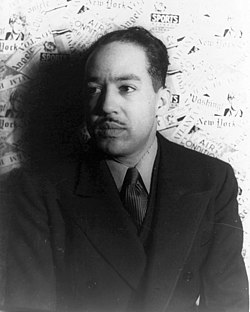
Langston Hughes, communist novelist and poet, photographed by Carl Van Vechten, 1936
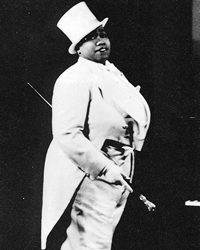
Blues singer Gladys Bentley