Guernica
Founded as a strategic commercial hub, Guernica evolved from a river port into a rigidly structured medieval society.
Founded as a strategic commercial hub, Guernica evolved from a river port into a rigidly structured medieval society.
The town was established in 1366 by Tello Alfonso at a vital intersection of roads leading to major Basque hubs like Bilbao and Bermeo. Its location on a river estuary allowed vessels to dock at the port of Suso, granting the site early strategic and economic importance. The town followed a classic Basque layout of parallel streets—Goienkale, Azokekale, Artekale, and Barrenkale—anchored by a church at each end.
For centuries, life in Guernica was strictly regulated to preserve the privileges of the dominant middle classes, a social structure that remained largely static until the late 17th century. By the 18th century, the town center had matured into a civic hub featuring a town hall, a regional gaol, and a hospital, while the economy balanced agriculture with specialized crafts like flax manufacturing and cobbling.
The Oak of Guernica serves as the living heart of Basque democracy and a symbol of ancient legal autonomy.
The Oak of Guernica serves as the living heart of Basque democracy and a symbol of ancient legal autonomy.
Long before modern parliaments, Basques held community assemblies under trees to discuss local laws. Guernica’s oak, the Gernikako Arbola, became the most significant of these sites, evolving into the seat of the Biscayan government. It was here that the "fueros" (local laws) were drafted, and where Spanish monarchs, including King Ferdinand in 1476, traveled to swear oaths to respect Basque liberties.
The tree is maintained through a biological relay; when one oak dies, it is replaced by a sapling grown from its predecessor's acorns. Although the laws of Biscay were centralized in 1876, the tree remains a potent symbol of identity. The site now features the Biltzar Jauregia (Assembly House), built in 1826, which sits alongside the preserved "Old Tree" stump from the 19th century.
The 1937 aerial attack was a calculated "terror bombing" experiment that weaponized a local market day for maximum casualties.
The 1937 aerial attack was a calculated "terror bombing" experiment that weaponized a local market day for maximum casualties.
On April 26, 1937, during the Spanish Civil War, Nazi Germany’s Condor Legion and Fascist Italy’s air force razed the town at the request of Francisco Franco. The attackers deliberately chose a Monday—market day—knowing that the streets would be crowded with farmers and traders from the surrounding countryside. This ensured the highest possible civilian death toll, which official Basque records place at 1,654 people.
The three-hour raid is historically significant as one of the first applications of "terror bombing" doctrine. Rather than focusing on military targets, the mission was an "experiment" in blitzkrieg tactics designed to demoralize the population and shatter the resistance of the Basque and Republican governments. While the town was leveled, the sacred Oak and the Assembly House miraculously survived the flames.
Transformed by Picasso’s brush, the town’s name became a global shorthand for the horrors of modern warfare.
Transformed by Picasso’s brush, the town’s name became a global shorthand for the horrors of modern warfare.
The tragedy of the bombing was immortalized by Pablo Picasso in his mural Guernica, which translated the town's suffering into a universal symbol of anti-war sentiment. This artistic legacy shifted the town's identity from a victim of conflict to a global "Symbol for Peace." In 1987, on the 50th anniversary of the bombing, the town began hosting international congresses for the World Association of Martyr Cities.
Today, the landscape of Guernica-Lumo is defined by peace-themed monuments, including Eduardo Chillida’s Gure Aitaren Etxea and Henry Moore’s Large Figure in a Shelter. The town actively maintains its "Peace City" status through twinning agreements with other cities that have faced historical trauma or represent cultural significance, such as Halabja in Iraq and Pforzheim in Germany.
Beyond its history of conflict, Guernica hosts the world's premier arena for the high-speed sport of Jai Alai.
Beyond its history of conflict, Guernica hosts the world's premier arena for the high-speed sport of Jai Alai.
Guernica is a primary bastion of Jai Alai (cesta-punta), a lightning-fast variation of pelota. The town boasts the largest operational Jai Alai court in the world, designed by the renowned 20th-century architect Secundino Zuano. Opened in 1963, the court is widely acknowledged by professional players as the finest facility of its kind.
The town's social rhythm is still dictated by the "Monday market," an event so central to local identity that a popular saying—lunes gerniqués, golperik ez—suggests that "not a stroke of work" gets done on Mondays. This tradition predates modern travel, serving as a weekly social pillar where people from across the province gather to trade produce, dine in local restaurants, and watch bare-handed pelota matches.

The Oak of Gernika (Gernikako Arbola)

Tiled wall in Guernica, the inscription below, written in Basque, expresses the desire to have the Picasso painting of the same name transferred to the city (it is currently exhibited in the Museo Reina Sofía).

An aerial view looking south.

Santa María Church
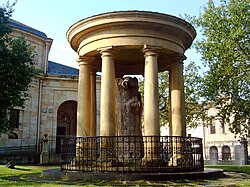
The "Old Tree" of Guernica inside its tholos

Guernica marketplace

A cesta-punta player