Introduction to general relativity
Source: WikipediaGravity is not an invisible "pull" but the byproduct of matter warping the fabric of spacetime.
For two centuries, Newtonian physics described gravity as an attractive force that somehow reached across empty space to tug on distant objects. While mathematically successful, Newton himself was unsettled by the "action at a distance" problem—he couldn't explain how the force was transmitted. Einstein solved this by proposing that space and time are not an empty stage, but a physical fabric.
Massive objects like stars and planets don't "pull" on their neighbors; instead, they sit in this fabric and dent it. When a smaller object moves near a larger one, it isn't being grabbed by an invisible hand; it is simply rolling into the dip created by the larger mass. This transformation turned gravity from a mysterious force into a tangible property of geometry.
The "Equivalence Principle" proves that falling through a gravitational field is identical to floating in deep space.
Einstein’s breakthrough began with a thought experiment: a person in a falling elevator. To the person inside, gravity effectively disappears; objects float weightlessly, and no experiment can distinguish this "free fall" from drifting in the furthest reaches of the galaxy. This suggests that "gravity" is not something being done to the observer, but is a state of motion.
Conversely, if you are in a rocket ship in deep space accelerating at 9.8 m/s², you would feel a force pushing you into the floor that feels exactly like Earth's gravity. Einstein realized that gravity and acceleration are two sides of the same coin. This "equivalence" allowed him to predict how gravity would affect light and time long before he had the final equations to prove it.
Massive objects act as chronological and optical lenses, slowing time and bending the path of light.
Because gravity is a curvature of spacetime itself, it affects everything that exists within that fabric—including light and time. When light passes near a massive object, it doesn't travel in a straight line; it follows the curve of the space it’s in. This "gravitational lensing" allows astronomers to see distant galaxies that are hidden behind closer ones, as the foreground mass bends the light around it like a giant magnifying glass.
Gravity also dictates the "speed" of time. The closer an observer is to a massive body (where the curvature is strongest), the slower time passes for them relative to someone further away. This isn't a mechanical error in clocks; it is a fundamental stretching of the seconds. This effect, known as gravitational time dilation, is so significant that GPS satellites must constantly correct their internal clocks to stay in sync with users on Earth’s surface.
The universe follows "geodesics," traveling the straightest possible paths through a curved reality.
In classical geometry, the shortest distance between two points is a straight line. But on a curved surface—like the Earth—the "straightest" possible path is a curve called a geodesic. Einstein applied this to the four dimensions of spacetime. Planets are not being forced into circular orbits by a tether; they are simply moving in "straight" lines through a space that has been bent into a loop by the Sun.
This shifted the study of the universe from a search for "forces" to a study of "geometry." The physicist John Wheeler famously summarized this relationship: "Spacetime tells matter how to move; matter tells spacetime how to curve." This reciprocal relationship is what keeps galaxies together and determines the trajectory of every photon in the universe.
General relativity provides the blueprint for the cosmos but remains fundamentally at odds with the subatomic world.
General relativity is the essential tool for modern cosmology, providing the mathematical foundation for our understanding of black holes—regions where gravity is so intense that the "dent" in spacetime becomes a bottomless pit. It also underpins the Big Bang theory, describing how an expanding universe evolves over billions of years.
Despite its perfection at the scale of stars, the theory remains incomplete. It is currently irreconcilable with quantum mechanics, which governs the behavior of subatomic particles. Where general relativity describes space as a smooth, continuous fabric, quantum physics sees a chaotic, grainy reality. Solving this "quantum gravity" puzzle is the final frontier for physicists seeking a "Theory of Everything."
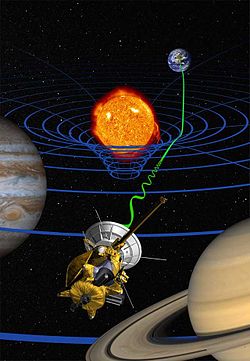
High-precision test of general relativity by the Cassini space probe (artist's impression): radio signals sent between the Earth and the probe (green wave) are delayed by the warping of spacetime (blue lines) due to the Sun's mass.
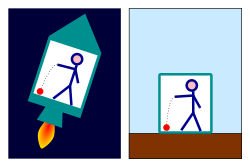
Ball falling to the floor in an accelerating rocket (left) and on Earth (right). The effect is identical.

The gravitational redshift of a light wave as it moves upwards against a gravitational field (caused by the yellow star below)

Two bodies falling towards the center of the Earth accelerate towards each other as they fall.
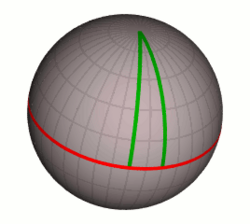
Converging geodesics: two lines of longitude (green) that start out in parallel at the equator (red) but converge to meet at the pole

Distances, at different latitudes, corresponding to 30 degrees difference in longitude

The Einstein Cross: four images of the same distant quasar, produced by a gravitational lens (the much closer foreground galaxy Huchra's lens)
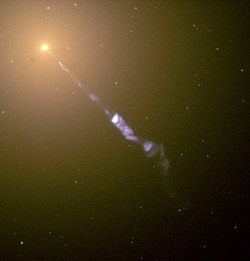
Black hole-powered jet emanating from the central region of the galaxy M87
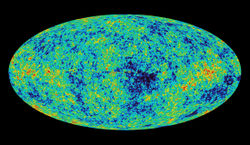
An image, created using data from the WMAP satellite telescope, of the radiation emitted no more than a few hundred thousand years after the Big Bang