Game theory
Source: WikipediaGame theory translates the messy reality of social interaction into the precise language of mathematical logic.
While the name suggests leisure, game theory is actually the rigorous science of rational decision-making. It studies "strategic interactions," where the outcome for one participant depends entirely on the choices made by others. Originally a tool for understanding two-person "zero-sum" contests—where one person’s gain is exactly equal to another’s loss—it has since expanded into an umbrella term for modeling behavior in humans, animals, and computer algorithms.
The field effectively bridges the gap between pure math and social science. By stripping away emotional noise, researchers in economics, logic, and systems science can use these models to predict how actors will behave in competitive environments. Whether it is a firm setting a price or a country managing a nuclear deterrent, game theory provides the framework to map out every possible move and its resulting payoff.
The discipline shifted from "win-lose" gambling models to a nuanced understanding of complex human cooperation.
Modern game theory traces its roots to the 1920s and John von Neumann, who used fixed-point theorems to prove that an optimal strategy exists for any two-player competitive game. However, the field’s true "breakout" occurred in the 1950s when John Nash introduced the Nash equilibrium. Unlike earlier models, Nash’s framework applied to "non-zero-sum" games, where players could potentially all win or all lose depending on their level of coordination.
This shift allowed the theory to move beyond the poker table and into the real world. It provided the first mathematical discussion of the "Prisoner’s Dilemma," a paradox where two rational individuals might not cooperate even if it is in their best interest to do so. This discovery was so profound that it led to investigations by the RAND Corporation into global nuclear strategy, proving that math could be a matter of life and death.
The "Taxonomy of Games" categorizes interactions by their rules of engagement and information flow.
Game theorists classify strategic encounters into several distinct "species." A fundamental split exists between cooperative games (where players can form binding, externally enforced contracts) and non-cooperative games (where agreements must be self-enforcing). This distinction determines whether a group will likely form a stable coalition or if individual greed will cause an alliance to collapse from within.
Information and timing are equally critical. In simultaneous games, players move at once without knowing their opponent's choice, whereas sequential games (like chess) allow players to react to previous moves. Furthermore, the theory distinguishes between "perfect information," where every player knows the entire history of the game, and "Bayesian" games, where participants must make guesses because they don't fully understand their opponent's strengths, costs, or true motivations.
Beyond the boardroom, game theory has become a primary tool for mapping biological survival and economic stability.
In the 1970s, the field underwent a radical expansion when John Maynard Smith applied game theory to evolution. He realized that "strategies" didn't have to be conscious decisions; they could be inherited traits. This "evolutionary game theory" explains why certain behaviors, like altruism or aggression, become stable within a species. It turned the focus from "rational actors" to "successful survivors," showing that math dictates the logic of nature itself.
The impact of these models is perhaps most visible in the Nobel Prizes. As of 2020, fifteen game theorists have won the Nobel Prize in Economics. Their work has moved from theoretical proofs to "mechanism design"—essentially engineering the rules of a "game" (like an auction or a labor market) to ensure a fair and efficient outcome. From matching kidney donors to patients to designing the auctions that sell off cellular spectrum rights, game theory now quietly runs the background processes of modern civilization.

John Nash

A game of imperfect information. The dotted line represents ignorance on the part of player 2, formally called an information set.

Example of a Bayesian game

An extensive form game

A four-stage centipede game
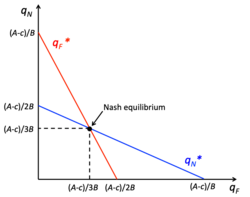
Equilibrium for Cournot quantity competition