Futurism
Futurism was a violent rejection of history that glorified the "technological triumph" of humanity over nature.
Futurism was a violent rejection of history that glorified the "technological triumph" of humanity over nature.
Founded in Milan in 1909 by poet Filippo Tommaso Marinetti, Futurism was less an art style and more a total war against the past. Marinetti and his followers expressed a "passionate loathing" of everything old—museums, libraries, and traditional political systems. They viewed the weight of the Italian Renaissance as a burden to be discarded, favoring the "smear of madness" and the raw energy of the industrial city over the "spineless admiration" of old canvases.
The movement celebrated a specific set of modern icons: the car, the airplane, the machine gun, and the industrial metropolis. To the Futurists, a roaring motor car was more beautiful than the Victory of Samothrace. This wasn't just an aesthetic choice; it was an ideological embrace of speed, youth, and the "destructive gesture of freedom-bringers." They aimed to synchronize the human spirit with the vibration of the machine age.
The movement translated the blur of modern life into a visual language of "Plastic Dynamism" and "Simultaneity."
The movement translated the blur of modern life into a visual language of "Plastic Dynamism" and "Simultaneity."
To capture a world in motion, Futurist painters like Umberto Boccioni and Giacomo Balla rejected static representation. They initially used "Divisionism"—breaking light into stippled dots—before adopting the fragmented planes of Cubism to analyze energy. Their goal was "universal dynamism," where objects were never separate from their surroundings. In a Futurist painting, a bus doesn't just pass a house; it rushes into the house, and the house throws itself upon the bus.
Key concepts included "lines of force," which tracked the directional energy of an object through space, and "simultaneity," the blending of memory, present sensation, and future anticipation into a single image. Balla’s Dynamism of a Dog on a Leash (1912) famously depicted a running dog not with four legs, but with dozens of blurred vibrations, reflecting the persistence of an image upon the retina.
Futurists functioned as a multimedia cult, codifying their radical lifestyle through aggressive public manifestos.
Futurists functioned as a multimedia cult, codifying their radical lifestyle through aggressive public manifestos.
The movement was unique in its reach, attempting to colonize every aspect of human experience including painting, architecture, music, fashion, and even cooking. They used the "Manifesto" as their primary weapon, publishing directives on everything from The Art of Noises (which integrated industrial sounds into music) to "anti-neutrality" in politics. If a medium existed, the Futurists wanted to "futurize" it by stripped-down, aggressive modernization.
This obsession with the "new" extended to three-dimensional space. Boccioni’s sculpture Unique Forms of Continuity in Space (1913) attempted to show a human figure not as a solid body, but as the environment's effect on that body in motion. This work remains so influential to Italian identity that it appears on the national side of the Italian 20-cent euro coin today.
The movement viewed war as the "world's only hygiene," a belief that ultimately fractured and transformed the group.
The movement viewed war as the "world's only hygiene," a belief that ultimately fractured and transformed the group.
Futurism was deeply intertwined with intense nationalism and a cult of violence. The founding manifesto explicitly glorified militarism and "beautiful ideas worth dying for." When World War I broke out, many Futurists—including Boccioni and Sant'Elia—enlisted eagerly, viewing the conflict as a cleansing fire that would burn away the "passéist" elements of Europe.
The reality of the war was devastating for the movement. The "First Futurism" effectively ended when its leading light, Boccioni, was killed in 1916. Post-war, Marinetti revived the movement into "Second Futurism," which shifted focus toward the "Mechanical Art" of the 1920s and the "Aeroaesthetics" of the 1930s. While it influenced movements like Art Deco and Surrealism, its early, violent purity was buried in the trenches of the Great War.
Parallel movements in Russia transformed Futurism into a tool for revolutionary social engineering.
Parallel movements in Russia transformed Futurism into a tool for revolutionary social engineering.
While the Italian movement trended toward nationalism, Russian Futurism emerged as a literary and visual powerhouse that eventually aligned with the Bolshevik Revolution. Figures like Vladimir Mayakovsky and Kazimir Malevich found inspiration in the Italian focus on dynamism but applied it to a "Literature of Fact" and the creation of a new proletarian culture.
Russian Futurists were less obsessed with the car and more focused on the evolution of language and the "trans-rational" (Zaum) poetry of Velimir Khlebnikov. Though they shared the Italian disdain for the past, the Russian branch became a vital pillar of the early Soviet avant-garde, proving that the Futurist impulse for "speed and technology" could be adapted to serve entirely different political ends.

Gino Severini, 1912, Dynamic Hieroglyphic of the Bal Tabarin, oil on canvas with sequins, 161.6 × 156.2 cm (63.6 × 61.5 in.), Museum of Modern Art, New York

Italian futurists Luigi Russolo, Carlo Carrà, Filippo Tommaso Marinetti, Umberto Boccioni and Gino Severini in front of Le Figaro, Paris, February 9, 1912
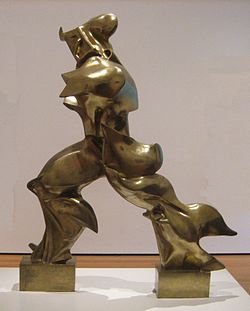
Umberto Boccioni, Unique Forms of Continuity in Space (1913)

Umberto Boccioni, The City Rises (1910)

Giacomo Balla, 1912, Dinamismo di un Cane al Guinzaglio (Dynamism of a Dog on a Leash), Albright-Knox Art Gallery

Umberto Boccioni The Laugh, 1911

Luigi Russolo Solidity of Fog, 1912

Aldo Palazzeschi, Carlo Carrà, Giovanni Papini, Umberto Boccioni, and Filippo Tommaso Marinetti, 1914

Natalia Goncharova, Cyclist, 1913
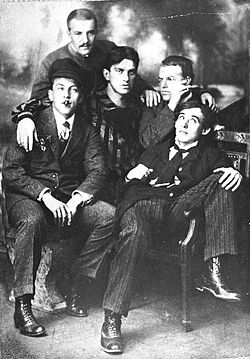
Group photograph of several Russian Futurists, published in their manifesto A Slap in the Face of Public Taste. Left to right: Aleksei Kruchyonykh, Vladimir Burliuk, Vladimir Mayakovsky, David Burliuk, and Benedikt Livshits.

An example of Futurist architecture by Antonio Sant'Elia

Thaïs by Anton Giulio Bragaglia (1917)

Joseph Stella, 1919–20, Brooklyn Bridge, oil on canvas, 215.3 × 194.6 cm, Yale University Art Gallery

Sail: In Two Movements by Charles Demuth 1919

An example of Futurist design: "Skyscraper Lamp", by the Italian architect Arnaldo dell'Ira, 1929