French Revolution
The Revolution was fueled by a demographic boom meeting an inflexible and archaic tax system.
The Revolution was fueled by a demographic boom meeting an inflexible and archaic tax system.
Between 1715 and 1789, France’s population surged from 21 to 28 million, creating a massive, educated middle class that represented 10% of the population. While the country grew wealthier, the benefits were captured almost exclusively by the elite, while wage laborers and farmers saw their living standards plummet. A series of bad harvests in the late 1780s turned this chronic economic friction into an acute subsistence crisis.
The state’s inability to respond was rooted in a "debt-trap" tax system. Unlike Britain, France had no uniform tax code; rates were inconsistent, collected by private "tax farmers," and riddled with exemptions for the nobility and Church. When the monarchy tried to modernize the system to pay for wars (including the American Revolution), the regional courts (parlements) blocked the reforms to protect their own privileges, forcing a total political impasse.
A bureaucratic deadlock over voting procedures triggered a complete seizure of sovereign power.
A bureaucratic deadlock over voting procedures triggered a complete seizure of sovereign power.
When the Estates-General was finally convened in 1789—the first time in 175 years—it was intended to solve a budget crisis, not reinvent the government. However, the "Third Estate" (commoners) realized that if they voted by "estate" rather than by "head," the nobility and clergy would always outvote them 2-to-1. Their demand for individual voting was a direct challenge to the three-tiered social order.
This procedural dispute escalated into a constitutional coup. When the King locked their meeting hall, the Third Estate retreated to a nearby indoor tennis court, swearing not to leave until they had written a constitution. By declaring themselves the "National Assembly," they effectively stripped the King of his absolute authority, claiming that sovereignty resided in the nation, not the crown.
The fall of the Bastille turned street protests into a permanent shift of physical authority.
The fall of the Bastille turned street protests into a permanent shift of physical authority.
The storming of the Bastille on July 14, 1789, was more symbolic than strategic—the prison held only seven prisoners at the time. However, it represented the moment the Parisian public became an armed political actor. By seizing the fortress’s gunpowder and killing its governor, the mob proved that the King’s elite Swiss Guards could no longer maintain order in the capital.
This shift in power forced the King to recognize the new "Commune" of Paris and wear the tricolore cockade, the symbol of the revolution. But the collapse of order wasn't confined to Paris; in the countryside, a wave of paranoia known as the "Great Fear" led peasants to arm themselves and burn down aristocratic estates. This grassroots violence effectively ended the old regime's ability to govern through traditional social deference.
In a single summer, the Assembly dismantled a millennium of feudal hierarchy.
In a single summer, the Assembly dismantled a millennium of feudal hierarchy.
Between August and November 1789, the National Assembly executed one of history’s most radical legal overhauls. Through the "August Decrees," they abolished the entire feudal system, canceling the dues peasants owed to landlords and the tithes owed to the Church. They replaced centuries of provincial privileges with a uniform law, declaring all citizens equal in the eyes of the state.
The crowning achievement of this period was the Declaration of the Rights of Man and of the Citizen. Influenced by Enlightenment thought and the American Revolution, it redefined people from "subjects" of a king to "citizens" with inherent rights to liberty, property, and security. In just four months, the institutional pillars that had supported France for 1,000 years were replaced by the framework of a modern liberal democracy.
Fear of counter-revolution transformed a constitutional experiment into a Republic of Terror.
Fear of counter-revolution transformed a constitutional experiment into a Republic of Terror.
The transition to a stable constitutional monarchy failed because of deep-seated distrust. King Louis XVI’s attempted flight to Varennes in 1791 convinced the public he was a traitor, while the outbreak of war with Austria and Prussia in 1792 stoked fears of a foreign-backed restoration. This "siege mentality" radicalized the political climate, leading to the abolition of the monarchy and the execution of the King in 1793.
Power eventually centralized in the hands of the Committee of Public Safety, led by Maximilien Robespierre. To "save" the revolution from internal and external enemies, they suspended the constitution and launched the Reign of Terror, executing approximately 16,000 people. This era of extreme radicalism only ended when the revolutionaries turned on each other, eventually paving the way for the military stability offered by Napoleon Bonaparte.
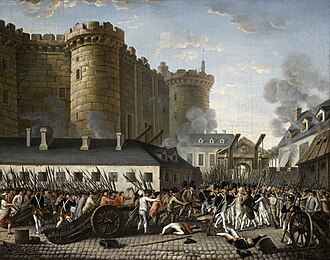
Image from Wikipedia

The regional Parlements in 1789; note area covered by the Parlement of Paris
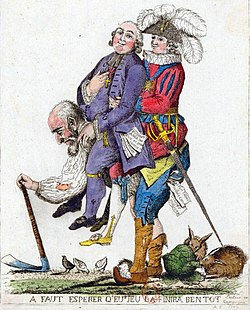
Caricature of the Third Estate carrying the First Estate (clergy) and the Second Estate (nobility) on its back

Le Serment du Jeu de paume by Jacques-Louis David (c. 1791), depicting the Tennis Court Oath

The Storming of the Bastille on 14 July 1789; the iconic event of the Revolution, still commemorated each year as Bastille Day

In this caricature, monks and nuns enjoy their new freedom after the decree of 16 February 1790.

The Fête de la Fédération on 14 July 1790 celebrated the establishment of the constitutional monarchy.

After the Flight to Varennes; the royal family are escorted back to Paris

The insurrection of 10 August 1792
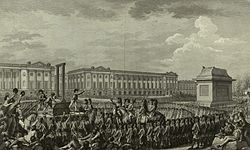
Execution of Louis XVI in the Place de la Concorde, facing the empty pedestal where the statue of his grandfather Louis XV previously stood
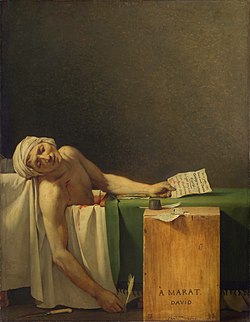
The Death of Marat by Jacques-Louis David (1793)

Nine émigrés are executed by guillotine, 1793

Georges Danton; Robespierre's close friend and Montagnard leader, executed 5 April 1794

The execution of Robespierre on 28 July 1794 marked the end of the Reign of Terror.
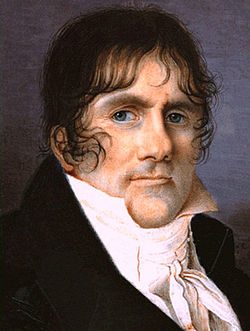
Former Viscount and Montagnard Paul Barras, who took part in the Thermidorian reaction and later headed the French Directory