Freakonomics
Economics is the study of incentives, not just money, applied to the "hidden side" of everyday life
Economics is the study of incentives, not just money, applied to the "hidden side" of everyday life
The central thesis of Freakonomics is that the world is a web of incentives—moral, social, and financial. While traditional economics focuses on markets and trade, authors Steven Levitt and Stephen Dubner argue that economic tools can explain diverse human behaviors, from the cheating habits of sumo wrestlers to the career trajectories of crack dealers. By treating the world as a giant database, they attempt to unmask the actual motivations that drive social outcomes.
The book functions as a collection of "rogue" inquiries rather than a unified narrative. It challenges the "conventional wisdom" often cited by experts, suggesting that what we think we know is often based on faulty assumptions or a lack of data. By applying rigorous statistical analysis to non-traditional subjects, the authors aim to show that the underlying mechanics of society are often counterintuitive.
Statistical anomalies in closed systems can unmask hidden patterns of corruption and collusion
Statistical anomalies in closed systems can unmask hidden patterns of corruption and collusion
One of the book's most famous insights involves data mining in the world of professional sumo wrestling. By analyzing the final matches of tournaments—where a wrestler with a 7–7 record needs one more win to avoid demotion—the authors found that they win roughly 80% of the time against 8–6 opponents who have already secured their rank. This statistical spike suggests a system of mutual back-scratching and match-fixing that was later confirmed by actual scandals within the sport.
Similarly, the authors used data mining to detect cheating among Chicago schoolteachers. By looking for suspicious patterns in student answer sheets—such as a string of identical correct answers on difficult questions following a series of wrong answers on easy ones—Levitt demonstrated that high-stakes testing creates an incentive for teachers to "help" their students. This highlights a recurring theme: whenever there is a high reward for a specific outcome, humans will find ways to game the system.
The most controversial claim links the 1990s crime drop to the legalization of abortion two decades prior
The most controversial claim links the 1990s crime drop to the legalization of abortion two decades prior
Levitt and John Donohue argued that the dramatic, unexpected decline in U.S. crime during the 1990s was not primarily due to better policing or a stronger economy, but rather the 1973 Roe v. Wade decision. Their theory posits that children who are "unwanted" or born into unstable environments are statistically more likely to commit crimes as adults; therefore, the legalization of abortion reduced the "pool" of potential criminals twenty years later.
This hypothesis ignited a firestorm of criticism from both moral and statistical perspectives. Critics argued that the data was messy and the correlation was flawed, with some economists pointing out programming errors in Levitt’s original code. Despite the controversy, Levitt maintains that the study is a cold analysis of crime data, not a moral argument for or against abortion, famously describing the prevented homicides as a "pebble in the ocean" compared to the scale of the abortion debate itself.
Critics view the work as "academic imperialism" that prioritizes clever storytelling over statistical rigor
Critics view the work as "academic imperialism" that prioritizes clever storytelling over statistical rigor
Despite its massive popularity, Freakonomics has been dismissed by some scholars as "amateur sociology." Critics like economist Ariel Rubinstein argue that the book's connection to actual economic theory is non-existent and that Levitt has "swaggered" into other fields where he lacks expertise. This "academic imperialism" is seen by some as a move away from the serious study of markets toward a form of high-brow entertainment.
Technical critiques have also haunted the book’s legacy. Programming errors were discovered in the authors' analysis of how electoral cycles affect police hiring and crime rates. Furthermore, the authors faced a defamation lawsuit from researcher John Lott regarding their claims about the replicability of his "more guns, less crime" research. While the authors corrected some errors in subsequent editions, these incidents highlight the risks of using complex data to draw broad, provocative conclusions.
Strategic digital marketing transformed a niche academic collaboration into a global multi-media franchise
Strategic digital marketing transformed a niche academic collaboration into a global multi-media franchise
The success of Freakonomics was not accidental; the publisher targeted the "blogosphere" in 2005, sending advance copies to over a hundred influential bloggers to generate organic buzz. This strategy helped the book sell over 4 million copies and reach number two on the New York Times Best Seller list. It proved that there was a massive appetite for "smart-thinking" books that melded pop culture with data-driven insights.
Today, the Freakonomics brand has evolved into a massive ecosystem including a sequel (SuperFreakonomics), a documentary film, and a long-running radio program and podcast. What began as a series of academic papers has become a staple of modern media, influencing how the general public thinks about data, incentives, and the "hidden side" of the world around them.
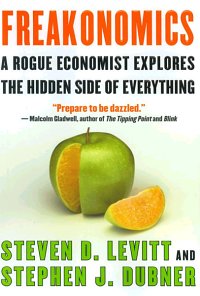
Image from Wikipedia

Screen shot of Freakonomics Blog