Fast food
Fast food is a $570 billion global industry built on the tactical elimination of waiting
Fast food is a $570 billion global industry built on the tactical elimination of waiting
The primary product of a fast-food establishment isn't just food; it is time. By utilizing frozen, pre-heated, or pre-cooked ingredients, "quick-service restaurants" reduce the interval between ordering and eating to mere seconds or minutes. This commercial strategy emerged to accommodate the frantic schedules of travelers, commuters, and wage workers who require "on the go" fuel that can be eaten as finger food without traditional cutlery.
The scale is immense. In the United States alone, the industry employs over 5.4 million people. To maintain speed at this volume, the menu is intentionally limited and standardized. Whether it is a hamburger in Kansas or a kebab in London, the goal is "to order" assembly from mass-produced components, ensuring the customer knows exactly what they are getting before they even reach the counter or drive-through window.
Urban density and the lack of domestic kitchens made "ready-to-eat" meals a historical necessity
Urban density and the lack of domestic kitchens made "ready-to-eat" meals a historical necessity
The concept of fast food is not a modern invention but a response to urban living. In Ancient Rome, most citizens lived in multi-story apartment blocks (insulae) that lacked kitchens. To eat, they relied on street stands and popina (simple eateries) for wine-soaked bread, stews, and cured meats. Similarly, in 12th-century China and Middle Ages London, vendors sold fried dough and meat pies to single-person households who couldn't afford the space or the expensive fuel required for a home fire.
Modern fast food exploded during the post-WWII economic boom. As consumerism rose and women entered the workforce in record numbers, the "traditional" home-cooked family dinner became a logistical burden. Eating out transitioned from a luxury to a daily necessity. Today, the average American man spends only 19 minutes a day on food preparation, a direct result of the convenience offered by the commercialization of the kitchen.
Industrial standardization ensures that a burger in New York tastes identical to one in Tokyo
Industrial standardization ensures that a burger in New York tastes identical to one in Tokyo
The "magic" of the fast-food model lies in its centralized supply chain. Instead of chefs, these restaurants use "assemblers." Franchise operations receive standardized foodstuffs from central locations—pre-washed vegetables, bagged condiments, and frozen patties—which are then reheated or assembled on-site. This eliminates the need for skilled labor and expensive equipment at individual outlets, slashing overhead costs while maintaining a consistent "brand" experience.
This industrialization pioneered the concept of franchising. In 1921, A&W Root Beer began franchising its syrup, while White Castle introduced the high-volume, low-cost hamburger model. These innovations allowed companies to scale rapidly across borders. Today, the U.S. fast-food industry is the world's largest, with American chains operating in over 100 countries, exporting a standardized "ultra-processed" diet to the global population.
Cultural variations adapt the "fast" model to local tastes, from British eels to Dutch "war" fries
Cultural variations adapt the "fast" model to local tastes, from British eels to Dutch "war" fries
While the hamburger is the global icon of fast food, the model adapts to local geography. In the UK, the industry grew out of 19th-century trawler fishing, leading to the "fish and chips" shop—a staple for the Victorian working class. By 1920, there were over 35,000 such shops in Britain. Other regions have their own versions: the Middle East has the rotisserie-shaved kebab, Japan has the bentō and sushi, and the Netherlands has deep-fried snacks served with oorlog ("war") sauce—a mix of mayonnaise and peanut sauce.
Street vendors represent the most "organic" version of this trade. From Vietnamese rice soup carts to New York hot dog stands, these independent operators use "street theatrics"—singing, chanting, and colorful displays—to capture the attention of passers-by. Despite the dominance of massive chains, these localized vendors continue to provide the "colorful and varying range" of options that define urban street life.
The industry thrives on "inelastic demand," remaining popular even as health risks and prices rise
The industry thrives on "inelastic demand," remaining popular even as health risks and prices rise
Fast food is notoriously high in saturated fat, salt, sugar, and calories. Extensive research links its consumption to cardiovascular disease, obesity, and insulin resistance. Even when researchers control for other lifestyle factors, the correlation between fast food and early mortality remains high. Many local governments have attempted to regulate or limit these restaurants to combat obesity epidemics.
However, consumer demand for fast food is "inelastic." Data shows that US adults are largely unwilling to change their consumption habits even in the face of rising prices or economic recessions. This suggests that for many, fast food is no longer a choice but a structural dependency—it is the only affordable or accessible option in "food deserts" where fresh ingredients are scarce but franchises are ubiquitous.

Examples of fast food (left to right, top to bottom): Cheeseburger, soft drink, french fries, pepperoni pizza, hot dog, fried chicken, submarine sandwich, and donuts

Pulling wheat dough into thin strands to form lamian

Blue plaque in Oldham, England commemorating the 1860s origins of fish and chip shops and the fast food industry

Fish and chips in a wrapper
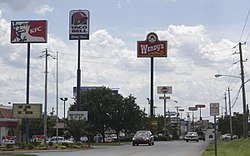
Neighboring fast food restaurant advertisement signs in Bowling Green, Kentucky for Wendy's, KFC, Krystal and Taco Bell. A McDonald's sign can be seen in the very far background.

McDonald's first two-lane drive-thru was at the Rock N Roll McDonald's in Chicago.

Street vendor serving fast food in Nepal

Fastfood restaurant in Eastern Europe: The Pajdaš (in Prekmurje Slovene Buddy), Murska Sobota Slovenia.

Fastfood in Ilorin, Kwara

Many types of sushi ready to eat

Lamb shish kebab

A fast-food kiosk in Yambol, Bulgaria

A box of five chicken wings, served at a Hesburger fast food restaurant in Helsinki, Finland
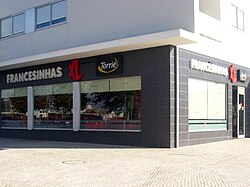
Fast-food place in Portugal

A small restaurant with pasztecik szczeciński in Szczecin, Poland