Fall of the Western Roman Empire
The "Fall" was not a single catastrophic event, but a slow-motion transformation that spanned three centuries.
The "Fall" was not a single catastrophic event, but a slow-motion transformation that spanned three centuries.
While popular history points to 476 AD—when the Germanic chieftain Odoacer deposed the teenage emperor Romulus Augustus—the empire didn't vanish overnight. For most people living through it, the "fall" was a series of gradual shifts in law, religion, and local governance. The central government simply became increasingly irrelevant until it ceased to function, transitioning the Mediterranean world from Classical Antiquity into the Early Middle Ages.
This process was less of a sudden crash and more of a "complex systems failure." The Roman state was a massive machine that required constant input (conquest, taxes, and slaves) to maintain its output (infrastructure, law, and military protection). When the inputs slowed down during the 3rd century, the machine began to rattle; by the 5th century, the parts were being sold for scrap by the very people hired to maintain them.
Rome didn't just fight "barbarians"; it outsourced its defense to them until the line between invader and soldier vanished.
Rome didn't just fight "barbarians"; it outsourced its defense to them until the line between invader and soldier vanished.
By the 4th century, the Roman legions were largely composed of Germanic soldiers known as foederati. Because the empire could no longer afford to pay its troops in coin, it paid them in land and status. This created a paradoxical military where the people defending the borders were ethnically and culturally the same as those attacking them.
This "barbarization" of the army meant that the ultimate collapse was more of a military coup than a foreign conquest. Odoacer, the man who ended the Western Empire, was himself a high-ranking officer in the Roman military. He didn't want to destroy Rome; he simply realized the Western Emperor was a puppet he no longer needed to protect.
The loss of North Africa severed the empire's financial jugular, turning a military crisis into a terminal economic collapse.
The loss of North Africa severed the empire's financial jugular, turning a military crisis into a terminal economic collapse.
If there was a "point of no return," it was the Vandal conquest of Carthage in 439 AD. North Africa was the empire's breadbasket and its primary source of tax revenue. When the Vandals seized this territory, they didn't just stop the grain ships from reaching Rome; they effectively bankrupted the Western government.
Without African tax revenue, the West could no longer afford to hire the mercenaries required to keep other tribes at bay. This triggered a death spiral: as the state lost territory, it lost taxes; as it lost taxes, it lost the ability to defend its remaining territory. By the mid-5th century, the Western Empire was a "state" in name only, unable to project power beyond the borders of Italy.
Rome survived by dividing itself, but the wealthy East ultimately abandoned the West to ensure its own survival.
Rome survived by dividing itself, but the wealthy East ultimately abandoned the West to ensure its own survival.
To manage the empire's vast scale, the Emperor Diocletian split it into Eastern and Western halves. While intended to provide administrative stability, this division created a fatal imbalance. The Eastern Empire (Byzantium) was richer, more urbanized, and easier to defend.
When the West was besieged by Visigoths and Huns, the East often provided only token support, or worse, redirected invaders toward Italy to keep them away from Constantinople. This strategic selfishness allowed the Eastern Roman Empire to survive for another thousand years, while the Western half was left to be partitioned by the very tribes it could no longer afford to fight or feed.
Modern historians view the collapse as a "historical Rorschach test" that reflects current anxieties.
Modern historians view the collapse as a "historical Rorschach test" that reflects current anxieties.
There is no consensus on why Rome fell; instead, there are over 200 proposed theories. In the 18th century, Edward Gibbon famously blamed the "effeminacy" of Christianity for sapping the Roman martial spirit. In the 20th century, historians looked at lead poisoning, climate change, and hyper-taxation.
Today, the Fall of Rome is often cited as a cautionary tale for modern superpowers regarding overextension, environmental degradation, and the dangers of extreme wealth inequality. The "Fall" remains the ultimate historical mirror: we look at the ruins of Rome and see the potential cracks in our own civilization.

Routes taken by barbarian invaders of the Roman Empire during the Migration Period

Roman Empire in the early second century

The Roman Empire under the Tetrarchy, showing the dioceses and the four Tetrarchs' zones of responsibility
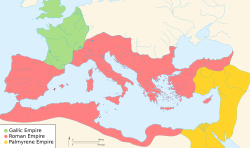
The divided Empire in 271 CE

Solidus of Julian, c. 361. Obverse: Julian with the beard appropriate to a Neoplatonic philosopher. Inscription: FL(AVIVS) CL(AVDIVS) IVLIANVS PP(=Pater Patriae, "father of the nation") AVG(=Augustus). Reverse: an armed Roman, military standard in one hand, a captive in the other. Inscription: VIRTVS EXERCITVS ROMANORVM, "the bravery/virtue of the Roman army"; the mint mark is SIRM, Sirmium.

The Eastern and Western Roman Empire at the death of Theodosius I in 395
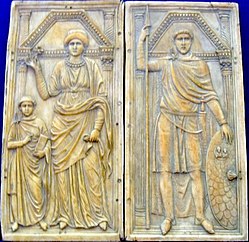
An ivory diptych, thought to depict Stilicho (right) with his wife Serena and son Eucherius, ca. 395 (Monza Cathedral)
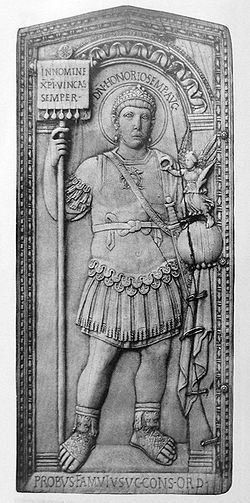
A contemporary depiction of Honorius on a consular diptych issued by Anicius Petronius Probus to celebrate Probus's consulship in 406, now in the Aosta museum

Chi-rho pendant of Empress Maria, daughter of Stilicho, and wife of Honorius, now in the Louvre, Paris. The pendant reads, around a central cross (clockwise):HONORIMARIASERHNAVIVATISSTELICHO.The letters form a Christogram.

Inscription honouring Honorius, as florentissimo invictissimoque, the most excellent and invincible, 417–418, Forum Romanum

Areas allotted to or claimed by barbarian groups in 416–418

During his four-year reign Majorian reconquered most of Hispania and southern Gaul, meanwhile reducing the Visigoths, Burgundians and Suevi to federate status.

Tremissis of Anthemius

Tremissis of Julius Nepos

Europe and the Mediterranean in AD 476