Fall of the Berlin Wall
A "peaceful picnic" and a travel loophole in Hungary shattered the Eastern Bloc's unity months before the Wall fell.
A "peaceful picnic" and a travel loophole in Hungary shattered the Eastern Bloc's unity months before the Wall fell.
The collapse was not a localized Berlin event but the result of a "peaceful chain reaction" across Europe. In August 1989, the Pan-European Picnic at the Austrian-Hungarian border served as a stress test for Soviet resolve. When Hungary allowed East Germans to cross into the West and the USSR failed to intervene, the "Iron Curtain" was effectively pierced.
By the time November arrived, East Germany was hemmed in by its own neighbors. Refugees were flooding into West German embassies in Prague and Budapest. This mass exodus created a financial and diplomatic crisis that forced the GDR leadership to draft new travel regulations simply to prevent the total economic collapse of the state.
The literal fall of the Wall was triggered by a bureaucratic blunder during a live press conference.
The literal fall of the Wall was triggered by a bureaucratic blunder during a live press conference.
On November 9, 1989, party spokesman Günter Schabowski was handed a note about new travel regulations just minutes before a live broadcast. He had not been briefed on the details—specifically, that the law was intended to take effect the following day with an orderly application process.
When asked by journalists when the rules would start, a visible confused Schabowski replied, "As far as I know, it takes effect immediately, without delay." Within minutes, West German news bulletins blasted the headline: "The GDR is opening its borders." This accidental announcement acted as a mass summons, sending thousands of East Berliners rushing toward the checkpoints before the guards had received any official orders.
Faced with an overwhelming, peaceful crowd, low-level border commanders chose to open the gates rather than resort to violence.
Faced with an overwhelming, peaceful crowd, low-level border commanders chose to open the gates rather than resort to violence.
The situation at the checkpoints was a powder keg. Thousands of citizens demanded passage based on Schabowski’s broadcast, while guards stood behind a "shoot-to-kill" policy with no instructions from their superiors. At the Bornholmer Straße crossing, commander Harald Jäger made a historic, independent decision: rather than use lethal force against the "aggressive" crowd, he ordered his men to open the gates.
This moment highlighted the total paralysis of the East German leadership. No one in the Politburo was willing to take personal responsibility for ordering a massacre. Once the first gate at Bornholmer Straße opened around 10:45 PM, the psychological barrier of the Wall vanished, and other checkpoints quickly followed suit.
The transition from a "Death Strip" to a souvenir market happened almost overnight.
The transition from a "Death Strip" to a souvenir market happened almost overnight.
The Wall was a formidable 155-kilometer double-wall system separated by a mined "death strip" and 302 watchtowers. Yet, as soon as the borders opened, it was instantly demystified. Citizens from both sides, nicknamed Mauerspechte (wallpeckers), began using hammers and chisels to reclaim the city, chipping off chunks of concrete as souvenirs.
While the East German regime tried to maintain order by announcing "new" official crossings at historic sites like Potsdamer Platz, they were merely chasing a reality already established by the public. By June 1990, the systematic deconstruction of the Wall began, paving the way for German reunification just 11 months after the first breach.

Image from Wikipedia

This section of the Wall's "death strip" featured Czech hedgehogs, a guard tower and a cleared area, 1977.

The press conference on 9 November 1989 by Günter Schabowski (seated on stage, second from right) and other East German officials which led to the fall of the Wall. Riccardo Ehrman is sitting on the floor of the podium with the table just behind him.

DPA bulletin

St. Nicholas Church in Leipzig has become a famous symbol of the reunification of Germany.
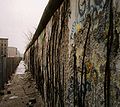
Almost all of the remaining sections were rapidly chipped away. December 1990.