Fall of Constantinople
The collapse of the city ended a 1,500-year Roman lineage and forced Europe into the Early Modern era.
The collapse of the city ended a 1,500-year Roman lineage and forced Europe into the Early Modern era.
The fall of Constantinople on May 29, 1453, was more than a military defeat; it was the formal conclusion of the Roman Empire, which had endured in various forms since 27 BC. For contemporary Europeans, the loss of the "Queen of Cities" felt like the end of the world. For modern historians, it serves as the definitive boundary between the Middle Ages and the Early Modern period.
By the time Sultan Mehmed II arrived, the "empire" was a ghost of its former self. Ravaged by the Black Death and hollowed out by centuries of civil war and Latin crusades, the city was no longer a thriving metropolis but a collection of fortified villages separated by fields. When the city fell, the center of gravity for the Orthodox world shifted, and the Ottoman Empire established itself as the dominant superpower at the crossroads of Europe and Asia.
The legendary Theodosian Walls, invincible for 800 years, were rendered obsolete by the birth of heavy siege artillery.
The legendary Theodosian Walls, invincible for 800 years, were rendered obsolete by the birth of heavy siege artillery.
Constantinople possessed the most advanced defensive system in the medieval world. The Theodosian Walls had repelled every invader for nearly a millennium, but they were built for an era of bows and catapults. The Ottoman siege heralded a paradigm shift in military history: the transition from static masonry defenses to the era of gunpowder and mobile heavy artillery.
Mehmed II commissioned massive "bombards," including the "Basilica" designed by the engineer Orban. These 27-foot-long cannons fired 1,100-pound stone balls over a mile, systematically pulverizing walls that had stood since the 5th century. This proved that no fortification, no matter how ancient or thick, could withstand the concentrated application of modern chemistry and engineering.
Centuries of religious schism and European exhaustion left the Byzantines to fight a global power with a skeleton crew.
Centuries of religious schism and European exhaustion left the Byzantines to fight a global power with a skeleton crew.
Despite the existential threat, the Christian world was too fractured to offer a unified defense. The "Great Schism" between the Roman Catholic and Eastern Orthodox churches meant that papal help came with strings attached—namely, Byzantine submission to Rome. This "Union" was so unpopular in Constantinople that many citizens famously preferred the Ottoman turban to the Latin mitre.
While the Ottomans fielded upwards of 80,000 soldiers, including the elite Janissary corps, the Byzantine Emperor Constantine XI could only muster about 7,000 defenders. Western Europe was preoccupied: England and France were drained by the Hundred Years' War, and the Iberian kingdoms were focused on the Reconquista. Aside from a few heroic Italian volunteers like Giovanni Giustiniani, the city was left to face its fate largely alone.
Mehmed II used "throat-cutting" logistics to strangle the city’s supply lines before the first shot was fired.
Mehmed II used "throat-cutting" logistics to strangle the city’s supply lines before the first shot was fired.
The 21-year-old Sultan won the city through superior preparation as much as brute force. In 1452, he constructed the Rumeli Hisarı (the "Throat-Cutter") fortress on the European side of the Bosphorus. Paired with an existing fortress on the Asian side, this gave the Ottomans total control over the strait, effectively severing the city’s grain and reinforcement routes from the Black Sea.
The Byzantines countered by stretching a massive iron chain across the Golden Horn to block the Ottoman fleet. In a feat of engineering that demoralized the defenders, Mehmed bypassed the chain by building a greased wooden "slipway" over land, physically dragging his ships across a hill and dropping them into the harbor behind the Byzantine defenses. This forced the already thin Greek lines to defend the city’s sea walls as well as its land walls, stretching the 7,000 defenders to the breaking point.

Image from Wikipedia

Restored walls of Constantinople

The chain that closed off the entrance to the Golden Horn in 1453, now on display in the İstanbul Archaeology Museums

The Ottoman Sultanate and the Eastern Roman Empire in April 1453

Map of Constantinople and the dispositions of the defenders and the besiegers

The Dardanelles Gun, cast by Munir Ali in 1464, is similar to bombards used by the Ottoman besiegers of Constantinople in 1453 (British Royal Armouries collection).
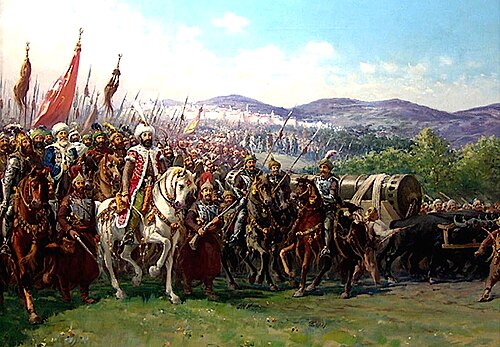
Modern painting of Mehmed and the Ottoman Army approaching Constantinople with a giant bombard, by Fausto Zonaro

Painting of the Fall of Constantinople, by Theophilos Hatzimihail

Painting by Fausto Zonaro depicting the Ottoman Turks transporting their fleet overland into the Golden Horn

Siege of Constantinople as depicted between 1470 and 1479

Painting by the Greek folk painter Theophilos Hatzimihail showing the battle inside the city. Constantine is visible on a white horse.

Following the city's conquest, the Church of the Holy Wisdom (the Hagia Sophia) was converted into a mosque.

Mehmed II by Gentile Bellini

Siege of Constantinople on a mural at the Moldovița Monastery in Romania, painted in 1537
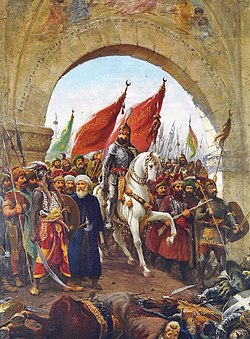
Mehmed the Conqueror enters Constantinople. Painting by Fausto Zonaro.