Intensive animal farming
Agricultural industrialization replaced traditional pastoralism with a high-density "factory" model driven by 19th-century scientific breakthroughs.
Agricultural industrialization replaced traditional pastoralism with a high-density "factory" model driven by 19th-century scientific breakthroughs.
The shift from family farms to industrial operations wasn't accidental; it was a response to the discovery of vitamins A and D. Before this, livestock required sunlight and pasture to survive. Once nutritionists realized they could supplement feed, animals could be moved indoors into climate-controlled environments, stripping away the seasonal and geographical limits of traditional farming.
Following World War II, this process accelerated as surplus ammonium nitrate (used for explosives) was repurposed as synthetic fertilizer. This created an explosion in cheap grain production, providing the low-cost fuel necessary to sustain massive numbers of animals in small spaces. What began as a way to ensure food security evolved into a globalized system of standardized "units" of protein.
Synthetic nutrition and pharmaceuticals function as the "operating system" that prevents biological collapse in extreme stocking densities.
Synthetic nutrition and pharmaceuticals function as the "operating system" that prevents biological collapse in extreme stocking densities.
In a natural environment, the sheer density of a Concentrated Animal Feeding Operation (CAFO) would lead to immediate mass mortality from disease. To bypass this biological limit, the industry relies on the prophylactic use of antibiotics—not just to treat sick animals, but to prevent infections and promote faster growth. In some regions, up to 80% of all antibiotics are consumed by livestock rather than humans.
Beyond medicine, the "technology" of intensive farming includes specialized breeding. Selective genetics have created chickens that reach slaughter weight in six weeks—twice as fast as they did fifty years ago—and cows that produce significantly more milk than their ancestors. This efficiency turns the animal into a high-throughput machine, though often at the cost of its skeletal and cardiovascular health.
The system prioritizes "vertical integration" to drive down prices, making meat a global commodity rather than a luxury.
The system prioritizes "vertical integration" to drive down prices, making meat a global commodity rather than a luxury.
Modern intensive farming is defined by vertical integration, where a single corporation controls every stage of production, from the genetics of the chick to the plastic-wrapped cut in the grocery store. This consolidation allows for massive economies of scale, reducing the cost of meat to historic lows. In the mid-20th century, chicken was a luxury meal; today, it is often the cheapest protein available in developed nations.
However, this economic efficiency creates a "treadmill" for farmers. Most do not own the animals they raise; they are contractors for large "integrators." They provide the land and the labor while carrying the debt for expensive automated facilities, while the corporations control the supply chain and the market price, leaving individual producers with razor-thin margins.
Standardized confinement practices prioritize throughput but trigger intense ethical debates over animal autonomy and physical suffering.
Standardized confinement practices prioritize throughput but trigger intense ethical debates over animal autonomy and physical suffering.
To maximize space, the industry utilizes restrictive housing such as battery cages for hens and gestation crates for pigs. These systems are designed to prevent movement that would "waste" calories, ensuring every ounce of feed is converted into meat or eggs. For many animals, this means living their entire lives without enough space to turn around or stretch their limbs.
The psychological toll on the animals often manifests in "stereotypies"—repetitive, purposeless behaviors like bar-biting or feather-pecking. While industry proponents argue that controlled environments protect animals from predators and weather, critics point to the loss of natural behaviors as a fundamental violation of animal welfare. This tension has led to a growing wave of legislation, particularly in the EU and parts of the US, to ban the most restrictive forms of confinement.
Environmental externalities and antibiotic resistance represent the "unpaid debt" of cheap industrial protein.
Environmental externalities and antibiotic resistance represent the "unpaid debt" of cheap industrial protein.
The efficiency of factory farming comes with a massive "cleanup" cost that is rarely reflected in the price of a hamburger. Massive quantities of manure are stored in "lagoons," which can leak into groundwater or volatilize into the air, causing respiratory issues for nearby communities. Furthermore, the concentrated methane emissions from ruminants are a primary driver of global climate change.
Perhaps the most significant long-term risk is the "superbug" phenomenon. By bathing millions of animals in low doses of antibiotics, the industry creates a perfect laboratory for evolution. Bacteria that survive these environments become resistant to the drugs humans rely on for life-saving medicine. This creates a global health paradox: the very system that made protein affordable may be undermining our ability to treat basic infections.
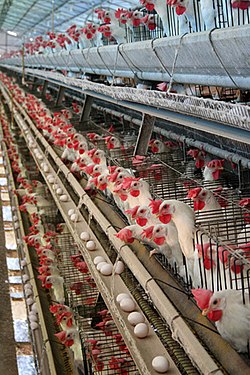
Hens in Brazil

Pigs confined to a barn in an intensive system, Midwestern United States

Beef cattle on a feedlot in the Texas Panhandle. Such confinement creates more work for the farmer but allows the animals to grow rapidly.

Diagram of feedlot system. This can be contrasted with more traditional grazing systems.

Blue mussels cultivated in proximity to Atlantic salmon in the Bay of Fundy, Canada