Expressionism
Expressionism prioritizes the "inner world," distorting the physical landscape to reveal raw emotional truth.
Expressionism prioritizes the "inner world," distorting the physical landscape to reveal raw emotional truth.
Unlike Impressionism, which sought to capture how light hit an object, Expressionism is interested in how an object hits the soul. The movement radically distorts reality—using jarring colors and agitated brushwork—not to depict a scene, but to evoke a specific mood or idea. It is a "subjective perspective" where the artist’s emotional response to the world is more "real" than the physical world itself.
This approach was a direct reaction against the "dehumanizing" effects of industrialization and the rapid growth of cities in the early 20th century. By rejecting the ideology of realism, artists sought to reclaim their individuality. As art historian Antonin Matějček noted, the Expressionist "rids the world of all substantial accretions" to produce a clear essence of a feeling through a visual "shorthand."
The movement was fueled by a diverse intellectual lineage, ranging from Nietzsche’s philosophy to Freud’s psychoanalysis.
The movement was fueled by a diverse intellectual lineage, ranging from Nietzsche’s philosophy to Freud’s psychoanalysis.
Expressionism didn't emerge in a vacuum; it was the visual byproduct of a massive shift in Western thought. The "precursors" were a mix of tortured painters and provocative thinkers. The German philosopher Friedrich Nietzsche provided the intellectual fire, while Sigmund Freud provided the map of the subconscious. Figures like Edvard Munch and Vincent van Gogh provided the visual proof that art could be "restless" and "tragic" without losing its power.
These influences helped the movement expand beyond painting into poetry, literature, theatre, and film. The common thread was a sense of angst and a rejection of "positivism"—the idea that everything can be explained by science and logic. Instead, Expressionism embraced the "complex psychic structures" of the human experience, finding beauty in the violently unpleasant.
Two German collectives, Die Brücke and Der Blaue Reiter, codified the movement through "jarring" aesthetics and spiritual abstraction.
Two German collectives, Die Brücke and Der Blaue Reiter, codified the movement through "jarring" aesthetics and spiritual abstraction.
The movement found its strongest footing in two distinct German groups. Die Brücke (The Bridge), founded in Dresden in 1905, sought to create a bridge to the "art of the future" by using primitive, raw styles and arbitrary colors. Later, in 1911, Der Blaue Reiter (The Blue Rider) formed in Munich. Led by Wassily Kandinsky, this group pushed toward abstraction, believing that simple shapes and colors could directly communicate feelings to a spectator's soul.
While these groups were short-lived, their impact was permanent. They moved away from "pleasing" the viewer, opting instead for powerful, dynamic compositions that forced an emotional reaction. Their work was later labeled "Degenerate Art" by the Nazi regime in the 1930s, which ironically helped drive the style's popularity in the United States as a symbol of cultural resistance.
The School of Paris transformed Expressionism into a vehicle for documenting Jewish identity and human tragedy.
The School of Paris transformed Expressionism into a vehicle for documenting Jewish identity and human tragedy.
As the movement moved toward France, it took on a more figurative and humanistic tone. Centered in the Montparnasse district, a group of foreign-born Jewish artists—including Chaim Soutine and Marc Chagall—formed the "School of Paris." Their brand of Expressionism was characterized by a "restless" energy, often focusing on the human face to evoke deep empathy.
Critics have noted that this specific branch of Expressionism was often dramatic and tragic, likely reflecting the history of Jewish suffering and persecution. Unlike the Baroque style, which remained "well-mannered" even when depicting drama, this Parisian Expressionism was described as throwing "terrific 'fuck yous'" at the viewer, refusing to shun the unpleasant aspects of existence.
After World War II, the movement evolved from a German "rebel" style into the foundation for global Modernism.
After World War II, the movement evolved from a German "rebel" style into the foundation for global Modernism.
Though Expressionism declined in Germany during the 1930s due to political suppression, it experienced a massive rebirth in the United States after 1945. The influx of European refugees in New York City transformed the American art scene, leading to the birth of Abstract Expressionism. This new evolution took the original German "inner world" philosophy and expanded it onto massive canvases where the act of painting itself became the expression.
This legacy continued through various "Figurative Expressionist" movements in Boston, the Bay Area, and Europe. Today, the movement is seen as a pivotal bridge between the representational art of the past and the complete abstraction of the modern era, proving that the "subjective emotion" of the artist is a universal language.

Image from Wikipedia

Ernst Ludwig Kirchner, Czardas Dancers, oil on canvas, 1908/1920, Kunstmuseum Den Haag

El Greco View of Toledo, 1595/1610 is a Mannerist precursor of 20th-century expressionism.

Käthe Kollwitz, Woman with Dead Child, 1903, etching, Museum of Modern Art

Alvar Cawén, Sokea soittoniekka (Blind Musician), 1922

Franz Marc, Rehe im Walde (Deer in Woods), 1914

Ernst Ludwig Kirchner, Nollendorfplatz, 1912

August Macke, Lady in a Green Jacket, 1913

Franz Marc, Fighting Forms, 1914

Ernst Ludwig Kirchner, Self-Portrait as a Soldier, 1915

Chaïm Soutine - Vue de Céret 1922

Chaim Soutine - Carcass of Beef c. 1925
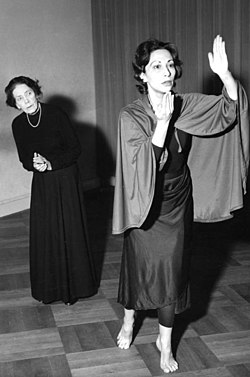
Mary Wigman, pioneer of Expressionist dance (left) at her West Berlin studio in 1959

Einsteinturm in Potsdam