Existentialism
Individuals create their own identity because existence arrives before any pre-defined purpose.
Individuals create their own identity because existence arrives before any pre-defined purpose.
Traditional philosophy often argued that things have an "essence"—a blueprint or purpose—before they ever exist. Existentialism flips this: humans are born ("surage up in the world") as blank slates without a pre-ordained manual. Jean-Paul Sartre’s famous phrase, "existence precedes essence," means that you are not born a hero, a coward, or a waiter; you define yourself through a lifetime of specific, deliberate actions.
This radical freedom brings a heavy burden of responsibility. If there is no biological or divine script to follow, you cannot blame your temperament, your genes, or "human nature" for your choices. Existentialists view "bad faith" as the act of lying to oneself by pretending these external factors dictate one's life. To be authentic is to own your choices entirely, recognizing that you are the sole architect of your values.
The movement emerged as a rebellion against abstract systems, prioritizing raw human experience over academic logic.
The movement emerged as a rebellion against abstract systems, prioritizing raw human experience over academic logic.
Existentialism isn't just a set of rules; it's a "general approach" that rejects the cold, systematic philosophies of the 19th century. Figures like Kierkegaard and Nietzsche felt that traditional academic thinking was too detached from the messy, concrete reality of being alive. They were less interested in "What is the Good?" and more consumed by the visceral struggle of "What is my life for?"
While the term was coined in the 1940s by Gabriel Marcel, the roots go back to 19th-century thinkers who grappled with the "problem of meaning" in an increasingly secularizing Europe. It eventually evolved into a massive cultural movement in post-WWII France, influencing everything from the gritty novels of Albert Camus to the "theater of the absurd," because it spoke directly to a generation that had seen traditional social and moral structures collapse.
The "Absurd" is the collision between our hunger for human meaning and a universe that offers none.
The "Absurd" is the collision between our hunger for human meaning and a universe that offers none.
The concept of the Absurd isn't just about weirdness; it's a specific tension between the human mind’s desperate search for order and the world’s "unreasonable silence." For Albert Camus, the world isn't absurd on its own, and humans aren't absurd on their own—the absurdity only appears when the two meet. It is the realization that the universe is indifferent to our moral categories of "fairness" or "justice."
Faced with this meaninglessness, one might be tempted by "quietism" or despair. Camus famously argued that suicide is the only truly serious philosophical problem: if life has no inherent meaning, is it worth living? The existentialist answer is a defiant "yes." By persevering in the face of the Absurd without succumbing to false hope or self-destruction, the individual becomes an "absurd hero," creating meaning through the very act of living.
"Facticity" provides the raw data of our lives, but our freedom dictates how we interpret it.
"Facticity" provides the raw data of our lives, but our freedom dictates how we interpret it.
You did not choose your birthplace, your parents, or the body you inhabit—this is what Heidegger called being "thrown into the world" and what Sartre called "facticity." These are the fixed facts of your past and your physical reality. However, existentialism argues that while you cannot change these facts, you are entirely free to choose the meaning you assign to them.
An authentic life requires a delicate balance: you cannot ignore your facticity (that would be living in a fantasy), but you must not let it determine your future. A person who blames their criminal past for their present crimes is denying their freedom. Conversely, someone who only dreams of the future without acknowledging their current limitations is equally inauthentic. Freedom exists in the gap between what you are (facticity) and what you will become (transcendence).
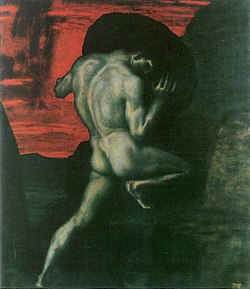
Sisyphus, the symbol of the absurdity of existence, painting by Franz Stuck (1920)

French philosophers Jean-Paul Sartre and Simone de Beauvoir

French philosopher, novelist, and playwright Albert Camus

Adolphe Menjou (left) and Kirk Douglas (right) in Paths of Glory (1957)

First edition of The Trial by Franz Kafka (1925)