Electromagnetism
Electricity and magnetism are not separate forces, but two sides of the same relativistic coin.
Electricity and magnetism are not separate forces, but two sides of the same relativistic coin.
For most of human history, lightning and lodestones were seen as unrelated mysteries. We now know that they are manifestations of a single electromagnetic field. The distinction between "electric" and "magnetic" depends entirely on your frame of reference: what looks like a pure electric field to a stationary observer will appear as a magnetic field to someone moving past it.
This interaction is one of the four fundamental forces of nature. While gravity governs the stars, electromagnetism governs our immediate world. It is the dominant force in the interactions of atoms and molecules, operating through the exchange of photons—discrete packets of energy that act as the messengers of the electromagnetic force.
Electromagnetism is the "glue" that makes chemistry, biology, and solid matter possible.
Electromagnetism is the "glue" that makes chemistry, biology, and solid matter possible.
Though we think of it in terms of wires and batteries, electromagnetism is the primary architect of the physical world. The attraction between atomic nuclei and electrons holds atoms together, while the shared forces between those atoms allow them to bond into molecules and complex proteins. Without this force, matter would have no structure, and life would be impossible.
Even the sensation of "touch" is an electromagnetic illusion. When you push against a wall, the atoms in your hand aren't actually touching the atoms in the wall; instead, the electromagnetic fields of the electrons in both surfaces are repelling each other. This "contact force," along with friction and air resistance, is simply a macroscopic manifestation of microscopic electromagnetic repulsion.
A series of 19th-century experiments collapsed 2,000 years of mystery into four elegant equations.
A series of 19th-century experiments collapsed 2,000 years of mystery into four elegant equations.
The path to understanding began with a "happy accident" in 1820, when Hans Christian Ørsted noticed a compass needle twitching near a live wire. This proved that electricity creates magnetism. Shortly after, Michael Faraday showed the reverse: moving a magnet near a wire creates electricity. These discoveries shattered the old view that these were separate phenomena.
The era culminated in the 1860s with James Clerk Maxwell, who unified these observations into a set of four partial differential equations. Maxwell’s math didn’t just explain known behavior; it predicted the existence of self-sustaining electromagnetic waves. He realized that these waves traveled at the exact speed of light, leading to the world-changing insight that light itself is an electromagnetic wave.
Maxwell’s math broke classical physics, forcing Einstein to reinvent our understanding of time and space.
Maxwell’s math broke classical physics, forcing Einstein to reinvent our understanding of time and space.
In the late 1800s, physics faced a crisis: Maxwell’s equations showed the speed of light was constant, which contradicted the established rules of classical mechanics. If you were on a moving train, light shouldn't "speed up" relative to you; it stays the same. This paradox suggested that either Maxwell was wrong or our understanding of motion was flawed.
Albert Einstein chose the latter. By trusting the math of electromagnetism over classical intuition, he developed the Theory of Special Relativity in 1905. This shift replaced the idea of a fixed "ether" in space with a universe where time and space are flexible, but the speed of light—determined by the electromagnetic properties of a vacuum—is the ultimate universal limit.
Despite its maturity, the theory still faces gaps regarding "lone" magnetic poles and biological sensors.
Despite its maturity, the theory still faces gaps regarding "lone" magnetic poles and biological sensors.
Classical electromagnetism is nearly "solved," yet several stubborn mysteries remain. Chief among them is the absence of magnetic monopoles. In electricity, you can have a lone positive or negative charge, but in magnetism, every North pole always comes with a South pole. If you cut a magnet in half, you simply get two smaller magnets. Why nature forbids a lone magnetic charge remains an open question.
Furthermore, we are still uncovering how biology interacts with these fields. While we use electromagnetism to power our entire modern infrastructure—from fiber optics to electric motors—we do not fully understand the mechanism by which certain organisms "sense" the Earth's magnetic field for navigation, or exactly where electromagnetic field energy is stored in space.

Electromagnetic interactions are responsible for the glowing filaments in this plasma globe.
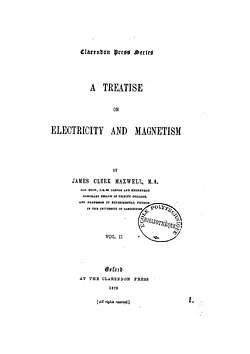
Cover of A Treatise on Electricity and Magnetism