Electromagnetic spectrum
The spectrum is a single, continuous phenomenon categorized by human labels rather than physical boundaries.
The spectrum is a single, continuous phenomenon categorized by human labels rather than physical boundaries.
Everything from the radio waves carrying your Wi-Fi signal to the X-rays at the dentist is the same fundamental "stuff": electromagnetic radiation. It consists of photons—packets of energy—traveling as oscillating electric and magnetic fields at the speed of light.
While we divide the spectrum into distinct bands like "microwave" or "infrared," these are arbitrary human constructs. In nature, there are no hard lines; the spectrum is a smooth, infinite gradient. We only distinguish them because our technology and our bodies interact with different frequencies in different ways.
The inverse relationship between wavelength and frequency determines whether radiation is a gentle wave or a dangerous bullet.
The inverse relationship between wavelength and frequency determines whether radiation is a gentle wave or a dangerous bullet.
Energy is tied directly to frequency. Low-energy radio waves can have wavelengths longer than a skyscraper, passing harmlessly through your body without a trace. At the opposite end, Gamma rays have wavelengths smaller than an atomic nucleus and pack enough concentrated energy to shatter DNA molecules.
This scale creates the "ionizing" divide. Waves above the visible light threshold—specifically high-frequency UV, X-rays, and Gamma rays—have enough energy to knock electrons off atoms. Below this line, in the "non-ionizing" range (including visible light and radio), the radiation generally lacks the punch to cause such chemical damage, usually only causing molecules to vibrate or rotate, which we perceive as heat.
Our "visible light" is a narrow biological accident tuned to the Sun’s peak output and Earth's atmospheric clarity.
Our "visible light" is a narrow biological accident tuned to the Sun’s peak output and Earth's atmospheric clarity.
The rainbow of colors we see represents less than one-trillionth of the known electromagnetic spectrum. We evolved to perceive this specific sliver because it is where the Sun emits its most intense radiation and where Earth’s atmosphere is most transparent. To us, it is "light"; to the rest of the universe, it is a tiny, unremarkable flicker.
Other organisms live in different "realities." Bees see ultraviolet patterns on flowers that guide them to nectar, while pit vipers possess "pit organs" that allow them to "see" the infrared heat signatures of prey in total darkness. Our visual experience is not a complete picture of the world, but a filtered subset optimized for survival on a specific planet.
The atmosphere acts as a selective filter, blocking most of the universe while leaving narrow "windows" for life and science.
The atmosphere acts as a selective filter, blocking most of the universe while leaving narrow "windows" for life and science.
If our eyes could see all frequencies, the sky would look like a solid wall. Earth’s atmosphere is opaque to most of the spectrum, shielding us from the lethal X-rays and Gamma rays pouring out of deep space. However, it is almost perfectly transparent to visible light and certain radio frequencies.
This "atmospheric window" dictated the history of astronomy. For centuries, we could only study what we could see. It wasn't until we launched telescopes like the Hubble and James Webb into orbit—above the "soup" of our atmosphere—that we could finally see the infrared glow of the first stars or the high-energy X-ray outbursts of black holes.
Humanity has "colonized" the spectrum, treating invisible frequencies like high-value real estate.
Humanity has "colonized" the spectrum, treating invisible frequencies like high-value real estate.
Modern civilization operates on a global nervous system of manipulated radiation. We use the radio window for long-distance communication and microwaves for short-range data (Wi-Fi and Bluetooth) because those specific wavelengths can penetrate walls and weather.
Because different technologies can interfere with one another if they use the same frequency, the spectrum has become a regulated resource. Governments auction off "spectral real estate" to telecommunications companies for billions of dollars. We treat empty space as a physical commodity, carved into strictly managed lanes for everything from GPS to air traffic control.
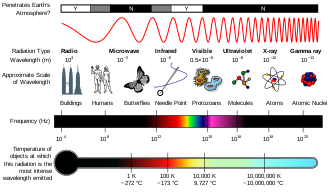
A diagram of the electromagnetic spectrum, showing various properties across the range of frequencies and wavelengths

1944 informational poster of the electromagnetic spectrum

The electromagnetic spectrum

A visualization of the electromagnetic spectrum.
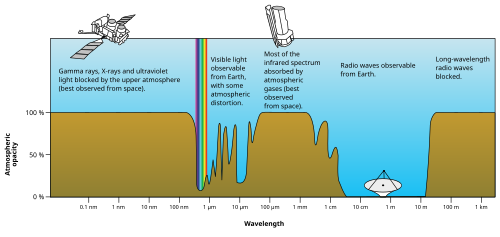
Plot of Earth's atmospheric opacity to various wavelengths of electromagnetic radiation. This is the surface-to-space opacity, the atmosphere is transparent to longwave radio transmissions within the troposphere but opaque to space due to the ionosphere.

Plot of atmospheric opacity for terrestrial to terrestrial transmission showing the molecules responsible for some of the resonances

The amount of penetration of UV relative to altitude in Earth's ozone