Education
Education evolved from tribal survival rituals into a standardized industrial machine designed for mass compliance.
Education evolved from tribal survival rituals into a standardized industrial machine designed for mass compliance.
In its earliest forms, education was informal and oral, focused on passing down the specific skills and values needed for a group to survive. As civilizations grew complex, formal systems emerged—first for elites (like the scribes of Egypt or philosophers of Greece) and later for the clergy. It wasn't until the Industrial Revolution that "mass schooling" was invented. The goal wasn't just literacy; it was to produce a disciplined workforce capable of following schedules and repetitive instructions.
Today, we still live with this "factory model," characterized by bells, age-based cohorts, and standardized testing. While this system successfully raised global literacy rates to over 86%, it is increasingly criticized for stifling the creativity and critical thinking required in a post-industrial economy.
Formal schooling follows a rigid global hierarchy, yet the most critical cognitive development happens before the first bell rings.
Formal schooling follows a rigid global hierarchy, yet the most critical cognitive development happens before the first bell rings.
The modern educational "ladder" is remarkably consistent worldwide: primary school builds foundational literacy, secondary school introduces specialized subjects, and tertiary (higher) education prepares individuals for professional life. However, neuroscientists and economists now agree that the "Early Childhood" stage—preschool and kindergarten—offers the highest return on investment. The brain's plasticity in these early years forms the architecture for all future learning.
Despite the prestige of universities, many developed nations are shifting focus toward vocational and technical education. This "dual system" (popular in countries like Germany) recognizes that academic degrees aren't the only path to high-value skills, blending classroom theory with on-the-job apprenticeships to close the gap between schooling and employment.
Effective pedagogy has shifted from "the sage on the stage" to the science of active inquiry.
Effective pedagogy has shifted from "the sage on the stage" to the science of active inquiry.
For centuries, teaching was synonymous with rote memorization and lectures. Modern pedagogy, however, treats the learner as an active participant rather than a passive vessel. Approaches like the Montessori method or Waldorf education emphasize self-directed learning and physical interaction with the environment. These methods rely on "scaffolding"—the process of providing just enough support for a student to reach the next level of understanding on their own.
The focus is moving toward "meta-learning"—teaching students how to learn. In an age where information is infinite and free, the value of knowing a fact is lower than the value of knowing how to verify, synthesize, and apply that fact to a novel problem.
Education acts as both a primary engine for social mobility and a mechanism for entrenching inequality.
Education acts as both a primary engine for social mobility and a mechanism for entrenching inequality.
On an individual level, education is the most reliable predictor of lifetime earnings and health outcomes. Collectively, "human capital" is what drives national GDP; a more educated workforce is more innovative and efficient. This is why many nations treat education as a fundamental human right and a public good, funded by the state to ensure a baseline of opportunity for all citizens.
However, a "digital divide" and "credential inflation" have created new barriers. In many societies, the quality of education is tied to geography and wealth, meaning the system often replicates existing social hierarchies rather than dismantling them. When a college degree becomes a basic requirement for entry-level work, those who cannot afford the time or tuition are effectively locked out of the middle class.
The digital frontier is deconstructing the traditional classroom in favor of decentralized, AI-driven lifelong learning.
The digital frontier is deconstructing the traditional classroom in favor of decentralized, AI-driven lifelong learning.
We are currently in the midst of the most significant shift since the invention of the printing press. Educational Technology (EdTech) and Open Educational Resources (OER) have unbundled the university; a student in a remote village can now access the same MIT or Stanford lectures as a local resident. The "flipped classroom" model—where students watch lectures at home and do "homework" (active problem-solving) in class—is gaining traction.
Looking forward, Artificial Intelligence is moving education toward radical personalization. Instead of a single teacher managing 30 students at once, AI tutors can adapt in real-time to a student's specific pace, strengths, and frustrations. This marks a transition from "time-based" education (where you move on when the semester ends) to "competency-based" education (where you move on only when you’ve actually mastered the material).

Education is a wide phenomenon that applies to all age groups and covers formal education (top row) as well as non-formal and informal education (bottom row).

Tutoring exemplifies non-formal education, whereas learning how to cook from one's parents falls under informal education.

Children in a Japanese kindergarten

Primary school classroom in Ethiopia

A high school senior (twelfth grade) classroom in the United States

Students in a laboratory at Saint Petersburg State Polytechnical University, Russia
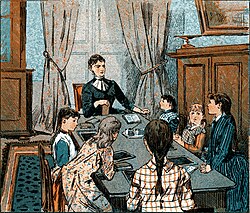
Homeschooling represents one form of alternative education.

Highly specialized professionals, such as medical researchers, often undergo extensive education to master their fields and make significant contributions to society.

Median annual salaries across educational levels varied by a factor of about 3.
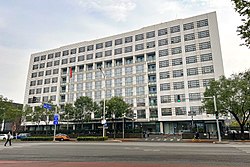
Governmental institutions such as the Chinese Ministry of Education influence numerous aspects of public education.

International organizations, such as UNESCO, have wielded significant influence in shaping educational standards and policies worldwide.
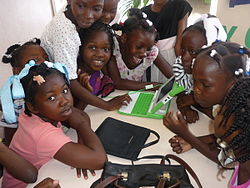
Introducing children in Haiti to a One Laptop per Child device

John Locke's book Some Thoughts Concerning Education from 1693 is a foundational work in education studies.

Comparative education utilizes tools like the Education Index to compare educational systems across various countries. High-scoring countries are depicted in green, while low-scoring ones are shown in red.

Propaganda poster in a primary school in North Korea. Authoritarian regimes frequently employ education as a tool for indoctrinating students.