East India Company
The EIC was the world’s first corporate superpower, commanding a private army twice the size of the British military.
The EIC was the world’s first corporate superpower, commanding a private army twice the size of the British military.
Founded in 1600 as a joint-stock company, the East India Company (EIC) evolved from a group of London merchants into a sovereign-like entity. At its peak, it controlled half of all world trade, specializing in commodities like cotton, silk, tea, and opium. Its scale was unprecedented; it didn't just manage warehouses, it managed territories.
To protect its interests, the Company maintained its own armed forces—the three presidency armies—which totaled approximately 260,000 soldiers. This private military force was used to exercise power, assume administrative functions, and eventually rule vast swaths of the Indian subcontinent, making the EIC the most powerful corporation in history.
British entry into the Indian market was a strategic "Plan B" forced by Dutch dominance in the spice trade.
British entry into the Indian market was a strategic "Plan B" forced by Dutch dominance in the spice trade.
The English originally targeted the "Spice Islands" (modern-day Indonesia) after Francis Drake’s 1577 expedition yielded a 5,000 percent return on investment. However, the Dutch East India Company (VOC) was better financed and more aggressive. Through superior government support and military skirmishes, the Dutch successfully established a near-monopoly in the East Indies.
This exclusion from the lucrative spice islands compelled the EIC to pivot toward mainland India. What began as a secondary trade opportunity became the cornerstone of the British Empire. After securing a major naval victory over the Portuguese at the Battle of Swally in 1612, the Company turned its full attention to building a foothold in the Mughal Empire.
The Company rose to power by acting as a humble "vassal" to the Mughal Empire before eventually replacing it.
The Company rose to power by acting as a humble "vassal" to the Mughal Empire before eventually replacing it.
The EIC’s early success in India relied on diplomatic "currying of favors" and well-placed bribes rather than raw conquest. In 1615, Sir Thomas Roe secured a commercial treaty from Mughal Emperor Jahangir by offering European rarities and "rich goods" in exchange for the right to establish factories. For nearly a century, the Company operated within the Mughal system, acting as a subservient trading partner.
This relationship changed in 1707 following the death of Emperor Aurangzeb. As the Mughal Empire fractured into anarchy and independent fiefdoms, the EIC stepped into the power vacuum. By using the existing administrative machinery and outmaneuvering local rulers through treaties and military force, the Company transitioned from a merchant group to a territorial ruler.
A massive rebellion and recurring financial instability eventually rendered the corporate state obsolete.
A massive rebellion and recurring financial instability eventually rendered the corporate state obsolete.
Despite its vast power, the Company was plagued by financial mismanagement and required frequent government interventions. Its transition from a trading company to a governing body created a "vestigial" and "powerless" structure that was increasingly difficult for the British government to justify.
The breaking point was the Sepoy Rebellion of 1857. This widespread uprising forced the British Crown to realize that a private corporation could no longer safely manage a subcontinent. Through the Government of India Act 1858, the Crown assumed direct control, absorbing the Company's armies and administrative functions. The EIC was officially dissolved in 1874, having paved the way for the formal British Raj.

Image from Wikipedia

James Lancaster commanded the first East India Company voyage in 1601

Red Dragon fought the Portuguese at the Battle of Swally in 1612, and made several voyages to the East Indies

The emperor Jahangir investing a courtier with a robe of honour, watched by Sir Thomas Roe, English ambassador to the court of Jahangir at Agra from 1615 to 1618, and others

A document with the original vermilion seal of Tokugawa Ieyasu, granting trade privileges in Japan to the East India Company in 1613
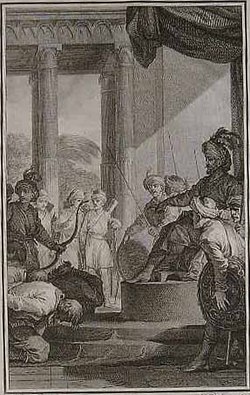
French illustration of Sir Josiah Child requesting a pardon from the Emperor Aurangzeb

English, Dutch and Danish factories at Mocha

British pirates that fought during the Child's War engaging the Ganj-i-Sawai

Depiction of Captain Every's encounter with the Mughal Emperor's granddaughter after his September 1695 capture of the Mughal trader Ganj-i-Sawai

Image from Wikipedia

Image from Wikipedia

Rear view of the East India Company's factory at Cossimbazar

Company painting depicting an official of the East India Company, c. 1760

Saltpetre used for gunpowder was one of the major trade goods of the company

The East Offering its Riches to Britannia - Roma Spiridone, 1778 - BL Foster 245