Dualism
Dualism splits reality into two fundamental, irreducible principles that are either at war or in harmony.
Dualism splits reality into two fundamental, irreducible principles that are either at war or in harmony.
At its core, dualism is the "rule of two." It rejects the idea that everything can be traced back to a single source (monism) or many sources (pluralism). Instead, it identifies a deep, unbridgeable gap between two kinds of things—like mind and matter, good and evil, or the creator and the created. While we often think of these pairs as enemies, dualism also includes "complementary" systems like Yin and Yang, where the two sides balance rather than battle.
The term itself is a relatively modern invention from the late 18th century, but the instinct is ancient. Whether it’s a legal scholar distinguishing between domestic and international law or a physicist looking at wave-particle duality, the dualist framework is a tool for organizing complexity by drawing a hard line down the middle of a domain.
The "Mind-Body" problem persists because private thoughts cannot be measured like physical objects.
The "Mind-Body" problem persists because private thoughts cannot be measured like physical objects.
The most famous application of dualism is the divide between the mental and the physical. Substance dualists, following René Descartes, argue that the mind is a "thinking thing" that doesn't occupy space, while the body is an "extended thing" that does. This suggests your consciousness could, in theory, survive the death of your body because they are made of different "stuff."
Property dualists take a softer approach, suggesting there is only one physical substance (the brain), but it possesses two entirely different types of properties. In this view, a brain state is a physical fact, but the feeling of happiness is a mental property that cannot be fully explained by looking at neurons. Both versions struggle with the same reality: mental life feels private and subjective, while the physical world feels public and objective.
The central crisis of dualism is explaining how a non-physical thought can trigger a physical action.
The central crisis of dualism is explaining how a non-physical thought can trigger a physical action.
If the mind and body are truly separate, how does the "ghost" pull the levers of the "machine"? This is the problem of interaction. If a mental desire to drink water causes your physical arm to move, energy is being introduced into a physical system from a non-physical source, which seems to violate the laws of physics.
Philosophers have proposed radical workarounds for this. "Epiphenomenalism" suggests the mind is just a useless byproduct of the brain—like the steam rising from a locomotive that doesn't actually help turn the wheels. "Parallelism" suggests the mind and body are like two clocks synchronized by God to show the same time without ever actually touching. These "solutions" highlight how difficult it is to maintain a dualist view without running into scientific contradictions.
Moral dualism transforms the universe into a cosmic battlefield between equal powers of light and dark.
Moral dualism transforms the universe into a cosmic battlefield between equal powers of light and dark.
In the realm of religion, dualism often takes an ethical turn, personifying good and evil as rival forces. In Zoroastrianism and Manichaeism, the world isn't just "flawed"; it is a literal war zone between a benevolent deity and a destructive adversary. This differs sharply from the mainstream Christian view (led by Augustine), which argues that evil isn't a "thing" at all, but merely the absence of good—much like cold is just the absence of heat.
Eastern traditions offer a third path. In Chinese Yin-Yang theory, the dualism isn't a fight to be won; it’s a balance to be maintained. In Indian Samkhya philosophy, the split is between Purusha (pure consciousness) and Prakriti (matter/nature). In these systems, the goal isn't to destroy one side, but to understand the relationship between the two to achieve liberation or harmony.

Dualism divides a domain or phenomenon into two separate principles or kinds.

Mind–body dualism regards mind and matter as fundamentally distinct substances or properties.

Ethical dualism holds that good and evil are antagonistic forces that govern human conduct and the cosmic order.

Some theological dualisms see God and the world as fundamentally distinct.

Platonic dualism distinguishes between the intelligible realm of abstract Forms and the sensory realm of concrete matter.

Epistemological dualism holds that subjectively experienced objects are distinct from real objects.

Kapila, a founding father of Samkhya
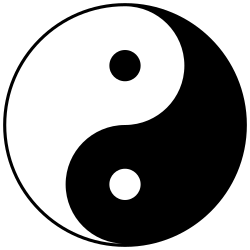
The taijitu symbol, with the black area representing yin and the white area representing yang

René Descartes proposed substance dualism, seeing mind and body as distinct substances that interact with each other.