De Stijl
De Stijl reduced visual language to a "primary" vocabulary to reveal a universal, spiritual reality.
De Stijl reduced visual language to a "primary" vocabulary to reveal a universal, spiritual reality.
Founded in 1917, the movement—Dutch for "The Style"—sought to strip art of all "natural particulars." Under the theory of Nieuwe Beelding (Neoplasticism), artists like Piet Mondrian and Bart van der Leck restricted themselves to the absolute essentials: straight horizontal and vertical lines, squares and rectangles, the three primary colors (red, yellow, blue), and the three primary values (black, white, grey).
This wasn't just a stylistic preference; it was a philosophical pursuit. By ignoring the messy, changing appearance of the natural world, De Stijl aimed to bring the viewer into contact with an "immutable core of reality." They replaced symmetry with a dynamic aesthetic balance achieved through opposition—tension between colors and lines that mirrored the spiritual harmony they believed underpinned the universe.
The movement was a decentralized "joint enterprise" held together by Theo van Doesburg’s propaganda.
The movement was a decentralized "joint enterprise" held together by Theo van Doesburg’s propaganda.
De Stijl was as much a magazine as it was an art movement. Founded by the flamboyant Theo van Doesburg, the journal De Stijl served as the primary vehicle for the group's manifestos and theories. Van Doesburg was a master networker who connected artists across the Netherlands who were isolated during World War I. At its peak, the movement had 100 members, though the journal's circulation remained tiny at roughly 300 copies.
Unlike traditional art schools, De Stijl was a collective project that mostly existed through correspondence. The movement's most famous figures, such as architect Gerrit Rietveld and painter Piet Mondrian, actually never met in person. The "group" was effectively a network of individuals aligned by a shared editorial vision rather than a physical studio or classroom.
Three-dimensional works translated rigid 2D rules into "layered" architecture and furniture.
Three-dimensional works translated rigid 2D rules into "layered" architecture and furniture.
In 3D design, De Stijl principles manifested as independent planes and lines that appeared to float or slide past one another. In the iconic Red and Blue Chair and the Rietveld Schröder House, vertical and horizontal elements are positioned in layers that do not intersect in a traditional sense. This allowed each element to exist unobstructed, creating a sense of spatial weightlessness.
This structural approach was heavily influenced by "crossing joints" in carpentry, where two pieces of wood overlap without being mitered or blended. By treating a building or a chair as a collection of primary planes, designers like Rietveld and J.J.P. Oud created a blueprint for what would eventually become the International Style and modern functionalist architecture.
A single diagonal line caused the movement’s most famous schism and the exit of Piet Mondrian.
A single diagonal line caused the movement’s most famous schism and the exit of Piet Mondrian.
The internal unity of De Stijl fractured in 1924 when Van Doesburg introduced "Elementarism." He argued that the strict horizontal-vertical axis was too static and proposed the use of diagonal lines to infuse works with "dynamic energy." For Piet Mondrian, this was a heresy that destroyed the movement's spiritual foundation; he resigned from the group in protest shortly after.
This rift highlighted the tension between De Stijl’s early mysticism and its later evolution. As Van Doesburg associated with the Bauhaus and Russian Constructivists, the movement became more experimental, incorporating Dadaist poetry (under Van Doesburg's pseudonyms) and more aggressive, "vital" geometries that moved away from the initial search for absolute stillness.
The movement’s survival was tied to Van Doesburg’s personality, collapsing immediately upon his death.
The movement’s survival was tied to Van Doesburg’s personality, collapsing immediately upon his death.
Theo van Doesburg died in 1931, and because he was the "central character" and editor, De Stijl effectively died with him. While individual members like Rietveld and Mondrian continued to work within the movement's basic aesthetic framework for the rest of their lives, the collective project vanished without its chief administrator and provocateur.
Despite its short formal lifespan, De Stijl’s DNA is embedded in modern life. Its influence migrated into the Bauhaus, the work of Mies van der Rohe, and eventually into mass-market interior design and clothing. Today, the world's largest collections of the movement's work are held in the Kunstmuseum (The Hague) and the Centraal Museum (Utrecht), which maintains the Rietveld Schröder House as a living manifesto of the style.

Theo van Doesburg, Composition VII (the three graces) 1917

De Stijl November 1921, Dadaism

Red and Blue Chair, designed by Gerrit Rietveld, version without colors 1919, version with colors 1923

The Rietveld Schröder House in Utrecht, 1924 – the only building realised completely according to the principles of De Stijl.

Piet Mondrian, Composition en couleur A, 1917, Kröller-Müller Museum

Theo van Doesburg (r) and Cornelis van Eesteren (l) in their studio in Paris, 1923

Aubette dance hall in Strasbourg, Theo van Doesburg in collaboration with Sophie Taeuber-Arp and Jean Arp, 1929
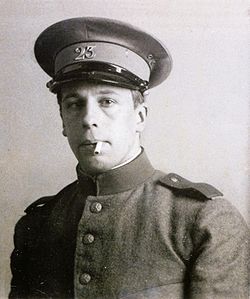
Theo van Doesburg

Piet Mondrian