Dada
Dada was a violent allergic reaction to the "rationality" that fueled the slaughter of World War I
Dada was a violent allergic reaction to the "rationality" that fueled the slaughter of World War I
Dada didn't begin in a gallery; it began in a cabaret in neutral Zurich in 1916. While Europe tore itself apart in the trenches, a group of exiles including Hugo Ball and Tristan Tzara concluded that if "logic" and "reason" had led to such industrial-scale murder, then logic and reason were the enemies. They embraced the irrational, the chaotic, and the nonsensical as the only honest response to a world gone mad.
The movement was defined more by what it hated than what it loved. It was "anti-art" in the sense that it rejected the traditional aesthetics of the bourgeoisie—the very people who were funding the war. To the Dadaists, a beautiful painting was a lie that masked a hideous reality. By performing "sound poems" that were mere gibberish or screaming at their audiences, they sought to shatter the cultural complacency of the era.
To be "Dada" was to destroy the sacred boundary between art and garbage
To be "Dada" was to destroy the sacred boundary between art and garbage
Dadaists pioneered the idea that the artist’s hand was less important than the artist’s choice. This peaked with Marcel Duchamp’s "readymades"—found objects like a bicycle wheel or a porcelain urinal (Fountain) that were declared art simply because he chose them. This was a radical pivot: art was no longer about technical mastery of oil paint or marble; it was a conceptual act of provocation.
The movement turned the debris of modern life into its medium. Hannah Höch and Raoul Hausmann invented photomontage, cutting up magazines and newspapers to create jarring, satirical critiques of government and gender roles. By using "non-art" materials—glue, trash, mass-produced photos, and noise—they democratized creation while simultaneously mocking the idea of the "masterpiece."
Each Dada hub developed its own flavor of chaos, from political rage in Berlin to playful nihilism in New York
Each Dada hub developed its own flavor of chaos, from political rage in Berlin to playful nihilism in New York
While the Zurich group focused on performance and "primitivism," the Berlin Dadaists were far more militant. Living in the collapse of the German Empire, artists like George Grosz and John Heartfield used art as a weapon against the rising tide of nationalism and the military-industrial complex. Their work was jagged, angry, and explicitly designed to incite social change.
Across the Atlantic, New York Dada was less political and more ironic. Centered around Duchamp and Francis Picabia, it focused on the absurdity of the machine age and the fluidity of identity. Meanwhile, in Paris, the movement became more literary and linguistic, eventually dissolving into internal squabbles that would birth a more structured successor: Surrealism.
Dada "succeeded" by self-destructing before it could become the establishment it despised
Dada "succeeded" by self-destructing before it could become the establishment it despised
By the early 1920s, Dada began to die of its own success. Once the movement started being featured in prestigious galleries and analyzed by serious critics, it lost its status as an outsider threat. Tristan Tzara famously remarked that "Dada is like a vitamin," meant to be absorbed and used up, not preserved in a museum. Many of its core members grew tired of pure negation and sought a more constructive way to explore the unconscious.
Though short-lived, its DNA is the foundation of almost all modern and contemporary art. Without Dada, there is no Pop Art, no Conceptualism, and no Punk Rock. It taught the world that art doesn't have to be beautiful, it doesn't have to be permanent, and it doesn't even have to be made by an "artist"—it just has to wake the viewer up.

Grand opening of the first Dada exhibition: International Dada Fair, Berlin, 5 June 1920. The central figure hanging from the ceiling is an effigy of a German officer with a pig's head. From left to right: Raoul Hausmann, Hannah Höch (sitting), Otto Burchard, Johannes Baader, Wieland Herzfelde, Margarete Herzfelde, Dr. Oz (Otto Schmalhausen), George Grosz and John Heartfield.
![Dada artists, group photograph, 1920, Paris. From left to right, Back row: Louis Aragon, Théodore Fraenkel [fr], Paul Eluard, Clément Pansaers, Emmanuel Fay (cut off). Second row: Paul Dermée, Philippe Soupault, Georges Ribemont-Dessaignes. Front row: Tristan Tzara (with monocle), Céline Arnauld, Francis Picabia, André Breton.](https://upload.wikimedia.org/wikipedia/commons/thumb/4/4f/DadaGroup-1921.png/500px-DadaGroup-1921.png)
Dada artists, group photograph, 1920, Paris. From left to right, Back row: Louis Aragon, Théodore Fraenkel [fr], Paul Eluard, Clément Pansaers, Emmanuel Fay (cut off). Second row: Paul Dermée, Philippe Soupault, Georges Ribemont-Dessaignes. Front row: Tristan Tzara (with monocle), Céline Arnauld, Francis Picabia, André Breton.

Cover of the first edition of the publication Dada, Tristan Tzara; Zürich, 1917
![Francis Picabia: left, Le saint des saints c'est de moi qu'il s'agit dans ce portrait, 1 July 1915; center, Portrait d'une jeune fille americaine dans l'état de nudité, 5 July 1915; right, J'ai vu et c'est de toi qu'il s'agit, De Zayas! De Zayas! Je suis venu sur les rivages du Pont-Euxin, New York, 1915[clarification needed]](https://upload.wikimedia.org/wikipedia/commons/thumb/8/89/Francis_Picabia%2C_1915%2C_New_York..jpg/500px-Francis_Picabia%2C_1915%2C_New_York..jpg)
Francis Picabia: left, Le saint des saints c'est de moi qu'il s'agit dans ce portrait, 1 July 1915; center, Portrait d'une jeune fille americaine dans l'état de nudité, 5 July 1915; right, J'ai vu et c'est de toi qu'il s'agit, De Zayas! De Zayas! Je suis venu sur les rivages du Pont-Euxin, New York, 1915[clarification needed]

Francis Picabia, Dame! Illustration for the cover of the periodical Dadaphone, n. 7, Paris, March 1920

Hannah Höch, Cut with the Kitchen Knife through the Last Epoch of Weimar Beer-Belly Culture in Germany, 1919, collage of pasted papers, 90×144 cm, Nationalgalerie, Staatliche Museen zu Berlin

Cover of Anna Blume, Dichtungen, 1919

Rrose Sélavy, the alter ego of Dadaist Marcel Duchamp
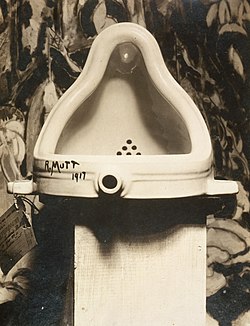
Marcel Duchamp, Fountain, 1917; photograph by Alfred Stieglitz

Man Ray, c. 1921–22, Rencontre dans la porte tournante, published on the cover of Der Sturm, Volume 13, Number 3, 5 March 1922

Man Ray, c. 1921–22, Dessin (Drawing), published on page 43 of Der Sturm, Volume 13, Number 3, 5 March 1922

A Bonset sound-poem, "Passing troop", 1916

Dada, an iconic character from the Ultra Series. His design draws inspiration from the art movement.

Dadaglobe solicitation form letter signed by Francis Picabia, Tristan Tzara, Georges Ribemont-Dessaignes, and Walter Serner, c. week of November 8, 1920. This example was sent from Paris to Alfred Vagts in Munich.

The Janco Dada Museum, named after Marcel Janco, in Ein Hod, Israel