Normandy landings
The invasion was a logistical "Hail Mary" designed to break the stalemate of Fortress Europe.
The invasion was a logistical "Hail Mary" designed to break the stalemate of Fortress Europe.
By 1944, Nazi Germany had spent years fortifying the Atlantic Wall, a 1,600-mile system of coastal defenses. The Allies faced a binary choice: either launch a massive, high-risk amphibious assault or allow the Soviet Union to potentially liberate—and occupy—the entire continent alone. Operation Neptune was the naval component of this gamble, requiring the coordination of nearly 7,000 vessels and 2 million tons of supplies.
The success of the landings depended on a narrow "weather window" and absolute secrecy. General Dwight D. Eisenhower had to balance the moon phase (for paratrooper visibility) and the tide (to expose German beach obstacles). When the weather turned foul, Eisenhower made the gut-wrenching decision to go on June 6 during a brief break in the storm, knowing that a delay would push the invasion back by weeks and risk discovery.
A massive "Ghost Army" of inflatable tanks and fake radio chatter kept the German Panzers idle.
A massive "Ghost Army" of inflatable tanks and fake radio chatter kept the German Panzers idle.
The landings succeeded as much through psychological warfare as through firepower. Under the umbrella of Operation Bodyguard, the Allies created a fictional military unit, the First U.S. Army Group (FUSAG), purportedly led by the feared General George S. Patton. They used inflatable decoys, dummy camps, and constant fake radio traffic to convince Hitler that the Normandy landings were merely a diversion for a "real" invasion at Pas-de-Calais.
The deception was so effective that even as Allied troops were storming the beaches on June 6, the German High Command held back critical armored divisions in the north. They were convinced that the Normandy operation was a feint. By the time they realized the truth, the Allies had established a permanent foothold that could no longer be pushed back into the sea.
Special engineering "Funnies" and artificial harbors solved the problem of invading a coast without a port.
Special engineering "Funnies" and artificial harbors solved the problem of invading a coast without a port.
Military doctrine stated that a large-scale invasion required capturing a deep-water port immediately. However, the German defense of ports was impenetrable. To bypass this, the Allies brought their own ports with them. Known as "Mulberry harbors," these were massive, prefabricated concrete caissons towed across the English Channel and sunk to create instant breakwaters and piers.
On the sand, the British deployed "Hobart’s Funnies"—specialized tanks designed for specific obstacles. There were tanks that unrolled "carpets" over soft sand, tanks with rotating chains to explode mines (Flails), and tanks that carried bridges. These technical innovations significantly reduced casualties on the British and Canadian beaches, whereas the Americans at Omaha Beach, who lacked many of these tools, faced a much more brutal slog.
Omaha Beach became a "near-disaster" due to a perfect storm of intelligence failures and terrain.
Omaha Beach became a "near-disaster" due to a perfect storm of intelligence failures and terrain.
While the landings at Utah, Gold, Juno, and Sword were relatively successful, Omaha Beach turned into a slaughterhouse. Allied intelligence had missed the fact that a high-quality German infantry division had recently moved into the sector. Additionally, the pre-landing aerial bombardment missed its targets entirely due to heavy cloud cover, leaving the German pillboxes intact and overlooking the "draws" (exits) from the beach.
U.S. troops were pinned down at the water's edge under blistering crossfire, and for several hours, commanders considered abandoning the beach entirely. The situation was only saved by small, decentralized groups of soldiers and junior officers who ignored their original plans and scaled the bluffs directly, bypassing the heavily defended exits. It remains the most iconic and lethal example of the friction and "fog of war" inherent in the operation.
The successful breach shattered the myth of Nazi invincibility and forced a two-front war.
The successful breach shattered the myth of Nazi invincibility and forced a two-front war.
The Normandy landings did not end the war instantly, but they made a German victory impossible. By establishing a "Second Front," the Allies forced the German military to split its dwindling resources between the advancing Soviets in the East and the Western Allies in the West. This diluted the effectiveness of the Luftwaffe and the Panzer divisions, which could no longer focus on a single line of defense.
Beyond the strategic gain, D-Day was a psychological turning point. It signaled to occupied Europe that liberation was a physical reality rather than a distant hope. For the German leadership, the failure to "throw the Allies back into the sea" on the first day led to internal fractures, including an assassination attempt on Hitler just weeks later by officers who realized the war was strategically lost.
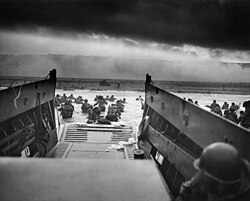
Image from Wikipedia

Meeting of the Supreme Headquarters Allied Expeditionary Force (SHAEF), 1 February 1944. Front row: Air Chief Marshal Sir Arthur Tedder; General Dwight D. Eisenhower; General Sir Bernard Montgomery. Back row: Lieutenant General Omar Bradley; Admiral Sir Bertram Ramsay; Air Chief Marshal Sir Trafford Leigh-Mallory; Lieutenant General Walter Bedell Smith.

Shoulder patches were designed for units of the fictitious First United States Army Group under George Patton.

Surface weather analysis map showing weather fronts on 5 June
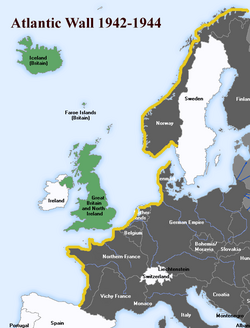
Map of the Atlantic Wall, shown in yellow Axis and occupied countries Allies and occupied countries Neutral countries
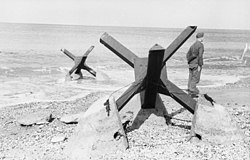
Czech hedgehogs deployed on the Atlantic Wall near Calais

D-day assault routes into Normandy

Royal Marine Commandos attached to 3rd Infantry Division move inland from Sword Beach, 6 June 1944. An armoured bridgelayer tank is in the background
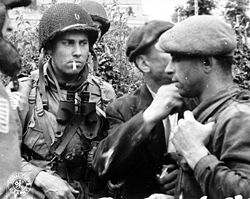
Members of the French Resistance and the US 82nd Airborne division during the Battle of Normandy in 1944.

D-Day planning map, used at Southwick House near Portsmouth

Large landing craft convoy crosses the English Channel on 6 June 1944

Map of the invasion area showing channels cleared of mines, location of vessels engaged in bombardment, and targets on shore

Gliders delivered reinforcements to the Cotentin Peninsula towed by Douglas C-47 Skytrains on the evening of 6 June 1944

A destroyed Waco CG-4 glider is examined by German troops

Map of the beaches and first day advances