Cuban Missile Crisis
The crisis was an attempt to bridge a massive nuclear "missile gap" that heavily favored the United States.
The crisis was an attempt to bridge a massive nuclear "missile gap" that heavily favored the United States.
While Nikita Khrushchev publicly boasted that the Soviet Union was churning out missiles "like sausages," the reality was a stark asymmetry of power. In 1962, the U.S. held a crushing advantage with 170 ICBMs against the Soviets' four. American nuclear missiles in Italy and Turkey were already within striking range of Moscow, while Soviet technology was largely unreliable and lacked the range to hit the contiguous United States from Russian soil.
Placing medium-range missiles in Cuba was a strategic shortcut. It allowed the USSR to achieve "mutual assured destruction" without the years of development required to catch up in ICBM technology. By moving existing weapons closer to the target, Khrushchev sought to right the nuclear imbalance overnight, transforming Cuba into a stationary aircraft carrier that neutralized the American geographical advantage.
A relentless U.S. campaign of sabotage and failed invasion forced Castro into a defensive pact with the Soviets.
A relentless U.S. campaign of sabotage and failed invasion forced Castro into a defensive pact with the Soviets.
The crisis was not merely a chess move between superpowers; it was a response to the existential threat felt by the Cuban government. Following the failed Bay of Pigs invasion in 1961, the Kennedy administration escalated "Operation Mongoose," a top-secret campaign of terrorism, economic sabotage, and assassination attempts designed to topple Fidel Castro. U.S. planners even had a timetable for an "open revolt" and overthrow of the regime set for October 1962.
Initially, Castro was hesitant to host nuclear weapons, but he accepted them as the only definitive deterrent against a full-scale American invasion. For the Soviets, the pact also served a secondary diplomatic purpose: preventing Cuba from drifting toward China’s sphere of influence. By installing the missiles, the USSR solidified its role as the primary protector of the Cuban Revolution, ensuring Cuba remained a loyal member of the Socialist Bloc.
Khrushchev intended to use the Cuban missiles as leverage to force the West out of Berlin.
Khrushchev intended to use the Cuban missiles as leverage to force the West out of Berlin.
Beyond the defense of Cuba, the Soviet leadership viewed the Caribbean deployment as a bargaining chip for the "central battlefield" of the Cold War: West Berlin. Khrushchev believed that if the U.S. discovered the missiles and did nothing, it would signal a lack of resolve that he could exploit to seize control of the divided German city. If the U.S. did object, he planned to offer a trade: Soviet missiles out of Cuba in exchange for the Western powers exiting Berlin.
Kennedy recognized this trap immediately. He noted that from Khrushchev’s perspective, the risk was high but the rewards were immense. Berlin was strategically more vital to Europe’s stability than Cuba was to the Western Hemisphere; by threatening the latter, Khrushchev hoped to win the former without firing a single shot.
The "Quarantine" was a calculated semantic trick designed to avoid an immediate declaration of war.
The "Quarantine" was a calculated semantic trick designed to avoid an immediate declaration of war.
When U-2 spy planes captured evidence of the missile sites, Kennedy’s advisors (EXCOMM) initially pushed for an immediate air strike followed by an invasion. Kennedy chose a middle path, ordering a naval blockade to stop further Soviet shipments. Crucially, he refused to call it a "blockade," which is an act of war under international law. Instead, he termed it a "quarantine."
This linguistic distinction allowed the U.S. to exert military pressure while leaving the Soviets "maneuvering room" to retreat without losing face. It was a masterpiece of crisis management: it halted the build-up of weapons while avoiding the legal and military triggers that would have made a nuclear exchange inevitable. The 13-day standoff ended not with a bang, but with a complex, high-stakes negotiation.
The resolution was a public victory for the United States that cost Khrushchev his political career.
The resolution was a public victory for the United States that cost Khrushchev his political career.
The deal that ended the crisis had two parts: a public agreement and a secret one. Publicly, the Soviets would dismantle their missiles in exchange for a U.S. pledge never to invade Cuba. Secretly, Kennedy agreed to remove American Jupiter missiles from Turkey. Because the Turkey deal was kept hidden to protect Kennedy’s "tough" image, the world saw the resolution as a total Soviet retreat.
This perceived humiliation crippled Khrushchev’s standing within the Kremlin. The Soviet Politburo viewed his actions as inept, first for precipitating the crisis and then for "backing down" to a younger, seemingly weaker president. This loss of prestige was a primary factor in Khrushchev's ousting from power two years later. Conversely, the "close call" led to the creation of the Moscow–Washington hotline, a direct communication link intended to prevent future misunderstandings from escalating into Armageddon.

Image from Wikipedia

An image of the Kennedy administration's plans for the Bay of Pigs Invasion

John F. Kennedy (1917–1963) and Nikita Khrushchev (1894–1971) in Vienna, Austria in May 1961

Fifteen US-built PGM-19 Jupiter missiles, with the capability to strike Moscow with nuclear warheads, were deployed in Turkey in 1961.

The relative ranges of the Il-28, SS-4, and SS-5 based on Cuba in nautical miles (NM)

Map created by American intelligence showing all known Surface-to-Air Missile activity in Cuba, 5 September 1962
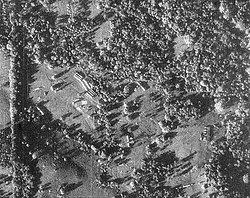
A U-2 reconnaissance photograph of Cuba, showing Soviet nuclear missiles, their transports and tents for fueling and maintenance

One of the first U-2 reconnaissance images of missile bases under construction shown to President Kennedy on the morning of 16 October 1962

President Kennedy meets in the Oval Office with General Curtis LeMay and the reconnaissance pilots who found the missile sites in Cuba.

Game tree models how the US and the Soviet Union would have considered their decisions

President Kennedy and Secretary of Defense McNamara in an EXCOMM meeting, 29 October 1962

President Kennedy meets in the Oval Office with Soviet Foreign Minister Andrei Gromyko, 18 October 1962.

A US Navy P-2H Neptune of VP-18 flying over a Soviet cargo ship with crated Il-28s on deck during the Cuban Crisis

President Kennedy signing the Proclamation for Interdiction of the Delivery of Offensive Weapons to Cuba at the Oval Office on 23 October 1962.

Adlai Stevenson shows aerial photos of Cuban missiles to the United Nations, 25 October 1962.