Columbian exchange
A 1972 book by Alfred Crosby reframed world history as an ecological and biological merger rather than just a political one.
A 1972 book by Alfred Crosby reframed world history as an ecological and biological merger rather than just a political one.
Before historian Alfred W. Crosby coined the term "Columbian exchange," the study of the post-1492 world focused largely on European conquest and statecraft. Crosby’s work shifted the focus to the "biological and cultural transfers" between the Old and New Worlds. He argued that the movement of seeds, animals, and germs was the most significant force in shaping the modern world, a concept he later expanded upon as "Ecological Imperialism."
This exchange was not a single event but a permanent shift in the planet's ecology. While humans had crossed from Siberia thousands of years prior, those populations remained biologically isolated. The 1492 voyage broke this isolation, triggering an "interchange" where some species were moved deliberately for profit, while others—like weeds and pathogens—hitchhiked across the Atlantic, forever altering the biodiversity of both hemispheres.
New World crops like potatoes and maize triggered a global population explosion while Old World staples reshaped American landscapes.
New World crops like potatoes and maize triggered a global population explosion while Old World staples reshaped American landscapes.
The introduction of American "super-crops" radically improved nutrition across Afro-Eurasia. The potato, native to South America, became a staple that supported an estimated 12% to 25% of the population growth in the Old World between 1700 and 1900. Similarly, cassava (manioc) migrated from South America to Africa, eventually replacing traditional grains like sorghum as the continent’s most vital food source.
In reverse, the Old World exported its own biological toolkit to the Americas. Rice, wheat, sugar cane, and coffee were introduced to New World soils. While these crops thrived, they also drove the creation of the plantation system. Because crops often traveled without their native pests or fungi—a phenomenon called a "yield honeymoon"—they initially produced massive harvests, fueling the economic engine of European colonization.
The introduction of Eurasian livestock fundamentally altered Indigenous mobility and transformed the ecology of the Americas.
The introduction of Eurasian livestock fundamentally altered Indigenous mobility and transformed the ecology of the Americas.
Before 1492, the Americas had very few large domestic animals, primarily dogs, llamas, and turkeys. The arrival of horses, cattle, pigs, and sheep from Europe revolutionized transport, hunting, and diet. The Plains Indians, for example, adopted the horse so completely that it redefined their entire culture around buffalo hunting. In the Chiloé Archipelago, European pigs became a staple by feeding on the abundant local algae and shellfish.
This animal migration also included smaller, unintended participants. The European honeybee was introduced to New Spain and proved far more productive than native Mesoamerican bees, becoming a pillar of local farming. However, the introduction of these species often came at a cost to native ecology; in the Andes, the explosion of sheep populations created fierce competition for grazing land, leading to a sharp decline in native llamas.
The "Great Dying" saw up to 95% of the Indigenous population perish from diseases for which they had no biological defense.
The "Great Dying" saw up to 95% of the Indigenous population perish from diseases for which they had no biological defense.
The most immediate and devastating facet of the exchange was the "microbial unification" of the world. Indigenous Americans had no immunity to Old World diseases like smallpox, measles, and influenza. Within 150 years of Columbus’s arrival, between 80% and 95% of the Native American population had died. In the Aztec capital of Tenochtitlan alone, smallpox killed 40% of the population during the war with Hernán Cortés.
While the New World received a barrage of deadly viruses, it provided one crucial medical defense: Quinine. Extracted from the bark of the Cinchona tree in the Andes, Quinine became the first effective treatment for malaria, a disease that had long plagued the Old World. Paradoxically, the high resistance to malaria among sub-Saharan Africans—linked to the sickle-cell trait—made them more "valuable" to slavers in the mosquito-infested climates of the Caribbean and the American South, further entrenching the Atlantic slave trade.
The movement of people created a "clash of cultures" that replaced communal traditions with European systems of property and religion.
The movement of people created a "clash of cultures" that replaced communal traditions with European systems of property and religion.
The Columbian exchange was as much about ideas and social structures as it was about biology. European colonists brought concepts of private property to regions where land was often viewed as communal. They also enforced universal monogamy and European gender roles. Christianity was aggressively exported by monks and priests, often overwriting or merging with Indigenous religious customs.
This era also saw a massive demographic shift where, for the first three centuries, far more Africans were brought to the New World (as enslaved labor) than Europeans. This forced migration created new, syncretic cultures but also generated intense resistance. Some groups, like the Mapuche of Araucanía, successfully adopted Spanish military technology—specifically the horse—to fight back against colonization and preserve their ancestral customs for centuries.

The Columbian exchange of crop plants, livestock, and diseases went in both directions between the Old World and the New World.

The 16th century Florentine Codex by the Spanish friar Bernardino de Sahagún provided an early depiction of maize, one of the plants the Spanish brought to the Old World.
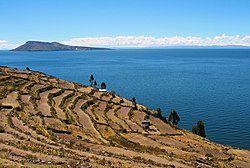
Andenes terraces on Taquile are used to grow traditional Andean staples such as quinoa and potatoes, alongside wheat—a European introduction.

Spanish conquest of Mexico, 1519–1521, with horses, pigs, cattle, and sheep being landed from ships. Florentine Codex.

Native Americans learned to use horses, dramatically expanding their hunting range. George Catlin, 1844.

An early Old World medical illustration of people with syphilis, Vienna, 1498

Sixteenth-century Aztec drawings of victims of smallpox in the Florentine Codex

The evangelization of Mexico

A depiction of slaves working at a plantation in Virginia, 1670