Color field
Painting evolved from a record of an artist's physical struggle into a calm, immersive field of pure visual sensation.
Painting evolved from a record of an artist's physical struggle into a calm, immersive field of pure visual sensation.
While "Action Painting" (think Jackson Pollock) emphasized the violent, athletic movement of the artist, Color Field painters sought to remove the "hand" of the creator. They moved away from thick, gestural brushstrokes toward large, unified areas of color that seemed to vibrate or float. The goal wasn't to tell a story or show a struggle, but to create a totalizing visual environment where the viewer could get lost.
This shift redefined the canvas. Instead of being a window into a fictional world or a stage for an event, the canvas became an "object" in its own right. By using massive scales and edge-to-edge color, artists like Mark Rothko and Barnett Newman forced the audience to experience the painting not as a picture, but as a physical atmosphere.
The movement split between the "spiritual" emotionalism of the old guard and the "cool" material focus of the next generation.
The movement split between the "spiritual" emotionalism of the old guard and the "cool" material focus of the next generation.
Color Field is often divided into two distinct waves. The pioneers—Rothko, Newman, and Clyfford Still—treated color as a vehicle for the "sublime." For them, these vast planes of pigment were meant to evoke deep human emotions, religious awe, or the infinite. They were the bridge between the chaos of Abstract Expressionism and the stillness of the field.
By the 1960s, a second wave known as "Post-Painterly Abstraction" stripped away this mysticism. Led by figures like Morris Louis and Kenneth Noland, these artists viewed painting through a more clinical lens. They weren't looking for God in the paint; they were looking for clarity, geometry, and the literal properties of the medium. The work became "cool"—detached, precise, and intentionally devoid of the artist's personal psychology.
Innovative "soak-stain" methods replaced the traditional brush with gravity and chemistry, making color part of the canvas rather than a layer on top.
Innovative "soak-stain" methods replaced the traditional brush with gravity and chemistry, making color part of the canvas rather than a layer on top.
Helen Frankenthaler revolutionized the movement with her "soak-stain" technique. By thinning oil paint with turpentine to the consistency of watercolor, she poured it directly onto raw, unprimed canvas. Instead of sitting on the surface like a skin, the paint saturated the fibers. This fused the image and the support into a single, inseparable entity, achieving a level of "flatness" never seen before.
Other artists took this further to remove any trace of a brush. Morris Louis would tilt his canvases and let gravity pull "veils" of thinned acrylic across the surface. This mechanical approach meant the painting "happened" rather than being "drawn." It emphasized the liquid nature of paint and the absorbent nature of fabric, turning the act of painting into a controlled experiment in fluid dynamics.
Powerhouse critic Clement Greenberg championed "flatness" as the ultimate goal of modern art, turning painting into a purely optical exercise.
Powerhouse critic Clement Greenberg championed "flatness" as the ultimate goal of modern art, turning painting into a purely optical exercise.
No figure influenced Color Field painting as much as the critic Clement Greenberg. He argued that for any art form to be "pure," it had to focus only on what made it unique. For painting, that meant acknowledging the two-dimensional flatness of the canvas. He loathed "illusionism"—the trick of making a flat surface look like it had depth—and pushed artists to embrace the literal surface.
Greenberg’s formalist theory essentially stripped art of its narrative and social context. Under his influence, the "meaning" of a painting became its color, its shape, and its relationship to the edge of the frame. While this provided a rigorous intellectual framework for the movement, it eventually drew criticism for being too narrow and "academic," ignoring the human and political elements of the world outside the studio.
Color Field’s radical reduction of form paved the way for Minimalism, stripping art down to its barest components.
Color Field’s radical reduction of form paved the way for Minimalism, stripping art down to its barest components.
By the late 1960s, Color Field had pushed painting to its logical conclusion: the work was no longer about anything other than itself. This "less is more" philosophy provided the essential blueprint for Minimalism. If a painting could just be a field of blue, then a sculpture could just be a steel box. The emphasis on the objecthood of the work and the viewer's physical presence in the room became the foundation for the next decade of contemporary art.
Even though it was eventually eclipsed by more conceptual and political movements, the influence of Color Field persists in modern design and architecture. Its focus on the psychological impact of pure color and the power of large-scale, uncluttered spaces remains a core tenet of how we design environments meant to evoke calm or presence today.

Kenneth Noland, Beginning, 1958, magna on canvas painting, Hirshhorn Museum and Sculpture Garden. Working in Washington, D.C., Noland was a pioneer of the color field movement in the late 1950s.

Henri Matisse, Porte-fenêtre à Collioure (French Window at Collioure), 1914, Centre Georges Pompidou, "Throughout my life, the 20th-century painter whom I've admired the most has been Matisse", Robert Motherwell 1970.

Jack Bush, Big A, 1968. Bush was a Canadian artist closely tied to color field painting and lyrical abstraction which grew out of abstract expressionism.
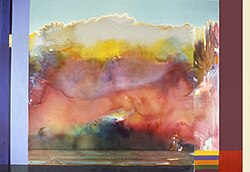
Ronnie Landfield, Rite of Spring, 1985. Landfield's work emerged during the 1960s. His works are reflections of both Chinese landscape painting and the color field idiom. His paintings bridge color field painting with lyrical abstraction.

Richard Diebenkorn, Ocean Park No.129, 1984. The Ocean Park series connects his earlier abstract expressionist works with Color field painting. The influence of both Henri Matisse and Joan Miró is particularly strong in this painting.

Henri Matisse, View of Notre-Dame, 1914, Museum of Modern Art. The Matisse paintings French Window at Collioure and View of Notre Dame both from 1914 exerted tremendous influence on American color field painters in general (including Robert Motherwell's Open Series) and on Richard Diebenkorn's Ocean Park paintings specifically.