Coffee
Coffee is a chemically complex stimulant that transitioned from a religious tool to a global morning ritual.
Coffee is a chemically complex stimulant that transitioned from a religious tool to a global morning ritual.
Brewed from the roasted seeds of the Coffea plant, coffee is defined by its dark color, acidity, and caffeine content. While primarily consumed for its stimulating effects, the beverage serves as a culinary canvas; its natural bitterness is frequently masked or enhanced by milk, cream, and sweeteners. Today, it exists in formats ranging from traditional French press and espresso to modern, shelf-stable canned varieties.
The production process is a transformative journey from fruit to cup. It begins with "coffee cherries," where the seeds are extracted, dried into green coffee beans, and then roasted to develop their characteristic flavor profile. This process turns an agricultural seed into a global commodity that is traded on a scale surpassed by few other products.
The drink’s history is rooted in 15th-century Sufi mysticism and linguistically tied to the concept of "wine."
The drink’s history is rooted in 15th-century Sufi mysticism and linguistically tied to the concept of "wine."
While legends attribute the discovery of coffee to an energized Ethiopian goatherd named Kaldi or the exiled Sheikh Omar, the first credible records appear in the mid-15th century among Sufi communities in Yemen. These religious practitioners used the brew specifically to maintain alertness during nighttime rituals. The term "coffee" itself followed a long linguistic path from the Arabic qahwah (traditionally meaning "wine" or "the dark one") through the Ottoman Turkish kahve.
By the 16th century, coffee had spread across the Middle East and North Africa, eventually reaching Europe through Venetian trade and Ottoman expansion. Despite early religious skepticism—some called it a "Muslim drink"—Pope Clement VIII’s blessing in 1600 helped cement its place in Western culture. This led to the rise of coffeehouses as hubs of social and intellectual exchange, with some 17th-century establishments like Oxford’s Queen's Lane Coffee House still operating today.
Commercial coffee is dominated by two species: the delicate, self-pollinating Arabica and the hardy, cross-breeding Robusta.
Commercial coffee is dominated by two species: the delicate, self-pollinating Arabica and the hardy, cross-breeding Robusta.
Though the genus Coffea contains many species, the global market is almost entirely split between C. arabica and C. canephora (known as Robusta). Arabica is the more highly prized variety, favored for its refined flavor and native to the highlands of Ethiopia. Because it is self-pollinating, Arabica crops tend to be genetically uniform. Robusta, conversely, is hardier and contains more caffeine but requires cross-pollination to thrive.
The biology of the coffee plant is characterized by its "cherries," which typically house two seeds. In roughly 5–10% of harvests, a natural mutation occurs where only one seed develops; these are known as "peaberries" and are often sought after for their concentrated flavor. These evergreen shrubs require specific equatorial climates, often referred to as the "Coffee Belt," spanning Africa, Southeast Asia, and the Americas.
The global spread of coffee was driven by colonial expansion and the clearing of massive rainforest tracts.
The global spread of coffee was driven by colonial expansion and the clearing of massive rainforest tracts.
Coffee became a global powerhouse through the efforts of colonial entities like the Dutch and British East India Companies. The Dutch were the first to cultivate coffee on a large scale in Java, while the French introduced the plant to the Caribbean in the 1720s. This expansion was not without cost; in Saint-Domingue (Haiti), coffee production relied on the brutal exploitation of enslaved people, a primary driver of the eventual Haitian Revolution.
In the 19th century, Brazil emerged as the world’s dominant producer by clearing vast areas of rainforest near Rio de Janeiro and São Paulo. By 1920, Brazil produced 70% of the world's supply. While countries like Costa Rica developed more egalitarian small-farm models, much of Central and South America’s coffee history is marked by the displacement of indigenous populations and the rise of massive, industrial-scale plantations.
While coffee is a $495 billion industry, its farmers frequently live in poverty and face mounting environmental pressures.
While coffee is a $495 billion industry, its farmers frequently live in poverty and face mounting environmental pressures.
Coffee is now a vital "cash crop" for over 100 million people in developing nations, acting as the economic backbone for countries like Ethiopia, Uganda, and Burundi. However, a stark paradox exists: while retail sales reach billions of dollars annually, the smallholder farmers who produce the beans rarely see a proportionate share of the wealth. This economic disparity remains one of the most significant criticisms of the modern coffee industry.
Environmental concerns have also moved to the forefront of the coffee debate. The high demand for "sun-grown" coffee has led to significant deforestation and high water consumption. Critics and environmentalists are increasingly pushing for sustainable practices to mitigate the impact of land clearing and the heavy chemical use required for high-yield, monoculture coffee farming.

Image from Wikipedia

Green coffee describes the beans before roasting.

A 1652 handbill advertising coffee for sale in St. Michael's Alley, London

A late 19th-century advertisement for coffee essence

The port city Mocha in Yemen 1692.

A coffee can from the first half of the 20th century. From the Museo del Objeto del Objeto collection.

Coffee bean production

Illustration of a single branch of a plant. Broad, ribbed leaves are accented by small white flowers at the base of the stalk. On the edge of the drawing are cutaway diagrams of parts of the plant.

C. robusta flowers

A flowering C. arabica tree

C. arabica berries on the bush

Map showing areas of coffee cultivation:r Coffea canephoram Coffea canephora and Coffea arabicaa Coffea arabica

Coffee leaf rust has forced the cultivation of resistant robusta coffee in many countries.

Robusta coffee tree infected by coffee wilt disease
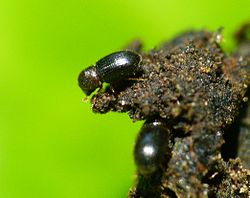
The coffee borer beetle is a major insect pest of the world's coffee industry.