Coca-Cola
With 1.8 billion daily servings, Coca-Cola operates more like a global utility than a standard consumer product.
With 1.8 billion daily servings, Coca-Cola operates more like a global utility than a standard consumer product.
Coca-Cola is the world’s most pervasive soft drink, sold in over 200 countries and territories. Its scale is difficult to overstate: the brand currently ranks as the world's sixth most valuable brand, and the company itself sits at No. 94 on the Fortune 500. This dominance is maintained through a unique "concentrate" model, where the parent company produces only the syrup and sells it to a global network of licensed bottlers who hold exclusive regional contracts.
The brand's identity is so strong that for decades the company resisted the nickname "Coke," fearing it would lead to trademark "genericide" (where a brand name becomes a generic term for the product). It wasn't until 1945—after "coke" had become a colloquialism for any soda in the Southern U.S.—that the company officially embraced and trademarked the four-letter shorthand to prevent competitors from claiming it.
Born as a morphine-free nerve tonic, Coke used the Prohibition movement to pivot from "medicine" to a "temperance" staple.
Born as a morphine-free nerve tonic, Coke used the Prohibition movement to pivot from "medicine" to a "temperance" staple.
In 1886, Confederate Colonel John Pemberton—a pharmacist addicted to morphine following war injuries—sought a cure for his own dependency. He originally developed "Pemberton's French Wine Coca," an alcoholic nerve tonic. However, when Atlanta passed prohibition legislation in 1886, Pemberton was forced to remove the wine. He replaced it with sugar and carbonated water, rebranding the concoction as "Coca-Cola: The temperance drink."
The name itself is a literal list of its original active ingredients: the coca leaf (from which cocaine is derived) and the African kola nut (a source of caffeine). While the modern formula remains a closely guarded trade secret known only to a few anonymous employees, it began as a "patent medicine" claimed to cure everything from indigestion and headaches to impotence.
A poorly negotiated $1 contract locked the company into a fixed five-cent price for over 70 years.
A poorly negotiated $1 contract locked the company into a fixed five-cent price for over 70 years.
In 1899, Coca-Cola's then-owner Asa Candler made what he eventually realized was a massive strategic error. He signed away the rights to bottle Coca-Cola for just $1, believing the future of the company lay solely in selling syrup for soda fountains. The contract gave bottlers exclusive control with no expiration date. This created a bizarre economic anomaly: because the company couldn't easily change the contract, the price of a bottle of Coke remained exactly five cents from 1886 until 1959.
To maximize profit under this fixed-price constraint, the company focused on aggressive volume and efficiency. This eventually led to the 1986 formation of Coca-Cola Enterprises Inc., a massive consolidation of bottling operations that allowed the parent company to regain tighter control over the distribution and merchandising of the finished product.
The "New Coke" disaster of 1985 proved that the brand’s value lies in consumer nostalgia rather than flavor alone.
The "New Coke" disaster of 1985 proved that the brand’s value lies in consumer nostalgia rather than flavor alone.
In the mid-1980s, facing stiff competition from Pepsi, Coca-Cola did the unthinkable: they changed their secret formula. Blind taste tests suggested that consumers actually preferred a sweeter profile (New Coke) over the original. However, the company drastically underestimated the emotional bond Americans had with the brand. The backlash was immediate and fierce, forcing management to bring back the original formula as "Coca-Cola Classic" just 79 days later.
This pivot, while a public relations nightmare, ultimately strengthened the brand. It highlighted that Coca-Cola was not just a beverage but a cultural icon. The "New Coke" formula lingered as "Coke II" until 2002, but the company eventually removed the "Classic" label from all packaging by 2011, as the original formula had once again become the unquestioned standard.
The shift to high-fructose corn syrup was a 1970s geopolitical maneuver sparked by Soviet sugar hoarding.
The shift to high-fructose corn syrup was a 1970s geopolitical maneuver sparked by Soviet sugar hoarding.
The flavor of Coca-Cola is not uniform across history or geography. In the 1970s, the Soviet Union—then the world's largest sugar producer—began hoarding the commodity, causing global prices to spike. In response, Coca-Cola switched its North American sweetener from cane sugar to high-fructose corn syrup (HFCS) in 1974 to stabilize costs.
This change created a permanent divide in the product's profile. Many enthusiasts still seek out "Mexican Coke," which is imported to the U.S. and continues to use cane sugar. Similarly, the company produces a specific "Kosher for Passover" version, identified by a yellow cap, which swaps corn syrup back for sugar to comply with Jewish dietary laws during the holiday.

John Pemberton, the original creator of Coca-Cola
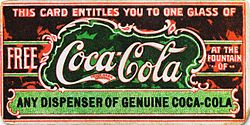
Believed to be the first coupon ever, this ticket for a free glass of Coca-Cola was first distributed in 1888 to help promote the drink. By 1913, the company had redeemed 8.5 million tickets.

This refurbished Coca-Cola advertisement from 1943 is still displayed in Minden, Louisiana.

Early Coca-Cola vending machine at Biedenharn Museum and Gardens in Monroe, Louisiana
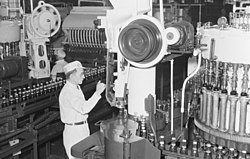
Bottling plant of Coca-Cola Canada Ltd., January 8, 1941, Montreal, Canada

Original framed Coca-Cola artist's drawn graphic presented by the Coca-Cola Company on July 12, 1944, to Charles Howard Candler on the occasion of Coca-Cola's "1 Billionth Gallon of Coca-Cola Syrup"

Claimed to be the first installation anywhere of the 1948 model "Boat Motor" styled Coca-Cola soda dispenser, Fleeman's Pharmacy, Atlanta, Georgia. The "Boat Motor" soda dispenser was introduced in the late 1930s and manufactured until the late 1950s. Photograph c. 1948

The Las Vegas Strip World of Coca-Cola museum in 2003
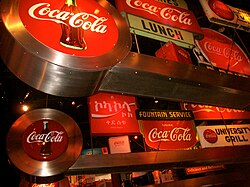
World of Coca-Cola museum in Atlanta, Georgia

An early Coca-Cola advertisement

Illustration of a gourd-shaped cocoa pod in the Encyclopædia Britannica

Final production version with slimmer middle section

A Coca-Cola bottle designed by Jean Paul Gaultier and inspired by American singer Madonna
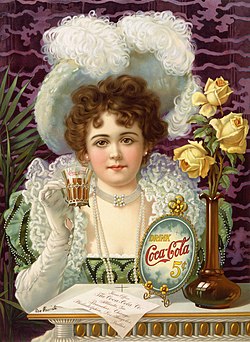
An 1890s advertisement showing model and operetta star Hilda Clark in formal 19th century attire. The ad is titled Drink Coca-Cola 5¢. (US).

Santa Claus in a White Rock Beverages ad from December 1923; pre-dating Coca-Cola's usage of Santa