Chinese cuisine
Culinary excellence is measured by medical balance and philosophical harmony rather than flavor alone.
Culinary excellence is measured by medical balance and philosophical harmony rather than flavor alone.
Chinese cuisine is deeply inseparable from traditional Chinese medicine and the philosophy of "qi" (energy). A meal is not merely a collection of ingredients but a calculated balance of the "Four Natures" (hot, warm, cool, cold) and the "Five Tastes" (pungent, sweet, sour, bitter, salty). This holistic approach, rooted in the I Ching, dictates that food should maintain the body’s internal yin and yang.
The sensory experience is codified into three traditional pillars: color, scent, and taste. Beyond these, the "meaning" and nutritional profile of a dish are paramount. This high-art status was solidified as early as the late Zhou dynasty; Confucius himself famously established rigorous standards for dining, insisting that meat be cut perfectly and sauces be precisely paired, arguing that improper preparation rendered food unfit for consumption.
The "Rice-Wheat Divide" was forged by ancient climates and solidified by mass migrations.
The "Rice-Wheat Divide" was forged by ancient climates and solidified by mass migrations.
China’s staple food geography is a direct reflection of its varied landscape. Historically, the "Rice Theory" explains the north-south cultural split: the warmer, wetter Yangtze River basin in the south favored rice cultivation (domesticated 9,000 years ago), while the cooler North China Plain relied on millet and later wheat (arriving from Western Asia around 2000 BC). This created a permanent culinary schism between the noodle-and-bread-heavy North and the rice-reliant South.
The importance of southern staples surged during the Song dynasty as invasions drove massive populations south. This migration turned former regional preferences into national standards. Even today, the distinction remains sharp: Southern breakfast might center on rice congee, while Northern mornings are defined by mantou (steamed buns) and wheat-based bing (flatbreads).
Chinese cuisine pioneered the transformation of simple grains into a complex "architectural library" of textures.
Chinese cuisine pioneered the transformation of simple grains into a complex "architectural library" of textures.
Over 4,000 years, Chinese cooks mastered the art of food engineering, specifically with soybeans and wheat. Rather than consuming grains in their raw form, they developed sophisticated processing techniques. The soybean was transformed from a humble legume into tofu, soy milk, fermented pastes, and "stinky" varieties that mimic the funk of blue cheese. This provided essential protein in a society where meat was often scarce and reserved for the wealthy.
Noodle technology followed a similar path of innovation. Invented in China over four millennia ago, noodles became a canvas for texture, categorized by their production method—such as "hand-pulled" varieties. These staples were often designed for longevity and health; for example, Shou Mian (longevity noodles) are traditionally served to symbolize a long life.
The "Eight Cuisines" map China’s ecological diversity onto the dinner plate.
The "Eight Cuisines" map China’s ecological diversity onto the dinner plate.
While outsiders often view Chinese food as a monolith, it is officially categorized into "Four Great Traditions"—Chuan (West), Lu (North), Yue (South), and Huaiyang (East)—which expanded into the modern "Eight Cuisines" in the 1980s. Each style is an adaptation to local resources: Sichuan (Chuan) focuses on baking and pungent spices, while Jiangsu favors braising and stewing to highlight fresh, delicate flavors.
These regional styles are not static; they were shaped by imperial whims and local necessity. For instance, Fujian cuisine is famous for its "woodland" ingredients and seafood, while Anhui cuisine is noted for its use of wild herbs and uncultivated plants. This hierarchy of styles reflects a transition from the flamboyant, ceremonial feasts of the Manchu Han Imperial era to the refined, province-specific identities recognized today.
Global exchange and "barbarian" imports have repeatedly reinvented the definition of "authentic" Chinese food.
Global exchange and "barbarian" imports have repeatedly reinvented the definition of "authentic" Chinese food.
The history of Chinese food is a history of integration. Many items now considered "traditional" are actually the results of ancient globalization. The shaobing (roasted flatbread) is believed to have been brought from Central Asia by Han dynasty generals, while the nomadic Xianbei people introduced dairy products like yogurt and goat milk to the North.
The most radical shift occurred during the Columbian Exchange in the 16th century. Spanish and Portuguese traders introduced New World crops that changed the face of Chinese agriculture. Mexican chili peppers became the soul of Sichuan and Hunan cooking, while calorically dense potatoes and corn became vital survival crops for the northern plains. This constant synthesis proves that Chinese cuisine is an evolving fusion, perpetually absorbing foreign influences and re-exporting them via the global diaspora.

An assortment of Chinese food. Clockwise from top left: Peking duck, misua, Kung Pao chicken, mooncakes, baijiu, wonton soup, spring rolls

A Quanjude cook is slicing Peking roast duck. Peking duck is eaten by rolling pieces of duck with scallion, cucumber and sweet bean sauce using steamed pancakes.

Dàzhǔ gānsī is a typical soup dish of Huaiyang cuisine. It is made of finely sliced dried tofu, chicken, ham and bamboo shoot, and the ingredients need to be braised with shrimp in chicken soup. It was highly praised by the Qianlong emperor.

Làzǐ Jī, stir-fried chicken with chili and Sichuan pepper in Sichuan style

Steamed whole perch with roe inside. Sliced ginger and spring onion is usually spread on top.

Map showing major regional cuisines of China

"Lion's head with crab meat" (蟹粉獅子頭) is a traditional eastern Chinese meatball soup.

Jiaozi

Several kinds of soybean products are sold in a farmer's market in Haikou, China.

Stir-fried razor shell with douchi (fermented black soybeans) in Jiaodong style

Stinky tofu

Ingredients of wu xiang fen (five-spice powder) are Sichuan peppercorn, cloves, cinnamon, fennel seeds, and star anise.

Different gāo diǎn (traditional Chinese pastry) with different stuffing, including lotus seed, rose, and mixture of pea and jackbean
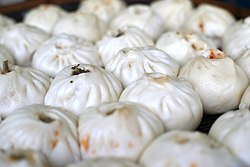
Bāozi are steamed buns containing savoury or sweet combinations of meat, vegetables, and mushrooms, traditionally associated with breakfast.

Double skin milk