Chinatown
Modern Chinatowns are evolving from rigid ethnic enclaves into "pan-Asian" hubs and suburban "ethnoburbs."
Modern Chinatowns are evolving from rigid ethnic enclaves into "pan-Asian" hubs and suburban "ethnoburbs."
While the Oxford Dictionary defines Chinatown as a predominantly Chinese district in a non-Asian town, the modern reality is far more fluid. Many districts that retain the name "Chinatown" have become pan-Asian centers, such as Cleveland’s Asiatown, which serves as a unifying hub for Korean, Vietnamese, Filipino, and Thai communities. In some cases, "second Chinatowns" are actually Vietnamese enclaves, blurring the ethnic lines of the traditional definition.
The physical form of these enclaves is also shifting. Urban designers now distinguish between "traditional" urban districts (like Manhattan), "suburban" ethnoburbs (like Monterey Park), and "fabricated" Chinese-themed malls (like Austin’s Chinatown). This evolution reflects a move away from the self-contained "city within a city" toward integrated commercial zones that cater to a broad range of Asian-American identities.
The global map of Chinatowns was drawn by 19th-century gold rushes and colonial trade policies.
The global map of Chinatowns was drawn by 19th-century gold rushes and colonial trade policies.
The history of Chinatowns dates back to the Tang Dynasty in the 10th century, but the modern global spread accelerated in the mid-19th century. Binondo in Manila, established in 1594, holds the title of the world's oldest standing Chinatown, born from Spanish colonial policies of ethnic segregation. Outside of Asia, the most famous enclaves—San Francisco and Melbourne—were products of the 1850s gold rushes, serving as ports of entry for prospectors and laborers.
Migration patterns were highly specific: the signing of the Treaty of Peking in 1860 opened China’s borders, leading to a massive exodus from coastal provinces like Guangdong and Fujian. Because many early North American immigrants came from just four counties (Sze Yup) in Guangdong, the Toishanese dialect became the dominant language of Chinatowns in the U.S. and Canada for over a century.
Traditional Chinatowns follow a specific architectural DNA centered on maritime protection and commerce.
Traditional Chinatowns follow a specific architectural DNA centered on maritime protection and commerce.
The layout of early Chinese settlements was rarely accidental; it followed a "core pattern" designed for survival and prosperity. Settlements typically developed along a jetty and were anchored by a Mazu temple dedicated to the Goddess of the Sea. Shophouses—buildings with businesses on the ground floor and residences above—lined the streets leading from the temple, with a Tudigong (Land God) temple placed at the opposite end to bookend the community’s spiritual and economic life.
This spatial logic allowed these enclaves to function as transitional spaces for new immigrants. By providing a familiar cultural and linguistic "landing pad," Chinatowns offered essential services and social safety nets. As these districts matured, Kuan Ti temples were often added to ensure commercial success, creating a distinct urban fabric that remains the historical center of many Southeast Asian cities today.
Economic shocks and political violence have historically forced Chinatowns to relocate or reinvent themselves.
Economic shocks and political violence have historically forced Chinatowns to relocate or reinvent themselves.
The survival of a Chinatown is often a story of resilience against external pressure. In the American West, racial tensions often turned deadly, such as the Rock Springs Massacre, leading to the extinction of many "frontier" Chinatowns as the Chinese Exclusion Act was passed. Even in more stable environments, disasters forced change: San Francisco’s Chinatown was entirely rebuilt after being destroyed in 1906, and Liverpool’s original community had to relocate after heavy bombing during World War II.
A striking modern example of displacement occurred following the September 11 attacks in 2001. The collapse of the garment industry in Manhattan’s Chinatown caused a mass migration of roughly 14,000 workers to Montville, Connecticut. These workers transitioned from urban manufacturing to service jobs in the Mohegan Sun casino, illustrating how ethnic enclaves can suddenly shift geography in response to global events.
Gentrification and shifting migration are turning urban Chinatowns into historical landmarks rather than residential hubs.
Gentrification and shifting migration are turning urban Chinatowns into historical landmarks rather than residential hubs.
As economic conditions in China have improved and immigration laws have changed, the "transitional" mission of many Chinatowns is fading. In cities like Philadelphia and San Francisco, the influx of luxury housing and high-end development is fueling gentrification, making these districts less affordable for the working-class immigrants they were built to house. This has led to a "decay" of smaller Chinatowns, which often survive only as tourist-focused historical strips.
In contrast, the New York metropolitan area represents the pinnacle of the modern enclave, housing nearly 900,000 people across 12 different Chinatowns. While traditional centers like Manhattan face tourism and business struggles—exacerbated recently by the COVID-19 pandemic—"satellite" Chinatowns like Flushing, Queens, have exploded in size, becoming some of the largest and most vibrant Chinese communities in the world.

Image from Wikipedia

Established in 1594, Binondo in Manila is home to the world's oldest Chinatown.

Chinatown, Melbourne is the longest continuous Chinese settlement in the Western World and the oldest Chinatown in the Southern Hemisphere.

Manhattan's Chinatown, the largest concentration of Chinese people in the Western Hemisphere and one of nine Chinatown neighborhoods in New York City, as well as one of twelve in the surrounding New York metropolitan area
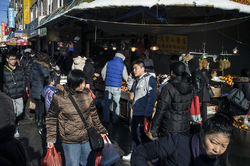
Brooklyn, the borough with the highest number of Chinatowns in New York City

Chinatown, San Francisco, the oldest Chinatown in the US

Chinatown, Boston, a Chinatown inspired and developed on the basis of modern engineering concepts

The design of Chinatown Square in Chinatown, Chicago was inspired by the Chinese Imperial Court.

Chinatown, Philadelphia, the recipient of significant Chinese immigration from both New York City and China

Liverpool's Chinatown, the oldest Chinatown in Europe

The busy intersection of Main Street and Roosevelt Avenue in the Flushing Chinatown (法拉盛華埠), Downtown Flushing, Queens, New York City, one of the busiest pedestrian intersections in the world. The segment of Main Street between Kissena Boulevard and Roosevelt Avenue, punctuated by the Long Island Rail Road trestle overpass, represents the cultural heart of Flushing Chinatown. Housing over 30,000 individuals born in China alone, the largest by this metric outside Asia, Flushing has become home to the largest and one of the fastest-growing Chinatowns in the world. Flushing is undergoing rapid gentrification by Chinese transnational entities, and the growth of the business activity at the core of Downtown Flushing, dominated by the Flushing Chinatown, has continued despite the Covid-19 pandemic. As of 2023, illegal Chinese immigration to New York City, and especially to the city's Flushing Chinatown, has accelerated.

Hoian Settlement Pattern, Vietnam, 1991

Pengchau Settlement Pattern, Hong Kong, 1991

Chinese Settlement in Georgetown, Malaysia, 1991

Chinese Settlement in Kuching, Malaysia, 1991