Chili pepper
Originally an Andean wild berry, the chili pepper conquered the global palate through the "Columbian Exchange."
Originally an Andean wild berry, the chili pepper conquered the global palate through the "Columbian Exchange."
Chili peppers are among the world's oldest cultivated crops, originating in the regions of modern-day Peru and Bolivia as early as 7,500 BC. While they were a staple in the Americas for millennia, they remained unknown to the rest of the world until Christopher Columbus encountered them in the Caribbean. Mislabeling them "peppers" because their heat reminded him of the unrelated black pepper (Piper nigrum), he triggered a rapid global dispersal known as the Columbian Exchange.
Unlike many tropical plants, chilies proved remarkably adaptable. By the mid-1500s, they had moved from Spanish gardens to the Balkans, where they were transformed into paprika. Within decades, Portuguese and Spanish traders introduced them to Africa, India, and East Asia. This rapid adoption was fueled by the plant's ability to grow in temperate climates and its immediate utility as a potent, easily preserved spice for diverse culinary traditions.
Chilies evolved capsaicin as a botanical defense mechanism that uniquely targets mammalian pain receptors.
Chilies evolved capsaicin as a botanical defense mechanism that uniquely targets mammalian pain receptors.
The "heat" of a chili comes from capsaicinoids, primarily capsaicin. This chemical is a sophisticated evolutionary survival strategy: it deters mammals, whose digestive systems destroy chili seeds, by binding to pain receptors in the mouth and throat that normally detect heat. In a biological loophole, birds lack these receptors, allowing them to eat the fruits and disperse the seeds over wide areas through their droppings.
The intensity of this defense is measured by the Scoville scale. Originally a subjective test of how much sugar water was needed to dilute a chili's heat until it was undetectable, it is now measured precisely via high-performance liquid chromatography. The range is staggering: while a bell pepper sits at 0 Scoville Heat Units (SHU), the current world’s hottest cultivars, like Pepper X or the Carolina Reaper, can exceed 2 million SHU.
Global cuisines leverage "constrained risk" to transform regional staples into high-sensory experiences.
Global cuisines leverage "constrained risk" to transform regional staples into high-sensory experiences.
The universal appeal of the chili lies in a psychological phenomenon called "constrained risk." Much like riding a roller coaster, humans enjoy the sensation of pain and heat from capsaicin because the brain recognizes the stimulus is not actually harmful. This allows for an "extreme" sensory experience without physical trauma, explaining why chilies have become the backbone of cuisines ranging from Sichuanese and Thai to Mexican and West African.
Beyond flavor, chilies serve as a vital nutritional engine. They are exceptionally dense in Vitamin C and Vitamin B6. In many cultures, the entire plant is utilized; for example, in Filipino and Korean cuisines, the mildly bitter leaves are cooked as greens or used in soups like tinola. This versatility has made the chili a cornerstone of global food security and cultural identity.
Beyond the kitchen, the chili’s chemical intensity serves as both a therapeutic analgesic and a non-lethal deterrent.
Beyond the kitchen, the chili’s chemical intensity serves as both a therapeutic analgesic and a non-lethal deterrent.
The same properties that make chilies painful to eat make them valuable in medicine. Capsaicin is a primary ingredient in topical ointments and dermal patches used to treat chronic pain, acting as a localized analgesic. Emerging research even suggests a correlation between regular chili consumption and a lower risk of death from cardiovascular disease, though the evidence remains preliminary.
On the front lines of conflict and conservation, the chili’s irritant properties are used as a non-lethal weapon. It is the active ingredient in pepper sprays and tear gas. In Africa and Asia, farmers use "chili dung bombs"—bricks of dung and chili—to create a noxious smoke that deters elephants from destroying crops, utilizing the animals' sensitive olfactory systems to protect both the harvest and the elephants themselves.
Five core species drive a massive global industry now being tested by climate change and space exploration.
Five core species drive a massive global industry now being tested by climate change and space exploration.
While there are thousands of cultivars, nearly all commercial chilies belong to five species: annuum, baccatum, chinense, frutescens, and pubescens. Today, the industry is a global powerhouse producing 45 million tonnes of green chilies annually. China dominates the market, accounting for nearly 40% of world production, followed by India.
As climate change threatens traditional farming, researchers at the World Vegetable Center are developing more resilient cultivars. The plant's hardiness is even being tested off-planet; in 2021, the International Space Station successfully grew four chili plants over 137 days. This experiment was not just for nutrition, but for the psychological boost that fresh, spicy food provides to astronauts living in sterile environments.

Chili peppers of varied colours and sizes: green bird's eye, yellow Madame Jeanette, red cayenne

Illustration from the Japanese agricultural encyclopedia Seikei Zusetsu, 1804
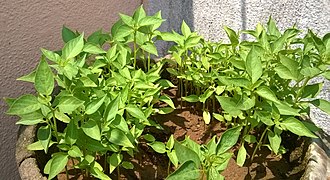
Young plants

Buds and flowers

Immature chilies in the field

Ripe chilies in the field, Myanmar

Leaf damaged by aphids

Ripe chili pepper with seeds

Chili peppers drying in Kathmandu, Nepal

Guntur chilli drying in the sun, Andhra Pradesh, India

New Mexico chiles dried on the plant in Mesilla, New Mexico

Sundried chili at Imogiri, Yogyakarta, Indonesia

Chili peppers drying in hanging ristras

Removing seeds and pith from dried chilies in San Pedro Atocpan, Mexico

Smoke-dried chipotle