Dynamical system
Source: WikipediaDynamical systems translate the messy flow of reality into mathematical "maps" of future states
A dynamical system is a formal description of how a system evolves over time. By turning observables—like the position of a planet or the price of a stock—into numbers, mathematicians can track a system's "state" within a defined space. This evolution is usually expressed in one of two ways: as a differential equation for continuous change, or as a "map" that jumps from the present state to a future one.
The power of this framework lies in its ability to predict. If you know the rules governing the system and its starting point (initial conditions), you can theoretically trace its "trajectory" or "orbit" through phase space. While simple systems like a swinging pendulum are easy to map, the same logic applies to massive, complex networks like global weather patterns or the self-organization of biological cells.
Complexity forces a shift from calculating exact paths to studying the "shape" of stability
In the real world, we rarely have perfect data or perfect equations. Small errors in measurement can lead to massive deviations in predicted outcomes—a hallmark of chaos. Because of this, modern dynamical systems theory often abandons the quest for a single, perfect trajectory. Instead, it focuses on "qualitative" properties: is the system stable, or will it collapse? Does it settle into a predictable loop (periodic behavior) or wander erratically?
This shift led to the concept of Lyapunov stability, which determines if a system will stay on track even if pushed slightly off course. By categorizing these behaviors, scientists can identify "bifurcation points"—critical moments where a small change in a parameter (like the speed of water in a pipe) causes the entire system to flip from smooth, orderly flow to erratic, turbulent chaos.
The field evolved from tracking celestial bodies to stabilizing the machinery of modern life
The discipline was born from "celestial mechanics," specifically Henri Poincaré’s 19th-century attempts to solve the motion of three bodies in space. Poincaré discovered that some systems eventually return to a state very close to where they started, a breakthrough that laid the groundwork for modern chaos theory. Later, mathematicians like George Birkhoff bridged the gap between physics and measure theory, helping us understand how systems behave over vast stretches of time.
In the late 20th century, these abstract theories became essential tools for engineers. Ali Nayfeh pioneered the use of nonlinear dynamics to ensure the structural integrity of skyscrapers, cranes, and jet engines. Today, the math once used to track the moon is the same math used to prevent bridges from collapsing and to keep spacecraft on their intended paths through the solar system.
"Time" and "Space" are treated as abstract playgrounds rather than rigid physical constraints
In advanced dynamics, the concepts of time and space are highly flexible. "Time" doesn't have to be a ticking clock; it can be a multidimensional "manifold" of control parameters or a "lattice" of discrete data points, such as the individual ticks of a stock market. This allows the theory to be applied to image processing or abstract algebra where "time" might simply represent a sequence of logical operations.
The "state space" is equally versatile. It can represent the pressure and temperature of a gas in a rocket, a "quantum state" in a Hilbert space, or even the configuration of a black hole's event horizon. By abstracting these concepts, dynamical systems theory provides a unified language that connects seemingly unrelated fields like thermodynamics, economics, and information theory.

A set of dynamical systems. Top left: a cellular automata. Top center: Exterior billiards. Top right a constrained 3-body problem. Bottom left a Poincare section of a Standard map (chaos arise in the dotted regions). Middle bottom: a chaotic Dynamical billiards (a symptom of chaos here are the trajectories filling the configuration space). Bottom right: A geodesic flow such as light on a surface, trajectories are geodesics i.e. minimum paths, in this case the phase space is a torus (stable orbits arise when the periods are rational, if irrational that is a path to chaos).

Two pages of the Rudolphine tables showing eclipses of the Sun and Moon, data was collected from Tycho brahe and published by Kepler

Stability diagram classifying Poincaré maps of linear autonomous system

Arnold cat map: picture showing how the linear map stretches the unit square and how its pieces are rearranged when the modulo operation is performed. The lines with the arrows show the direction of the contracting and expanding eigenspaces

Baker's map: Example of a measure that is invariant under the action of the (unrotated) baker's map: an invariant measure. Applying the baker's map to this image always results in exactly the same image.

Outer billiards: defined relative to a pentagon

Bouncing ball dynamics: The motion is not quite parabolic due to air resistance.

The recursive application of a Complex quadratic polynomial as a complex plane map gives a Dynamical system. Here there is a Dynamical plane with a Julia set and critical orbit.

The Lorenz attractor arises in the study of the Lorenz oscillator, a dynamical system.

An example of a Kármán vortex street, an emergent phenomenon from Fluid dynamics.

The Kicked Rotor, a famous chaotic system

Orbital resonance in Saturn's rings.
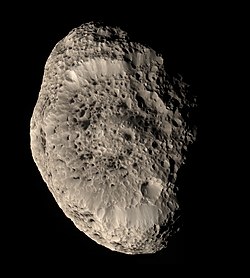
The chaotic rotation of Hyperion. The Solar System as a whole is full of examples of dynamical systems from Celestial mechanics

A two-dimensional Poincaré section of the forced Duffing equation

The Smale horseshoe map f is the composition of three geometrical transformations.