Bread
Bread is an "elastic-plastic foam" engineered by the molecular dance of glutenin and gliadin.
Bread is an "elastic-plastic foam" engineered by the molecular dance of glutenin and gliadin.
Structurally, bread is defined as a gas-in-solid solution. When wheat flour meets water, two water-insoluble proteins—glutenin and gliadin—form a complex network known as gluten. Glutenin provides the "elastic" quality, allowing the dough to regain its shape after being stretched, while gliadin provides the "plastic" quality, allowing it to hold a new shape. This network traps carbon dioxide bubbles produced by leavening agents, creating the porous, spongy texture we recognize.
While wheat is the gold standard for bread due to its high gluten content, other grains like rye, barley, and oats are frequently used. However, because these grains lack the same protein structure, they often require a blend with wheat to avoid becoming overly dense. For gluten-free varieties, bakers must use additives like xanthan gum or eggs to mechanically mimic the structural integrity that gluten naturally provides.
The invention of bread preceded the dawn of agriculture, suggesting it was a catalyst for—rather than a result of—settled civilization.
The invention of bread preceded the dawn of agriculture, suggesting it was a catalyst for—rather than a result of—settled civilization.
While often associated with the Neolithic revolution around 10,000 BC, the oldest evidence of bread-making dates back 14,500 years to a Natufian site in Jordan. Even earlier, 30,000-year-old starch residues on rocks suggest that Paleolithic humans were pounding wild tubers like cattails and ferns into primitive flatbreads long before they began farming grains.
Early leavening was likely accidental, caused by ubiquitous airborne yeast spores colonizing dough left out in the open. By 6000 BC, the Sumerians were refining these processes, and the Egyptians later perfected the use of yeast and controlled fermentation. Across these ancient cultures, the ability to refine flour and master the bakery arts became a primary metric for "civilization."
The industrial "Chorleywood" process prioritized production speed at the cost of nutritional digestibility.
The industrial "Chorleywood" process prioritized production speed at the cost of nutritional digestibility.
Developed in 1961, the Chorleywood bread process uses intense mechanical energy and chemical additives to reduce fermentation time from several hours to just one. While this allowed for the mass production of cheap, soft bread using lower-protein wheat, it bypassed the critical biological work performed by long fermentation.
Research suggests that a fermentation period of at least four hours is necessary to break down 90% of FODMAPs (indigestible carbohydrates) and phytates. Because industrial bread rises so quickly, these compounds remain in the loaf, frequently causing the bloating and digestive discomfort often mistaken for general gluten sensitivity. In this sense, the "intolerance" many feel toward modern bread is often a reaction to the technique of manufacture rather than the grain itself.
The Maillard reaction creates a crust that is more than just a container; it is a concentrated source of flavor and fiber.
The Maillard reaction creates a crust that is more than just a container; it is a concentrated source of flavor and fiber.
The bread's mass is divided into the "crumb" (the internal porous material) and the "crust." The crust forms through the Maillard reaction—a chemical interaction between amino acids and reducing sugars under intense heat. This reaction not only browns the surface but also creates a complex profile of flavors and aromas that the protected, moisture-rich crumb cannot achieve.
Contrary to the "old wives' tale" that the crust is just for chewing, it is often the healthiest part of the loaf. Studies indicate that the crust contains higher concentrations of dietary fiber and unique antioxidants, such as pronyl-lysine, which are synthesized during the baking process.
Professional baking is governed by "Baker’s Percentages," treating flour as the unchanging sun of a culinary solar system.
Professional baking is governed by "Baker’s Percentages," treating flour as the unchanging sun of a culinary solar system.
In professional formulations, recipes are recorded using a notation where the weight of the flour is always 100%, and every other ingredient is expressed as a percentage of that weight. This allows bakers to scale production up or down with perfect consistency and, more importantly, to understand the "hydration" of the dough at a glance.
The ratio of water to flour is the most critical variable in determining the final product's texture. Standard table breads typically use around 60% hydration, resulting in a fine, tight crumb. In contrast, "artisan" breads often push hydration to 75% or higher; this extra water creates larger CO2 bubbles during baking, resulting in the large, irregular holes and chewy texture prized in sourdoughs and ciabattas.

Loaves of bread in a basket

Woman baking bread (c. 2200 BC); Louvre

Sangak, an Iranian flatbread

Strucia — a type of European sweet bread

Small homemade bread with pumpkin and sunflower seeds

Bread pudding

Bread with crust crack (half left at the top) and (lighter) crumb inside

Steps in bread making, here for an unleavened Chilean tortilla

Baking bread in East Timor

A dough trough, located in Aberdour Castle, once used for leavening bread

Compressed fresh yeast

Before first rising
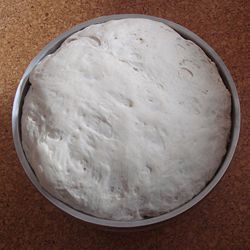
After first rising

After proofing, ready to bake

Sourdough loaves