Black pepper
Black pepper is a climbing vine whose "heat" is chemically distinct from the burn of chili peppers.
Black pepper is a climbing vine whose "heat" is chemically distinct from the burn of chili peppers.
While many associate "spicy" with the capsaicin found in chilies, black pepper derives its pungency from a compound called piperine. Refined piperine is only about 1% as hot as capsaicin, providing a steady, glowing heat rather than a sharp sting. This chemical signature is housed within the fruit of Piper nigrum, a perennial woody vine that can climb up to 13 feet.
The fruit itself is a "drupe" (a stone fruit like a cherry). What we call a peppercorn is actually the dried fruit or the seed within. Unlike most garden spices, pepper requires a long-term commitment from the farmer; the vines must be propagated by hand-selected cuttings and take four to five years to begin bearing fruit, remaining productive for only about seven years.
The spectrum of pepper colors is a result of harvest timing and processing rather than different species.
The spectrum of pepper colors is a result of harvest timing and processing rather than different species.
Almost all true pepper—black, white, green, and red—comes from the same plant. Black pepper is made from unripe drupes that are cooked briefly in hot water to rupture cell walls and speed up browning enzymes. White pepper, by contrast, is just the seed of the ripe fruit; the dark outer skin is removed through "retting," a week-long soaking process that allows the flesh to decompose before the seed is dried.
Green pepper is also unripe but is preserved via freeze-drying or pickling to keep its color and "bright" aroma. It is important to note that "pink pepper" is a biological imposter. Derived from the Peruvian pepper tree, pink peppercorns are members of the cashew family and can cause life-threatening allergic reactions in people with tree nut allergies.
Pepper was the "Black Gold" of antiquity, driving the Roman economy and launching the Age of Discovery.
Pepper was the "Black Gold" of antiquity, driving the Roman economy and launching the Age of Discovery.
In the Roman Empire, pepper was a ubiquitous luxury; it appears in the vast majority of recipes in the 3rd-century cookbook De re coquinaria. Its value was so high—and the overland trade routes so dominated by middlemen—that it eventually motivated the Portuguese to find a direct sea route to India. When Vasco da Gama reached the Malabar Coast in 1498, his mission was clear: "Christians and spices."
This trade reshaped the world map. The Portuguese held a 150-year monopoly on the spice trade, making them one of the wealthiest nations on Earth before losing control to the Dutch and English. Today, the "once-costly luxury" has become the world’s most traded spice, accounting for 20% of the global spice trade, with Vietnam now leading the world in production.
The complex aroma of pepper is highly volatile, disappearing quickly once the outer fruit layer is breached.
The complex aroma of pepper is highly volatile, disappearing quickly once the outer fruit layer is breached.
The "soul" of pepper’s flavor isn't just the heat of the piperine, but a cocktail of terpenes—limonene, pinene, and alpha-phellandrene—which contribute citrusy, woody, and floral notes. These aromatic compounds are concentrated in the outer fruit layer. Because these oils evaporate upon contact with air and degrade when exposed to light, ground pepper loses its nuance almost immediately.
This volatility explains the culinary insistence on the pepper mill. Grinding a peppercorn at the moment of use releases these trapped aromatics directly onto the food. In contrast, white pepper lacks these floral terpenes because the outer skin is removed; instead, the fermentation process during retting can introduce "off-flavors" described as cheesy or musky, which are prized in specific Chinese and Thai dishes but may surprise Western palates.

Image from Wikipedia

Black pepper vine climbing on jackfruit tree (Artocarpus heterophyllus)

Single stem with flowers

Black, green, white, and pink (Schinus terebinthifolia) peppercorns
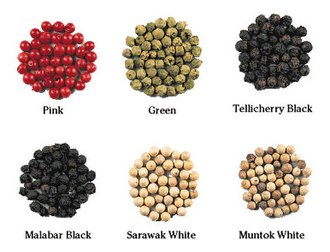
Six variants of peppercorns (two types of white and two types of black, based on region)

Black peppercorns and white peppercorns

Dried red Kampot peppercorns

Close-up of a peppercorn

Pepper harvested for the European trade, from a manuscript of Livre des merveilles de Marco Polo

A depiction of Calicut, India published in 1572 during Portugal's control of the pepper trade

Handheld pepper mills with black (left) and mixed (right) peppercorns
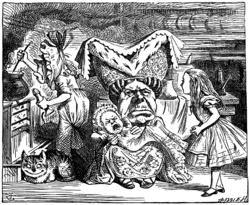
"There's certainly too much pepper in that soup!". Alice said to herself, as well as she could for sneezing — Alice in Wonderland (1865). Note the cook's pepper mill.

A Roman-era trade route from India to Italy