Bill Gates
A privileged, hyper-competitive upbringing at Lakeside School forged the technical skills and partnerships that predated Microsoft.
A privileged, hyper-competitive upbringing at Lakeside School forged the technical skills and partnerships that predated Microsoft.
Gates was born into a wealthy Seattle family that prioritized competition, whether in board games or athletics. At age 13, he gained rare access to a Teletype terminal funded by the school's Mothers' Club, where he met Paul Allen and began programming in BASIC. His early obsession was so intense that he was banned from a local computer center for exploiting bugs to get free time, only to later be hired by that same company to find software vulnerabilities.
Before even graduating high school, Gates and Allen formed Traf-O-Data, a venture to automate traffic-flow data. This early experience in real-world software utility, combined with his near-perfect SAT score (1590/1600) and brief stint at Harvard, provided the intellectual and social foundation for his career. When the MITS Altair 8800 launched in 1975, Gates dropped out of Harvard, recognizing a fleeting window of opportunity to build a software industry from scratch.
Gates secured Microsoft’s dominance not by inventing the operating system, but by revolutionizing the software licensing model.
Gates secured Microsoft’s dominance not by inventing the operating system, but by revolutionizing the software licensing model.
The pivotal moment in Gates’s career was the 1980 deal with IBM. When IBM needed an operating system for its new PC, Gates didn't have one; he bought the rights to 86-DOS from another company for $50,000, refined it, and licensed it to IBM as PC-DOS. Crucially, he retained the right to license the software to other manufacturers. As "IBM-compatible" clones flooded the market, Microsoft’s MS-DOS became the de facto industry standard, creating a massive revenue stream without the overhead of hardware manufacturing.
This strategy of platform dominance continued with the release of Windows in 1985. By layering a graphical user interface over the established DOS foundation, Gates fended off competition from Apple and cemented Microsoft’s position at the center of the computing universe. For much of the next two decades, Gates’s focus on market share and developer ecosystems made him the world's wealthiest individual, becoming the first "centibillionaire" in 1999.
A relentless, hands-on management style defined Microsoft’s culture while attracting significant antitrust scrutiny.
A relentless, hands-on management style defined Microsoft’s culture while attracting significant antitrust scrutiny.
In Microsoft’s first five years, Gates personally reviewed and often rewrote every line of code the company produced. He was known as a demanding executive who prioritized technical elegance and market aggression. This "neat hack" philosophy drove the company to release era-defining products like Excel and Word, but it also led to accusations of anti-competitive behavior. Courts eventually upheld findings that Microsoft used its monopoly power to stifle rivals, a period that defined Gates's public image as a polarizing corporate "monopolist."
As the company grew, Gates transitioned from a developer-manager to a long-term strategist. He stepped down as CEO in 2000, passing the reins to Steve Ballmer, and assumed the role of Chief Software Architect. This shift allowed him to focus on the technical direction of products like Windows XP and 8.1 before eventually pivoting away from the company entirely to focus on global issues.
Gates pivoted from software titan to global statesman by applying "philanthropic engineering" to world health.
Gates pivoted from software titan to global statesman by applying "philanthropic engineering" to world health.
Starting in 2000, Gates began transferring his wealth and intensity to the Bill & Melinda Gates Foundation. Applying the same data-driven, results-oriented approach he used at Microsoft, the foundation became the world’s largest private charitable organization. His work shifted toward "eradicating" rather than "treating," with massive investments in vaccines and infrastructure to combat polio, malaria, and tuberculosis in developing nations.
In 2010, he expanded this influence by co-founding the Giving Pledge with Warren Buffett, a commitment for billionaires to give away the majority of their wealth. Even after his 2021 divorce and resignation from the Microsoft board in 2020, Gates remains a central figure in global policy, funding ventures in climate change (Breakthrough Energy) and next-generation nuclear power (TerraPower), effectively rebranding himself as a premier architect of global solutions.

Bill Gates in 2025

Gates (right) with Paul Allen seated at Teletype Model 33 ASR terminals in Lakeside School, 1970

MITS Altair 8800 Computer with 8-inch (200 mm) floppy disk system whose first programming language was Microsoft's founding product, Altair BASIC

Gates delivers a speech at the World Economic Forum in Switzerland, January 2008.

Gates and UK Foreign Secretary David Cameron at COP28 in Dubai on December 1, 2023

With Indian Prime Minister Narendra Modi at the COP26 climate summit in Glasgow in November 2021

The European Commission, European Investment Bank and Gates' Breakthrough Energy Catalyst agreed at the 2021 UN Climate Change conference to work together to bring green technologies to market.

Gates during a September 2025 dinner hosted by President Trump

Gates with Bono, Queen Rania of Jordan, then British Prime Minister Gordon Brown, then President of Nigeria Umaru Yar'Adua and others during the Annual Meeting 2008 of the World Economic Forum

Gates in a fireside chat moderated by Shereen Bhan virtually at the Singapore FinTech Festival 2020
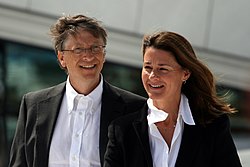
Gates with then wife Melinda, June 2009

Gates with U.S. Secretary of Defense Jim Mattis, February 2017

Gates giving his deposition at Microsoft on August 27, 1998
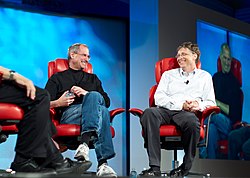
With Steve Jobs at D: All Things Digital in 2007