Big Bang
The universe did not explode into space; it is the expansion of space itself.
The universe did not explode into space; it is the expansion of space itself.
The Big Bang is often Misconceived as a localized explosion, but it actually describes a period of rapid expansion from an initial state of extreme density and temperature. Approximately 13.8 billion years ago, the fabric of space-time began to stretch, cooling as it grew. This process continues today, with galaxies moving away from one another not because they are traveling through space, but because the space between them is increasing.
The mathematical foundation for this was laid by Alexander Friedmann and Georges Lemaître in the 1920s, later confirmed by Edwin Hubble’s observation that distant galaxies recede faster than nearby ones. This relationship, known as Hubble’s Law, proved that the universe is dynamic rather than static, forever changing the trajectory of modern physics.
Our confidence in the Big Bang rests on "fossil" radiation and the chemical fingerprint of the stars.
Our confidence in the Big Bang rests on "fossil" radiation and the chemical fingerprint of the stars.
While we cannot see the Big Bang itself, we can see its "afterglow." In 1964, scientists discovered the Cosmic Microwave Background (CMB), a uniform sea of radiation that permeates the sky. This light was emitted roughly 380,000 years after the start when the universe cooled enough to become transparent. The CMB is a near-perfect snapshot of the infant universe, and its uniformity confirms that everything was once tightly packed together.
Beyond light, the Big Bang left a chemical legacy. The theory predicted that the early universe should consist mostly of hydrogen and helium with a tiny dash of lithium. Observations of the oldest stars and gas clouds match these predictions with startling precision. This "Big Bang Nucleosynthesis" provides a hard data point that any competing theory must reconcile.
In its first trillionth of a second, the universe grew exponentially through a process called "Inflation."
In its first trillionth of a second, the universe grew exponentially through a process called "Inflation."
The "Inflationary epoch" is the most dramatic event in cosmic history. At roughly $10^{-37}$ seconds, the universe underwent a phase transition that caused it to grow exponentially, far faster than the speed of light. This solved the "flatness problem"—explaining why the universe appears geometrically flat and why distant regions of space look identical despite never having been in contact.
During this frantic expansion, microscopic quantum fluctuations were stretched into macroscopic scales. These tiny ripples in density became the "seeds" for all future structures. Gravity later pulled matter into these slightly denser regions, eventually forming the web of gas clouds, stars, and galaxies we observe today.
The universe is a "dark" mystery where visible atoms are a 5% minority.
The universe is a "dark" mystery where visible atoms are a 5% minority.
Despite our detailed timeline, most of the universe remains invisible. Luminous matter—the stars, planets, and gas we can detect—makes up less than 5% of the universe’s total density. The rest is divided into two mysterious components: Dark Matter (27%), which provides the gravitational "glue" that holds galaxies together, and Dark Energy (68%), a repulsive force that is currently causing the expansion of the universe to accelerate.
This acceleration was an unexpected discovery made in the late 1990s through the study of distant supernovae. While the Big Bang describes how the universe began, Dark Energy dictates how it might end. Current models suggest that as space continues to stretch and accelerate, galaxies will eventually move so far apart that they become invisible to one another, leading to a lonely, cold future.
Physics breaks down at the "Singularity," leaving the very first moment a total blank.
Physics breaks down at the "Singularity," leaving the very first moment a total blank.
If we extrapolate the expansion of the universe backward, we eventually reach a point of infinite density and temperature known as a singularity. However, our current laws of physics—specifically General Relativity—cannot describe this state. At such extreme scales, gravity and quantum mechanics must merge into a single theory of "Quantum Gravity," which does not yet exist.
Because of this, the Big Bang theory doesn't actually explain the origin of the universe, but rather the evolution of the universe from a tiny fraction of a second after it started. What happened during the "Planck Epoch" remains the frontier of modern science, a period where even the concepts of time and space may cease to function as we understand them.

Timeline of the expansion of the universe, where space is represented schematically at each time by circular sections. On the left, the dramatic expansion of inflation; at the center, the expansion accelerates (artist's concept; neither time nor size are to scale).

Estimated relative distribution for components of the energy density of the universe. (In February 2015, the European-led research team behind the Planck cosmology probe released new data refining these values to 4.9% ordinary matter, 25.9% dark matter and 69.1% dark energy.)

Panoramic view of the entire near-infrared sky reveals the distribution of galaxies beyond the Milky Way. Galaxies are color-coded by redshift.

Abell 2744 galaxy cluster – Hubble Frontier Fields view

XDF size compared to the size of the Moon (XDF is the small box to the left of, and nearly below, the Moon) – several thousand galaxies, each consisting of billions of stars, are in this small view.

Redshift of absorption lines due to recessional velocity

The cosmic microwave background spectrum measured by the FIRAS instrument on the COBE satellite is the most-precisely measured blackbody spectrum in nature. The data points and error bars on this graph are obscured by the theoretical curve.
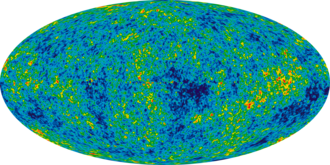
9 year WMAP image of the cosmic microwave background radiation (2012). The radiation is isotropic to roughly one part in 100,000.

Time evolution of light element abundances during Big Bang nucleosynthesis

Focal plane of BICEP2 telescope under a microscope – used to search for polarization in the CMB

Chart shows the proportion of different components of the universe – about 95% is dark matter and dark energy.

The overall geometry of the universe is determined by whether the Omega cosmological parameter is less than, equal to or greater than 1. Shown from top to bottom are a closed universe with positive curvature, a hyperbolic universe with negative curvature and a flat universe with zero curvature.