Berlin Blockade
Berlin was a geopolitical island trapped 110 miles deep within the Soviet occupation zone.
Berlin was a geopolitical island trapped 110 miles deep within the Soviet occupation zone.
At the end of WWII, Germany was carved into four occupation sectors, but its capital, Berlin, sat entirely within the Soviet-controlled East. In a diplomatic oversight, the Western Allies (US, UK, and France) secured written agreements for three 20-mile-wide air corridors but relied only on "customary use" for land and water access.
Stalin exploited this legal ambiguity to exert pressure. By June 1948, the Soviets severed all rail, road, and water links between the Western zones and West Berlin. Their goal was simple: starve the 2.5 million inhabitants into submission and force the Western Allies to abandon the city, effectively giving the USSR total control over the heart of Germany.
A new currency, the Deutsche Mark, acted as the fuse that ignited the Soviet blockade.
A new currency, the Deutsche Mark, acted as the fuse that ignited the Soviet blockade.
While the blockade was a military move, its immediate trigger was economic. The Western Allies introduced the Deutsche Mark to replace the hyper-inflated Reichsmark and stabilize the German economy. This move integrated West Germany and West Berlin into the Western economic sphere, threatening Soviet influence and the viability of their own East German currency.
Stalin viewed this as a direct violation of previous agreements. He retaliated by banning the new currency in the Soviet zone and immediately shutting down all traffic to West Berlin. The conflict was no longer just about territory; it was a battle over which economic system—Capitalist or Communist—would define the future of a rebuilt Europe.
Western powers bypassed the land siege by turning the sky into a relentless, 24/7 conveyor belt of survival.
Western powers bypassed the land siege by turning the sky into a relentless, 24/7 conveyor belt of survival.
Faced with the choice of retreating or risking World War III by forcing a land convoy, the Allies chose a third option: the Berlin Airlift (Operation Vittles). Experts initially claimed it was impossible to supply a city of millions solely by air. At the start, the city had only 36 days of food and 45 days of coal.
The result was the greatest logistical feat of the 20th century. At the height of the airlift, a plane landed in West Berlin every 30 to 60 seconds. Allied pilots flew over 278,000 sorties, delivering 2.3 million tons of supplies—including two-thirds of it as coal for heat and power. The operation proved that the West had the industrial capacity and technical will to sustain an entire metropolis indefinitely from the clouds.
The "Candy Bombers" transformed the German image of Americans from conquering occupiers to benevolent protectors.
The "Candy Bombers" transformed the German image of Americans from conquering occupiers to benevolent protectors.
The blockade shifted the psychological landscape of Europe. Only three years after the end of WWII, the German population in West Berlin went from being a defeated enemy to a vital ally. This shift was personified by pilot Gail Halvorsen, who began dropping small parachutes of chocolate and gum for the city's children.
This "Operation Little Vittles" became a massive PR victory. It humanized the American military and gave the besieged Berliners a reason to resist Soviet pressure. While the Soviets offered food to any Berliner who would register for rations in the East, only about 3% of the population took the offer. Most preferred to stay in the dark and cold of the West rather than submit to Soviet rule.
Stalin’s failed siege backfired, accelerating the formal division of Germany and the creation of NATO.
Stalin’s failed siege backfired, accelerating the formal division of Germany and the creation of NATO.
Realizing the blockade had failed to move the Allies or break the Berliners, the Soviets lifted the restrictions in May 1949. However, the damage to Soviet interests was permanent. Instead of pushing the West out, the crisis convinced the Western Allies that they needed a formal military alliance to counter Soviet expansion, leading directly to the formation of NATO in April 1949.
The blockade also ended any hope of a unified Germany in the near future. Within months of the blockade ending, the Western zones became the Federal Republic of Germany (West Germany), and the Soviet zone became the German Democratic Republic (East Germany). Berlin remained a flashpoint of the Cold War for the next four decades, a city divided by ideology long before it was divided by a wall.
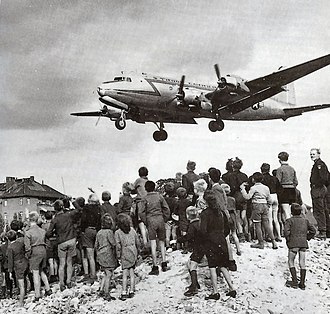
Image from Wikipedia

The red area of Germany is Soviet-controlled East Germany. German territory east of the Oder-Neisse line (light beige) was ceded to Poland, while a portion of the easternmost section of Germany East Prussia, Königsberg, was annexed by the USSR, as the Kaliningrad Oblast.

Sectors of divided Berlin

The only three permissible air corridors to Berlin

Germans watching supply planes at Tempelhof

A C-74 Globemaster plane at Gatow airfield on 19 August with more than 20 tons of flour from the United States

An RAF Short Sunderland moored on the Havel near Berlin unloading salt during the airlift

C-54s stand out against the snow at Wiesbaden Air Base during the Berlin Airlift in the Winter of 1948–49

US Air Force pilot Gail Halvorsen, who pioneered the idea of dropping candy bars and bubble gum with handmade miniature parachutes, which later became known as "Operation Little Vittles"

A Douglas C-54 Skymaster dropping candy over Berlin, c. 1948/49

Berlin Airlift Monument in Berlin-Tempelhof, displaying the names of the 39 British and 31 American airmen who lost their lives during the operation. Similar monuments are located at the military airfield of Wietzenbruch near the former RAF Celle and at Rhein-Main Air Base.

Base of the Berlin Airlift Monument in Berlin-Tempelhof with inscription "They gave their lives for the freedom of Berlin in service of the Berlin Airlift 1948/49"

Douglas C-47 Skytrain

Douglas C-74 Globemasters

A Douglas C-54 Skymaster, called Spirit of Freedom, operated as a flying museum by the Berlin Airlift Historical Foundation.