Beer
Ancient beer was a foundational currency and nutritional staple that fueled the rise of early civilizations.
Ancient beer was a foundational currency and nutritional staple that fueled the rise of early civilizations.
Beer is among the world’s oldest prepared substances, with residues in Israel suggesting a gruel-like brew existed 13,000 years ago. In Mesopotamia and Egypt, it wasn't merely a luxury but a crucial form of compensation. Workers in the city of Uruk were paid in beer 5,000 years ago, and the laborers who built the Egyptian pyramids received a daily ration of four to five liters, providing both the calories and hydration necessary for monumental construction.
This cultural importance is etched into the earliest human records. The Code of Hammurabi (1750 BC) regulated its distribution, and the "Hymn to Ninkasi" served as both a prayer to a goddess and a mnemonic device for memorizing recipes in a largely illiterate society. These early brews were often made from a diverse range of grains, including barley, wheat, and even rice in ancient China, though they lacked the clear, carbonated profile of modern lagers.
The word "beer" emerged to distinguish hopped European imports from the traditionally unhopped "ale" of the British Isles.
The word "beer" emerged to distinguish hopped European imports from the traditionally unhopped "ale" of the British Isles.
In early English and Scandinavian languages, the standard term for the beverage was "ale." The word "beer" (from the Old English bēor) likely shares roots with the Germanic word for "barley" or the Latin bibere (to drink). Originally, it may have referred to a sweet, strong drink similar to mead.
The linguistic shift occurred during the late Middle Ages when hopped brews from continental Europe were imported into Britain. To differentiate this bitter, preserved version from the local unhopped malt liquors, the term "beer" was adopted for the hopped variety. Over time, as hops became the universal standard, the word "beer" expanded to cover the entire category, while "ale" was relegated to a specific style of top-fermented brewing.
Regional water chemistry dictated the world’s most famous beer styles long before the advent of modern science.
Regional water chemistry dictated the world’s most famous beer styles long before the advent of modern science.
Because beer is 93% water, the mineral profile of a local source historically determined what a brewery could produce. Hard water rich in calcium and bicarbonate is ideal for balancing the dark, acidic malts used in stouts; consequently, Dublin became the world capital for that style. Conversely, the incredibly soft water of the Plzeň region in the Czech Republic allowed for the creation of the crisp, pale Pilsner.
Brewers eventually learned to "Burtonise" their water—adding gypsum to mimic the water of Burton-upon-Trent, England, which was famous for its world-class pale ales. This mineral intervention marks the transition from beer as a product of geography to beer as a product of chemistry, allowing iconic styles to be brewed anywhere in the world.
The 13th-century adoption of hops transformed beer from a perishable herbal concoction into a stable global commodity.
The 13th-century adoption of hops transformed beer from a perishable herbal concoction into a stable global commodity.
Before hops became the dominant flavoring agent, brewers used "gruit"—a mixture of herbs, spices, and occasionally narcotic plants that could cause hallucinations if prepared incorrectly. The first recorded use of hops in beer dates to 822 AD, but it took five centuries for their use to become widespread. Hops provided a critical breakthrough: they act as a natural antibiotic, suppressing undesirable bacteria and allowing beer to stay fresh for much longer.
In 1516, the Bavarian Reinheitsgebot (Purity Law) codified this shift, mandating that beer could only contain water, hops, and barley. This law, arguably the oldest food-quality regulation still in use, effectively ended the era of gruit and standardized the bitter, floral profile we recognize today. The addition of brown glass bottles in 1912 further stabilized the product by blocking light rays that would otherwise degrade the volatile hop compounds.
A massive consolidation of the industry has placed the majority of global production in the hands of a few multinational giants.
A massive consolidation of the industry has placed the majority of global production in the hands of a few multinational giants.
The modern brewing landscape is a study in extremes. Since the early 2000s, a series of massive mergers has created dominant players like Anheuser-Busch InBev, which formed through the consolidation of Belgian, Brazilian, and American giants. As of 2020, AB InBev remains the largest brewer in the world, followed by Heineken and CR Snow. This industrial scale is staggering; China alone consumes 450 billion liters of beer annually.
Simultaneously, a "craft" or microbrewery movement has surged in opposition to this consolidation. These smaller producers focus on traditional artisanal methods and regional styles, often operating as brewpubs. While the multinationals dominate by volume—particularly in the massive "value" segments of the market—the high density of microbreweries in regions like Franconia, Germany, preserves the historical diversity of the craft.

Schlenkerla Rauchbier, a traditional smoked beer, being poured from a cask into a beer glass

Ancient Egyptian painting, 18th dynasty, reign of Akhenaten, c. 1300 BC, showing Syrian mercenary drinking beer through a straw. Egyptian Museum of Berlin

François Jaques: Peasants enjoying beer at pub in Fribourg (Switzerland, 1923)

A 16th-century brewery

Malted barley before roasting

Hop cone in a Hallertau, Germany, hop yard

Quilmes' Brewery in the early 1900s, Argentina.

Industrial brewing

Annual beer consumption per capita by country

Cask ale hand pumps with pump clips detailing the beers and their breweries

Kriek, a lambic beer brewed with cherries

Paulaner dunkel – a dark lager
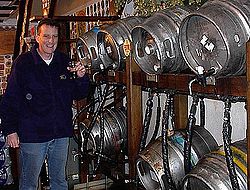
A selection of cask beers

A selection of Belgian, Danish, Dutch, German, and Irish beers

Organic aromatic acids found naturally in beer, such as tryptophan, tyrosine, and phenylalanine, absorb blue light and fluoresce in green under 450 nm laser light.