Bauhaus
The school sought to heal the rift between the individual artist and the industrial machine through the "total work of art."
The school sought to heal the rift between the individual artist and the industrial machine through the "total work of art."
Founded by Walter Gropius in 1919, the Bauhaus was built on the concept of the Gesamtkunstwerk—a comprehensive artwork where all the arts, from architecture to weaving, are unified. Gropius aimed to dissolve the "arrogant barrier" between the craftsman and the artist, creating a "new guild" that could meet the needs of a modern society without the class distinctions of the past.
This philosophy was not merely aesthetic but economic. Post-WWI Germany lacked raw materials and relied on a highly skilled labor force to export high-quality goods. The Bauhaus trained a new type of artist who could work directly with industry, ensuring that mass-produced objects—from chairs to tea infusions—retained artistic integrity while being functional and affordable.
Design was stripped to its rational bones to achieve a universal language of geometric simplicity and functional harmony.
Design was stripped to its rational bones to achieve a universal language of geometric simplicity and functional harmony.
The Bauhaus aesthetic, often called the International Style, is defined by what is missing: ornamentation. By removing "elaborate decorations," designers focused on primary geometric shapes—rectangles, spheres, and circles—and the use of modern materials like poured concrete, curved chrome pipes, and glass. The goal was to ensure the form of an object or building followed its specific function.
This shift was radical for its time. Buildings began to feature flat roofs, protruding balconies with "chunky" railings, and long "banks of windows" that invited light into previously dark industrial spaces. Typography and furniture followed suit, utilizing rounded corners and standardized parts to create a clean, consistent look that felt "machine-like" rather than hand-carved.
Driven across three cities by political friction, the school evolved from Expressionist mysticism to hard-edged "New Objectivity."
Driven across three cities by political friction, the school evolved from Expressionist mysticism to hard-edged "New Objectivity."
The Bauhaus was never a static entity; it was a moving target that existed in three cities (Weimar, Dessau, and Berlin) under three distinct directors. The early Weimar years were colored by Johannes Itten’s "Expressionist" influence, which was almost spiritual in nature. However, by 1923, Gropius shifted the focus toward "New Objectivity," famously declaring an architecture "adapted to our world of machines, radios, and fast cars."
Leadership changes brought ideological shifts. Hannes Meyer, the second director, emphasized social utility and "measurements and calculations" over pure art. The final director, Ludwig Mies van der Rohe, attempted to depoliticize the school to survive Nazi pressure, transforming it into a private architecture-heavy institution before its eventual closure in 1933.
The movement was born from a German "Zeitgeist" obsessed with standardizing quality for a global market.
The movement was born from a German "Zeitgeist" obsessed with standardizing quality for a global market.
While Gropius is the face of Bauhaus, the movement was part of a broader German trend called Neues Bauen. Before the school even opened, the Deutscher Werkbund (founded in 1907) was already debating whether "standardized parts" could coexist with individual artistic spirit. Figures like Peter Behrens were already integrating art into industrial giants like AEG, proving that corporate identity and high design could scale.
The Bauhaus also had a "sister" school in Russia called Vkhutemas. Both were state-sponsored initiatives attempting to merge craft with modern technology in the wake of world-altering revolutions. These schools represented a global moment where the "liberal spirit" of the 1920s allowed for radical experimentation that the previous conservative regimes had suppressed.
The school’s forced closure by the Nazi regime inadvertently seeded its modernist DNA across the globe.
The school’s forced closure by the Nazi regime inadvertently seeded its modernist DNA across the globe.
The Nazi party viewed the Bauhaus as a "center of communist intellectualism" and un-German, leading to its dissolution in 1933. However, this suppression backfired; the school’s key figures fled Germany and took their radical ideas with them. Teachers like Moholy-Nagy and Gropius became the avant-garde of American design education, fundamentally reshaping the skylines of cities like Chicago and New York.
The legacy reached as far as the Middle East. The "White City" of Tel Aviv contains the world's highest concentration of Bauhaus-style architecture, built by Jewish architects who emigrated from Germany. What began as a local German experiment in 1919 became the default aesthetic for the modern world, influencing everything from IKEA furniture to the minimalist interfaces of modern smartphones.

Image from Wikipedia

The Bauhaus emblem, designed by Oskar Schlemmer, was adopted in 1922.

Typography by Herbert Bayer above the entrance to the workshop block of the Bauhaus Dessau, 2005

Bauhaus founder Walter Gropius (1883–1969)

Poster for the Bauhausausstellung (1923)

The main building of the Bauhaus-University Weimar. Built between 1904 and 1911 and designed by Henry van de Velde to house the sculptors' studio at the Grand Ducal Saxon Art School, it was designated a UNESCO World Heritage Site in 1996.

Mechanical Stage Design by Joost Schmidt, 1925

Children's chair by Erich Dieckmann (furniture designer), 1925

Wassily Chairs by Marcel Breuer (1925–1926)

An Olivetti Studio 42 typewriter, designed by Bauhausler Xanti Schawinsky in 1936
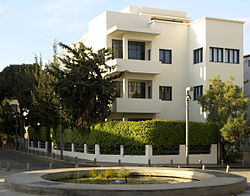
Bauhaus Foundation, Tel Aviv

A Bauhaus-style building with "thermometer" windows on Pines Street in Tel Aviv

A stage in the Festsaal, Dessau

Ceiling with light fixtures for stage in the Festsaal, Dessau

Dormitory balconies in the residence, Dessau