Batman Returns
Tim Burton leveraged a "one for them, one for me" deal to transform a corporate sequel into a personal auteurist fantasy.
Tim Burton leveraged a "one for them, one for me" deal to transform a corporate sequel into a personal auteurist fantasy.
Following the massive success of Batman (1989), Burton was initially reluctant to return, describing the idea of a sequel as "dumbfounded." He agreed to direct only after Warner Bros. granted him near-total creative control. This allowed him to sideline the original producers, replace the screenwriter with Daniel Waters (known for the dark comedy Heathers), and shift the focus from a traditional "hero vs. villain" plot to a character study of three societal outcasts.
The result was a film that ignored most of its predecessor's narrative threads. Burton’s version of Gotham became a claustrophobic, German Expressionist playground where the "hero" was secondary to the psychological exploration of his antagonists. By choosing artistic expression over franchise consistency, Burton essentially created the first high-budget "superhero art film," setting a precedent for the darker, director-driven comic book movies of the 21st century.
The antagonists serve as psychological mirrors of Batman, exploring the fine line between trauma and villainy.
The antagonists serve as psychological mirrors of Batman, exploring the fine line between trauma and villainy.
The script reimagined the Penguin and Catwoman as tragic "doubles" of Bruce Wayne. Oswald Cobblepot (the Penguin) is presented as a dark reflection of Wayne's orphanhood; whereas Bruce was a child of wealth protected by his status, Oswald was a child of wealth discarded by his parents due to his physical deformities. This shared "childhood trauma" creates a thematic link between the hero and the monster.
Similarly, Selina Kyle (Catwoman) is framed as a working-class feminist allegory. Rather than a simple femme fatale, she is a secretary "killed" by corporate patriarchy and reborn as a vigilante who seeks revenge against the same systems Bruce Wayne ostensibly upholds. The addition of Max Shreck—a corrupt industrialist who wears no mask—highlights the film's cynical thesis: the most dangerous villains are often the ones who are accepted by high society.
A massive mismatch between the film's grotesque tone and its "family-friendly" marketing caused a landmark cultural backlash.
A massive mismatch between the film's grotesque tone and its "family-friendly" marketing caused a landmark cultural backlash.
Warner Bros. launched a massive marketing campaign, including a major tie-in with McDonald's Happy Meals, expecting a repeat of the 1989 film’s broad appeal. However, the actual film featured sexual innuendo, "black bile" dripping from the Penguin's mouth, and a scene where a woman is pushed to her death. Parents were horrified, leading to public protests against marketing partners for promoting such a "dark and violent" film to children.
This backlash had long-lasting consequences for the franchise. Despite breaking box-office records in its opening weekend, the film's "alienating" tone caused a sharper-than-expected drop in attendance. This prompted the studio to pivot toward the "toy-friendly" neon aesthetic of Batman Forever (1995), replacing Burton with Joel Schumacher and leading Michael Keaton to walk away from the role.
The production prioritized "old school" practical effects and massive soundstages over the burgeoning CGI era.
The production prioritized "old school" practical effects and massive soundstages over the burgeoning CGI era.
Filmed almost entirely on the Warner Bros. and Universal lots in California, the production was a feat of practical craftsmanship. The Gotham City sets were so vast that they required 24-hour surveillance and massive soundstages to maintain the controlled, wintry atmosphere. Rather than relying on digital effects, the crew used dozens of live penguins, complex animatronics, and hours of prosthetic makeup application for Danny DeVito.
The film's visual identity—defined by cinematographer Stefan Czapsky and production designer Bo Welch—gave it a "lived-in" Gothic quality that CGI struggled to replicate at the time. This tactile approach, combined with the Christmastime setting, has helped the film endure as an "alternative Christmas classic," recognized more for its moody, immersive atmosphere than for its action sequences.
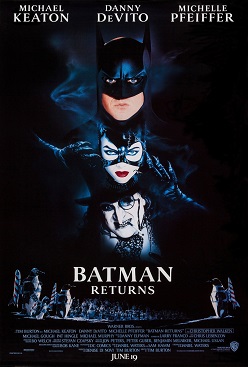
Image from Wikipedia

Michael Keaton (in 2002), Danny DeVito (in 2006), and Michelle Pfeiffer (in 2007)

Director Tim Burton (in 2012)

Writer Daniel Waters (in 2008) was hired by Tim Burton to revise Sam Hamm's initial draft.

Christopher Walken (pictured in 2008)

Composer Danny Elfman in 2022

Batman Returns premiered at the Grauman's Chinese Theatre (pictured in 2005) in Hollywood.

Michelle Pfeiffer in 1985. Although critics were polarized by many aspects of Batman Returns, Pfeiffer's performance received near-unanimous praise.

Batman: The Ride at Six Flags Great America was opened in 1992 with Batman Returns.