Baroque
The term "Baroque" began as a ridicule of imperfection, evolving from "flawed pearls" to a critique of "absurdly complex" logic.
The term "Baroque" began as a ridicule of imperfection, evolving from "flawed pearls" to a critique of "absurdly complex" logic.
Before it was an era, "baroque" was an insult. The word likely stems from the Portuguese barroco, describing an irregularly shaped, "flawed" pearl. By the 18th century, critics used the term to mock music and art they found bizarre, dissonant, or "uselessly complicated." Philosophers like Rousseau dismissed Baroque music as "confused" and "unnatural," while art historians initially used the label to ridicule the style for lacking respect for classical tradition.
It wasn't until the late 19th century that the term lost its derogatory sting. Historians like Heinrich Wölfflin began to treat the Baroque as a serious academic subject, identifying it not as a "failed" Renaissance, but as a distinct evolution that prioritized movement, mass, and theatricality over the static perfection of the previous age.
The Catholic Church weaponized visual awe and emotional intensity to counter the austerity of the Protestant Reformation.
The Catholic Church weaponized visual awe and emotional intensity to counter the austerity of the Protestant Reformation.
The Baroque style was the aesthetic engine of the Counter-Reformation. Following the Council of Trent (1545–1563), the Catholic Church sought to win back the masses by replacing the intellectual severity of Protestantism with art that provided a direct, emotional experience. While Protestant spaces grew simpler, Baroque churches became "theatres of the soul," using scale and splendor to illustrate the majesty of the divine.
This wasn't just a Roman phenomenon. Lutheran Baroque art also emerged in parts of Europe as a marker of confessional identity. However, the most exuberant expressions remained tied to the Catholic power centers, where architecture, sculpture, and painting were fused into a "total work of art" designed to overwhelm the senses and inspire religious devotion through shock and surprise.
Architects used "forced perspective" and "trompe-l'œil" to dissolve the boundaries between physical structures and the heavens.
Architects used "forced perspective" and "trompe-l'œil" to dissolve the boundaries between physical structures and the heavens.
Baroque design is defined by the rejection of the straight line. Architects like Francesco Borromini introduced undulating walls—surfaces that curve inward and outward to create a sense of breathing, living stone. Inside these buildings, the quadratura technique used "trompe-l'œil" (fools the eye) paintings on ceilings to make solid roofs appear to open directly into the sky, crowded with angels and saints in perfect perspective.
Technical trickery was a hallmark of the era. To make small spaces feel monumental, architects applied mathematical principles to "forced perspective." At the Palazzo Spada, Borromini designed a gallery only seven meters long that appears thirty meters deep; the floor rises, the ceiling descends, and a tiny 60-centimeter statue at the end looks life-sized. This mastery of illusion turned every building into a staged performance.
The Spanish "Churrigueresque" style pushed ornamentation to such extremes that it redefined the skylines of the New World.
The Spanish "Churrigueresque" style pushed ornamentation to such extremes that it redefined the skylines of the New World.
In Spain, the Baroque took a turn toward the hyper-ornate. Named after the Churriguera brothers, the "Churrigueresque" style abandoned nearly all classical restraint, covering surfaces in a "dense, overlapping, and loaded" repertoire of sculpture. This style emphasized the cartouche—large, carved plaques—and twisted columns that reflected light in dramatic, shifting patterns.
This high-intensity version of the Baroque became Spain’s most significant cultural export. As the Spanish Empire expanded, the Churrigueresque style was adapted across Latin America and the Philippines. The result was a global architectural language of "rocaille" (shell-like) decoration and gold-leafed altarpieces that persisted in the colonies well into the 19th century, long after Europe had moved toward the lighter Rococo and the rigid Neoclassical.
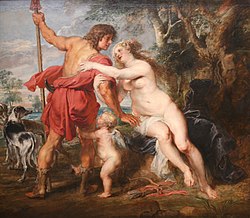
Image from Wikipedia

Pendant in the form of a siren, made of a baroque pearl (the torso) with enameled gold mounts set with rubies, probably c. 1860, in the Metropolitan Museum of Art (New York City, New York).

Quadratura or trompe-l'œil ceiling of the Church of the Gesù, Rome, by Giovanni Battista Gaulli, 1673–1678

St. Peter's Basilica, Rome, by Donato Bramante, Michelangelo, Carlo Maderno and others, completed in 1615

Santa Maria della Salute, Venice, by Baldassare Longhena, 1631–1687

San Carlo alle Quattro Fontane, Rome, by Francesco Borromini, 1638–1677

St. Peter's Square, Rome, by Gian Lorenzo Bernini, 1656–1667

Santa Maria della Pace, Rome, by Pietro da Cortona, 1656–1667

Palacio de San Telmo, Seville, Andalusia, by Leonardo de Figueroa, 1682–1754

Palacio de la Merced, Córdoba, Andalusia, 1245–1760

Royal Palace of Madrid, by Jean Bautista Sachetti, 1735–1764
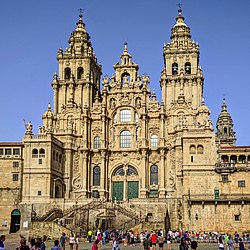
Façade of the Cathedral of Santiago de Compostela, Spain, by Fernando de Casas Novoa, 1738

Virreina Palace in Barcelona, Catalonia, built between 1772 and 1778 by Josep Ausich

Basilica of Our Lady of Mercy in Barcelona, Catalonia, built between 1765 and 1775 by José Mas Dordal

La Clerecía, Salamanca, Castile and León, built between 1617 and 1754.