Augustine of Hippo
Augustine’s journey from a "slave of lust" to a monastic leader redefined the Western concept of the spiritual autobiography.
Augustine’s journey from a "slave of lust" to a monastic leader redefined the Western concept of the spiritual autobiography.
Before becoming a central figure of the Church, Augustine lived a life of intellectual and sensual wandering. Born in Roman Africa to a pagan father and a devout Christian mother, he spent his youth as a brilliant but restless student of rhetoric. He famously struggled with his impulses, living with a long-term concubine and fathering a son, Adeodatus, while praying for "chastity and continence—but not yet." His internal conflict was famously captured in his Confessions, which is considered the first Western autobiography, focusing on the psychological depth of his conversion.
His intellectual path was equally winding. He was first drawn to Manichaeism (a dualistic religion) and later to Neoplatonism before his dramatic conversion in a Milanese garden in 386. Prompted by a child’s voice chanting "take up and read," he opened the epistles of St. Paul and found the resolve to abandon his secular career. This transition from a hedonistic rhetorician to a celibate priest and Bishop of Hippo provided the Church with its most powerful narrative of redemption through grace.
By formalizing the doctrines of original sin and divine grace, Augustine shifted Western Christianity’s focus toward human fragility.
By formalizing the doctrines of original sin and divine grace, Augustine shifted Western Christianity’s focus toward human fragility.
Augustine’s most enduring theological contribution is the framework of "original sin." He argued that humanity is inherently fallen due to the transgression of Adam and Eve, and thus incapable of achieving salvation through mere effort or "good works." This perspective was a direct challenge to contemporaries like Pelagius, who believed in the inherent capacity of humans to choose good. For Augustine, the human will was "bent" and required the "indispensable" grace of Christ to be set right.
These ideas became the bedrock of the Latin Church and, centuries later, the catalyst for the Protestant Reformation. Martin Luther and John Calvin both looked to Augustine’s teachings on salvation and predestination as the foundation for their break from Rome. By emphasizing God's sovereignty and the necessity of divine intervention, Augustine effectively redirected Western thought toward an introspective focus on the soul’s dependence on the creator.
As the Roman Empire began to collapse, Augustine’s "City of God" decoupled the fate of the Church from the survival of the State.
As the Roman Empire began to collapse, Augustine’s "City of God" decoupled the fate of the Church from the survival of the State.
Augustine lived through the disintegration of the Western Roman Empire, a period of profound cultural trauma. When Rome was sacked in 410, many pagans blamed Christianity for abandoning the traditional gods. In response, Augustine wrote The City of God, a massive work of political and social philosophy. He argued that history is a conflict between two "cities": the Earthly City, based on self-love and temporary power, and the City of God, a spiritual community based on the love of God.
This distinction allowed Christianity to survive the fall of Rome. By arguing that the Church was not tied to any specific political empire, Augustine provided a stabilizing worldview for the Middle Ages. Furthermore, his work on "Just War" theory established the ethical criteria for when a Christian could participate in violence, balancing the command for peace with the necessity of protecting the innocent and maintaining social order.
While he is the architect of the Western mind, his teachings remain a point of deep theological friction with the Eastern Orthodox Church.
While he is the architect of the Western mind, his teachings remain a point of deep theological friction with the Eastern Orthodox Church.
Augustine’s influence is not universal; he is a primary point of divergence between Western and Eastern Christianity. In the East, his views on original sin are often viewed as overly pessimistic, and his role in formulating the filioque (the idea that the Holy Spirit proceeds from both the Father and the Son) contributed to the Great Schism. While the West celebrates him as the "Doctor of Grace," many Eastern theologians have historically viewed his conclusions on predestination and the nature of the Trinity with skepticism.
Despite these disputes, Augustine remains a figure of immense intellectual gravity. He is recognized as a saint in the Catholic, Orthodox, Lutheran, and Anglican traditions alike. Whether through his influence on the medieval worldview, his impact on the Reformers, or his contributions to modern philosophy regarding time and memory, Augustine stands as the bridge between the classical world of Greece and Rome and the Christian culture of the West.

Image from Wikipedia

Saint Augustine Taken to School by Saint Monica, by Niccolò di Pietro, 1413–15
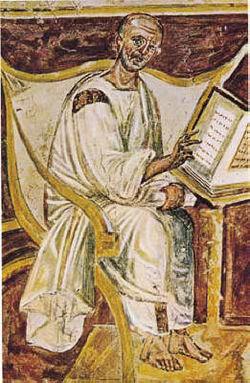
The earliest known portrait of Augustine in a 6th-century fresco, Lateran, Rome
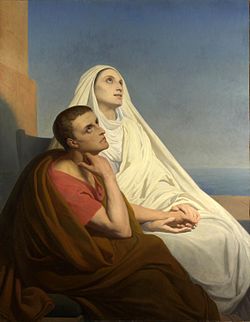
Saint Augustine and his mother, Saint Monica (1846) by Ary Scheffer

The Conversion of St. Augustine by Fra Angelico

The vision of St. Augustine by Ascanio Luciano

Augustine's arm bones, Saint Augustin Basilica, Annaba, Algeria

Giovanni di Balduccio, Tomb of St Augustine, 1362–1365, San Pietro in Ciel d'Oro, Pavia

Mosaic of Saint Augustine from the Cappella Palatina in Palermo, Italy (1140)

St. Augustine by Carlo Crivelli

Painting of Augustine (1458) by Tomás Giner, tempera on panel, Diocesan Museum of Zaragoza, Aragon, Spain

St. Augustine by Peter Paul Rubens

St. Augustine in His Study by Vittore Carpaccio, 1502

Saint Augustine in the Nuremberg Chronicle

Saint Augustine in His Study by Sandro Botticelli, 1494, Uffizi Gallery