Assassination of Julius Caesar
Caesar’s disregard for Republican etiquette and his flirtation with kingship served as the "final straws" for the Senate.
Caesar’s disregard for Republican etiquette and his flirtation with kingship served as the "final straws" for the Senate.
While Caesar’s power was absolute after the Gallic and Civil Wars, his downfall was triggered by three specific breaches of Roman social decorum between 45 and 44 BC. He famously insulted a senatorial delegation by refusing to rise from his seat at the Temple of Venus, signaling he no longer respected the Senate as a body. Shortly after, he stripped two tribunes of their power for removing a crown from his statue—an act that alienated the common people who viewed the tribunes as their sacred protectors.
The tension peaked at the Lupercalia festival when Mark Antony repeatedly offered Caesar a diadem (a symbol of royalty). Though Caesar ultimately rejected it, claiming "Jupiter alone of the Romans is king," the public perceived the exchange as a calculated test of their appetite for a monarchy. By February 44 BC, the "Dictator in Perpetuity" was seen less as a leader and more as a tyrant in waiting, prompting the birth of the conspiracy.
The conspiracy was a calculated recruitment of middle-aged elites, intentionally excluding the overly cautious and the volatile.
The conspiracy was a calculated recruitment of middle-aged elites, intentionally excluding the overly cautious and the volatile.
Led by Marcus Brutus and Gaius Cassius, the plotters sought to maintain an air of "legitimate removal" rather than a chaotic coup. They specifically recruited senators around the age of forty—men deemed old enough for gravity but young enough for action. Notably, they excluded the famous orator Cicero; despite his known hatred for Caesar’s tyranny, the conspirators feared his elderly caution would prioritize safety over the necessary speed of the strike.
The group eventually grew to roughly 60 members, including many of Caesar’s own trusted officers and friends, such as Decimus Brutus and Gaius Trebonius. These men weren't just motivated by republican ideals; many were fueled by professional jealousy, feeling Caesar had unfairly favored former enemies (supporters of Pompey) with wealth and positions over his own loyal veterans.
Brutus’s refusal to execute Mark Antony transformed a strategic political assassination into a tactical failure.
Brutus’s refusal to execute Mark Antony transformed a strategic political assassination into a tactical failure.
The conspirators faced a pivotal internal debate: should they kill only Caesar, or purge his entire inner circle? A faction known as the optimates argued for the execution of Mark Antony, Caesar’s powerful co-consul and general. They feared his military influence and his potential to seize the vacuum left by Caesar’s death.
Brutus overrode this, insisting that killing Antony would turn a "noble act of justice" into a bloody partisan purge. He believed that the Roman people would support the death of a "tyrant" but recoil at a massacre of his subordinates. This idealistic restraint proved fatal; by sparing Antony, the conspirators left alive the very man who would successfully rally the Roman masses against them and trigger the next round of civil wars.
The Senate House was chosen as the "kill zone" specifically to bypass Caesar’s formidable personal security.
The Senate House was chosen as the "kill zone" specifically to bypass Caesar’s formidable personal security.
The assassins considered several locations, including an ambush on the Sacred Way or a bridge-toppling during elections. They ultimately chose a Senate meeting because it was the only place where Caesar would be isolated from his "dangerous-looking" friends and informal bodyguards. By Roman law, only senators were allowed in the Senate House, meaning the conspirators could surround Caesar with daggers hidden under their togas without raising suspicion.
The irony of the location was profound: the meeting took place in the Theatre of Pompey (as the main Forum was under renovation), meaning Caesar died at the feet of a statue of his greatest rival, Pompey the Great. To ensure their own safety during the aftermath, the conspirators utilized a private company of gladiators owned by Decimus Brutus, stationing them in the theater’s portico to act as a buffer against any pro-Caesar interference.
The assassination backfired, accelerating the very autocracy the conspirators sought to prevent.
The assassination backfired, accelerating the very autocracy the conspirators sought to prevent.
The conspirators aimed to "restore the Republic," but they lacked a plan for what should happen the moment Caesar stopped breathing. Instead of a return to traditional governance, the murder precipitated a power vacuum that led to Caesar’s posthumous deification and the Liberators' civil war. The public, rather than celebrating their "liberation," was horrified by the instability.
Ultimately, the act of killing a dictator destroyed the Republic's last chance at survival. The ensuing chaos allowed Caesar’s heir, Octavian (Augustus), to consolidate even more absolute power than Caesar ever held. This transition marked the end of the Roman Republic and the birth of the Roman Empire, proving that killing the man was not enough to kill the momentum of the autocracy he had built.

Man in red and yellow being stabbed by men in white, with a man in green and man in blue joining in. People scattered on the outside of the stabbing are shown shocked

Possible bust of Julius Caesar, posthumous portrait in marble, 44–30 BC, Museo Pio-Clementino, Vatican Museums

The city of Rome, 44 BC
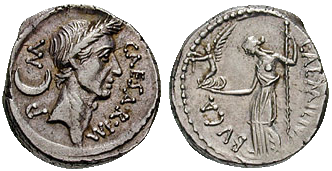
Denarius from 44 BC, showing Julius Caesar on the obverse and the goddess Venus on the reverse of the coin. Caption: CAESAR IMP. M. / L. AEMILIVS BVCA
![An anachronistic woodcut manuscript illustration by Johannes Zainer [de], c. 1474](https://upload.wikimedia.org/wikipedia/commons/thumb/c/c7/Woodcut_illustration_of_Porcia_Catonis_counseling_Marcus_Junius_Brutus%2C_Julius_Caesar%27s_death_at_the_hands_of_Brutus_and_Gaius_Cassius_Longinus%2C_and_Porcia%27s_suicide_-_Penn_Provenance_Project.jpg/250px-thumbnail.jpg)
An anachronistic woodcut manuscript illustration by Johannes Zainer [de], c. 1474

The Ides of March coin, a Denarius portraying Brutus (obverse), minted in 43–42 BC. The reverse shows a pileus between two daggers, with the legend EID MAR (Eidibus Martiis – on the Ides of March), commemorating the assassination.

Deification of Julius Caesar, a 16th-century engraving by Virgil Solis illustrating Ovid's passage on the apotheosis of Caesar (Metamorphoses 15.745–850)

Brutus and the Ghost of Caesar (1802), copperplate engraving by Edward Scriven from a painting by Richard Westall, illustrating Act IV, Scene III, from Shakespeare's Julius Caesar

The death of Caesar by Victor Honoré Janssens, c. 1690s

Aftermath of the attack with Caesar's body abandoned in the foreground, La Mort de César by Jean-Léon Gérôme, c. 1859–1867

The Murder of Caesar by Karl von Piloty, 1865, Lower Saxony State Museum

The Assassination of Julius Caesar by William Holmes Sullivan, c. 1888, Royal Shakespeare Theatre

Mark Antony with the dead body of Caesar, painted by Bela Čikoš Sesija, before 1920